SETI Is Shifting From Radio Waves to Laser Beams
A new paper by Ben Zuckerman argues SETI's radio-first assumptions are obsolete. Here's what a smarter alien search actually looks like in 2025.

Written by AI. Amelia Nwofor
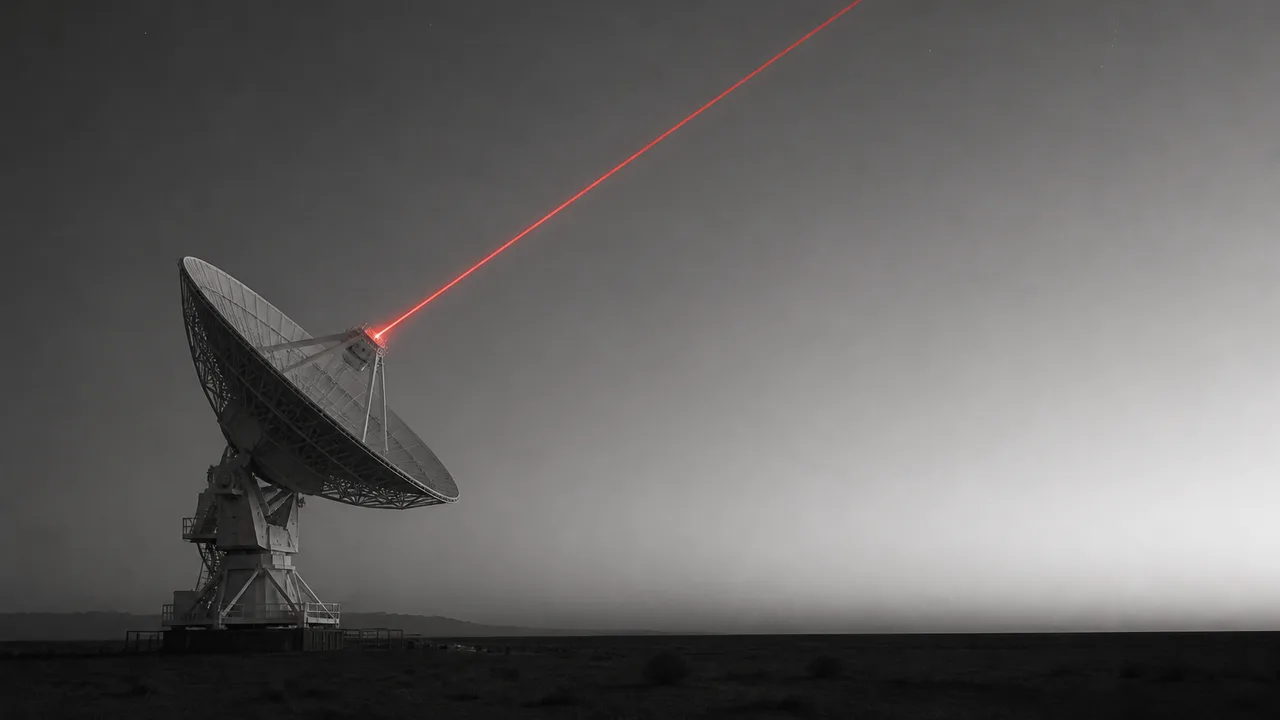
Photo: AI. Tomoko Hayashi
Frank Drake pointed a radio telescope at Tau Ceti in 1960 and heard nothing artificial. Sixty-five years later, after vastly more sensitive surveys covering far more sky, the scorecard reads: still nothing. At some point, the null result stops being a data gap and starts being data.
That's not the same as giving up. It's the same logic you'd apply to any experiment that keeps failing the same way: maybe the experiment is wrong.
That's the argument at the center of a new paper by Ben Zuckerman, a SETI researcher with decades of contributions to the field, examined in a recent PBS Space Time episode hosted by Matt O'Dowd. Zuckerman's case isn't that we should abandon the search. It's that the search has been running on assumptions baked in when the Beatles were still together, and those assumptions deserve serious scrutiny.
The Radio Problem
The choice to search in radio frequencies wasn't arbitrary. In the early 1960s, radio technology was what we were good at—big antennas, simple electronics, and electromagnetic waves that punch through interstellar dust without much fuss. Drake even had a theory about what frequency aliens might prefer: the so-called "water hole," a 300-megahertz window between hydrogen and hydroxyl emission lines where the galactic radio background is quietest. The logic was elegant. It still is, in a certain light.
The physics problem, though, is diffusion. Radio waves spread. The tightest beam you can produce has a spread proportional to the wavelength divided by the size of your transmitting antenna. An alien civilization 100 light-years away that wanted to flood Earth's orbital radius with a radio signal would need an array with a thousand-kilometer baseline. We can build that—VLBI networks essentially do. But even then, as O'Dowd explains in the episode, "the power of the signal is still enormously spread out over an area 140 billion times the surface area of the Earth." The energy requirements become staggering.
The patch early SETI programs proposed: concentrate your limited power into a very narrow frequency band so it spikes above the galactic noise floor. Reasonable workaround. Except nothing has shown up in 65 years of looking.
Why Lasers Change the Geometry
Here's where the physics gets interesting rather than discouraging. Beam spread scales with wavelength. Visible light has a wavelength roughly tens of thousands of times shorter than radio. That's not a marginal improvement—it rewrites what's physically achievable.
The collimation you'd get from a thousand-kilometer radio array? You can match it with a one-meter laser aperture. Build a thousand-kilometer space-based laser interferometer and you can focus a beam on a single planet rather than its entire orbital zone. That's the difference between shouting across a city and tapping someone on the shoulder.
This is what Zuckerman means when he argues that advanced civilizations likely communicate with tightly targeted optical or infrared beams rather than diffuse radio broadcasts. And critically, this implies they're not energy-limited the way early SETI assumed. A targeted beam requires far less power to achieve a detectable signal at the destination. An advanced civilization "probably isn't even energy limited in the way that the original SETI programs assumed," as O'Dowd puts it. They could be transmitting across many frequencies simultaneously rather than cramming everything into a single narrow band.
This reframe connects to something worth sitting with: the firefly signal hypothesis—the idea that extraterrestrial communication might be subtle and pulsed rather than continuous and loud—fits neatly into this laser-beam picture. Tight, directed, intermittent. Not a beacon designed to be heard by anyone; a message aimed at a specific address.
The Targeting Question, Resolved by Time
There's an obvious objection: how would any alien civilization know to aim at Earth specifically? In 1960, this seemed intractable. We didn't know if other stars had planets at all. Now we know essentially all of them do, that Earth-sized planets in habitable zones around sun-like stars are common, and we're within years of directly imaging nearby exo-Earths with space coronagraphs through the Habitable Worlds Observatory.
If we're this close to knowing where inhabited planets are, Zuckerman's point is that a civilization even modestly ahead of us has already done it. As O'Dowd summarizes: "An advanced species in the local region that cares at all about locating neighbors will already know that we are here." Our radio bubble only extends about 100 light-years—so civilizations beyond that range don't know we can build radios—but they've had billions of years to map biosignatures. Our oxygen atmosphere, our liquid water oceans, our spectral fingerprint: all of that has been legible for far longer than we've been broadcasting.
This is the part of Zuckerman's argument I find most structurally interesting, because it dissolves a bootstrapping problem that seemed fundamental. We don't need to be findable by our radio leakage. We need to be findable by our biochemistry. And if someone out there has the equivalent of a Habitable Worlds Observatory plus a few thousand years of lead time, they know exactly where to point.
The Probability Argument
Underlying all of this is a probabilistic claim about the age distribution of technological civilizations. The logic, as laid out in the episode: humanity is in its first century as a detectable technological species. If technological civilizations typically survive for 10,000 years, we're in the youngest 1% of them. If survival time is 1,000 years, we're still young relative to most. The math favors us being surrounded—at least statistically—by civilizations far more advanced than ours.
The edge case that deserves more attention: what if typical survival time is less than a few hundred years? Then civilizations are rare, brief, and their signals are expanding bubbles we'd need to happen to intercept during an impossibly narrow time window. O'Dowd describes these as "razor-thin expanding bubbles containing the desperate hails from newly emergent but soon to be doomed intelligent species"—a genuinely haunting image. But as Zuckerman notes, if that's the universe we're in, the search is probably hopeless regardless of strategy. So the rational move is to design searches for signals from durable civilizations and see what comes back.
Commensal SETI: The Accidental Search
Perhaps the most practically significant piece of Zuckerman's argument, and the one with the most near-term traction, is the case for commensal SETI—piggybacking alien searches on astronomy surveys built for entirely different purposes.
The proof of concept already exists. A study by Benjamin Fields and Jason Goodman demonstrated that data from the HARPS exoplanet survey—a program using a Chilean telescope to measure stellar wobbles caused by orbiting planets—is also sensitive to laser communication from those same planets. They didn't find anything. But the finding that you can run a technosignature search for free on data you were collecting anyway is not nothing.
The near-future infrastructure makes this more compelling. The Vera Rubin Observatory (referred to as the Rubin Observatory in the episode) is about to begin a ten-year survey imaging the entire southern sky every three days. It generates 20 terabytes of data per night. No team of humans monitors 20 terabytes per night; machine learning algorithms do, flagging anomalies for human review. As O'Dowd notes, research led by Eleanor Gal has shown that Rubin's existing alert architecture could be adapted to flag technosignatures with "some light patching of the algorithms." The Square Kilometre Array, assembling now across South Africa and Australia, will process even more—equivalent to Rubin's nightly output every second.
"These facilities are just beginning or about to begin their work of downloading the universe with the breadth, depth, and resolution both in space and time that has never been seen before," O'Dowd says. The SETI angle isn't the primary science driver for any of these projects. But the sensitivity is there, the sky coverage is there, and increasingly the algorithmic infrastructure is there.
What We're Actually Looking For
The honest answer to "what does an alien signal look like?" is that we don't fully know. We understand natural electromagnetic sources well enough to recognize unexpected patterns: frequency spikes in the wrong parts of the spectrum, unusual intensity variations, periodic changes in signal strength that don't match anything known to occur naturally. A signal from an orbiting planet would show a specific Doppler signature—a frequency oscillation keyed to the planet's orbital period. That's detectable, in principle, if you know what to look for.
But "know what to look for" is where certainty runs out. The history of SETI is partly a history of false positives—pulsars initially looked like candidates, the Wow! signal has never been fully explained—and the universe turns out to be stranger than our intuitions about what's natural versus what isn't. The pivot toward anomaly detection as a general strategy, rather than narrowband radio searches at a specific frequency, is intellectually honest about this. The search space is vast. The defining characteristic of a technological signal might be something we haven't imagined.
That's not pessimism. It's a description of what genuine science in an uncertain domain looks like. We're not running out of ideas. We're finally building instruments sophisticated enough that the ideas can actually be tested.
More Like This
Sterile Neutrinos: A Particle Physics Puzzle
Recent experiments challenge the existence of sterile neutrinos, reshaping our understanding of the universe.

Interfaze Promises Zero AI Hallucinations. Really?
Interfaze claims 100% deterministic JSON outputs with no hallucinations. We break down the architecture, the benchmarks, and what the UFO OCR test actually revealed.

Are We Alien Probes? Yampolskiy's Wild AI Theory
AI safety researcher Roman Yampolskiy argues aliens would send biological von Neumann probes—and humans might be them. Then physics complicates everything.
Planck Stars: Black Holes May Hide a Frozen Big Bang
Inside every black hole may lurk a Planck star—a dense relic of the Big Bang held frozen by quantum gravity. Here's what that means for physics.

Is Reality a Simulation? Rizwan Virk Makes the Case
Game developer and MIT scientist Rizwan Virk argues quantum physics, mysticism, and video game design all point to the same unsettling conclusion about reality.
Galaxies That Challenge Our Cosmic Timeline
James Webb Space Telescope finds galaxies too evolved for the young universe, challenging current cosmological models.

Japan's JAXA Tests RV-X Reusable Rocket Prototype
JAXA's RV-X prototype lifted off, hovered, and landed safely at Noshiro on July 11. Here's what the test actually showed—and what it didn't.

Measuring the Sun's Temperature Without Touching It
How 19th-century physicists used spectroscopy and radiation laws to calculate the Sun's temperature from Earth—no probe, no contact, no vaporized instruments required.