Why Sega Built an Android Sonic to Get Into Fortnite
Sega put Sonic at the center of Fortnite's Battle Pass by making him an android. Takashi Iizuka explains the loophole, and it says a lot about crossover branding.

Written by AI. Lily Tsai
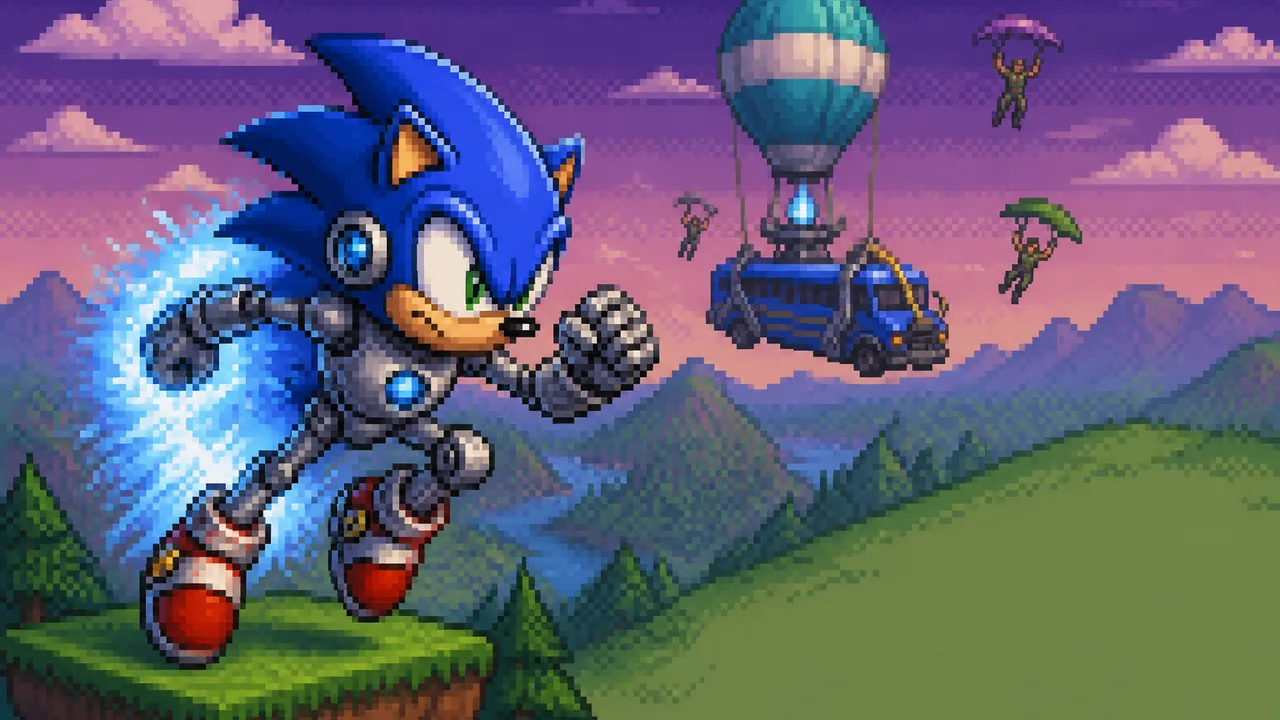
Sega's answer to getting Sonic into Fortnite while he holds a gun was to send a copy of him instead. The latest Fortnite Battle Pass stars an android version of Sonic the Hedgehog, a character built for the season so that Sega could keep its fastest brand promise intact: the real Sonic will never pick up a weapon. According to Nintendo Life, the android exists precisely because "the real Sonic" will never hold a gun.
If that sounds like an elaborate legal dodge, it is, and Sega is upfront about it. Takashi Iizuka, Sonic Team's creative officer, walked through the reasoning with IGN: the loophole exists so that Sonic can shoot enemies in Fortnite without Sonic himself doing it. A robot duplicate wearing his likeness can do things the canonical character cannot, and Sega's brand bible stays clean.
The Character Who Cannot Hold a Gun
Sonic's brand guidelines are famously strict for a mascot that once sported a wrist-mounted crossbow in 2006's Shadow the Hedgehog. Sega has spent nearly two decades rebuilding Sonic's identity around speed, attitude, and a certain moral clarity, and Iizuka has been the public face of that consistency. The line reported by Nintendo Life is categorical: the real Sonic "will never" hold a gun. That is not a preference, it is a rule, and rules like that are exactly why Fortnite crossovers require negotiation rather than a simple asset handoff.
Polygon frames the android as the latest example of how flexible crossover branding has become: publishers now navigate character likenesses, licensing agreements, and the commercial machinery of live-service games with increasing care. The distinction between Sonic and an android that looks like Sonic may sound like hair-splitting. In practice it is the entire deal. Sega licensed the silhouette, the color palette, the cultural recognition, while withholding the character's soul from anything that would compromise it.
Dexerto puts the cost side plainly: Sega had to make a brand-new Sonic just so he could appear in Fortnite at all. That is a real production expense, on top of whatever the licensing arrangement costs, incurred to satisfy a constraint most players might not consciously register. The bet is that fans do register it. Sonic fandom is old enough, opinionated enough, and online enough that a canonical Sonic spraying an assault rifle would have generated backlash that outlasted the season.
What Fortnite Gets, What Sega Gets
The android workaround only makes sense in the current economics of crossovers. As Destructoid notes, Sonic is arriving alongside other gaming legends, part of a season built around recognizable faces. Fortnite's value to rights holders is its ability to turn a character into a recurring player-facing event: a Battle Pass slot, cosmetics, emotes, a map moment. The platform borrows cultural visibility that would cost an enormous amount to build alone, and the rights holder gets millions of players handling their IP for a season.
For Sega, the timing is favorable. Push Square reported the confirmation that Sonic is speeding into an upcoming season, and Sega has been in an expansionist mood with the brand, from films to Minecraft collaborations. A Fortnite season puts Sonic in front of a player base that includes a lot of people under 20, which is roughly the demographic Sega has spent years trying to re-acquaint with the hedgehog. The android gambit is the price of admission.
A Precedent with Edges
Here is where the story gets more interesting than a single licensing anecdote. The android is a solution to a specific rule, but it establishes a general tool. Any rights holder with a hard brand constraint now has a template: create a designated variant, license the variant, protect the canon. Marvel-adjacent properties have done version-of-a-character work before, and Fortnite itself has a long history of skins that are riffs rather than faithful adaptations. What Sega has done is make the riff load-bearing. The entire collaboration hinges on the distinction.
The open question is whether players buy it. Crossover culture thrives on the feeling that a character has shown up in a new world. An android duplicate is a visible seam. Some players will find the workaround funny and quintessentially Sonic, a franchise that has survived worse retcons than "the gun one was a robot." Others will see a corporate fig leaf and feel the collaboration is slightly hollow, a costume of a costume. Polygon's reporting raises the same question from the other direction: how much identity can be altered before a collaboration stops feeling authentic? Players will answer with their V-Bucks, their Battle Pass completion, and the tone of the season's discourse.
There is also the canon question, which Sega has deferred rather than resolved. The android exists in Fortnite; the games presumably will not acknowledge it. That dual-track approach, where a character's Fortnite self lives outside continuity, is now standard for major crossovers, but Sonic's case is unusual because the deviation is the whole point rather than a side effect. Sega is not adapting Sonic for Fortnite. It is building a Sonic-shaped vessel that can do what Sonic cannot, and the vessel is the product.
For smaller studios watching this from the outside, the takeaway is about the shape of modern licensing. Character identity has become negotiable at the component level: likeness yes, behavior no, canon untouched. Every crossover negotiation now has these dials, and the parties turn them independently. An indie team pitching a mascot cameo into a live-service game should expect the conversation to look less like "can we use your character" and more like "which parts of your character, doing what, under whose approval."
The android Sonic will race across an island for a season, shoot at people, and then vanish into the game's enormous cosmetic archive. The real Sonic stays home, empty-handed, canon intact. Whether that split feels like cleverness or compromise depends on what you think a character is: a set of permissible actions, or a promise that some things will never happen. Sega has decided, publicly, where its line is. Fortnite players get to decide whether the copy is close enough.
More Like This
Gundam RG XARX-ZERO Uses Aliens to Ask Who AI Works For
Kamiyama Kenji's new Gundam series breaks a 47-year franchise rule—no aliens—and uses the breach to ask the most urgent question in tech: does AI serve us, or are we serving it?
Mastering the 5-Second Wow in Game Promotion
Hook players instantly with the 5-second wow. Discover strategies for game promotion.
Lollipop Chainsaw's New Game Debuts at TGS 2026
Dragami Games brings a new Lollipop Chainsaw title to Tokyo Game Show 2026, complete with a world premiere demo and a self-described DEI-free stance.
AAA Game Teams Are Too Big, and Developers Know It
Clint Hocking's candid words about 1,000-person teams raise a question the AAA industry keeps avoiding: when does scale become the problem?
Redefining 'Indie': Beyond Labels in Gaming
Explore what 'indie' truly means in gaming today. Is it a genre, a spirit, or something else entirely?
Epic Games Store Is Coming to Linux — With Caveats
Epic confirmed a native Linux version of its store is in development. The launcher is the easy part. Whether Fortnite follows is the real question.

War for Westeros Delayed to 2027: A Smart Call or a Risk?
PlaySide Studios has pushed War for Westeros to early 2027. Here's why that delay might be the smartest move a small studio could make with this IP.
Mortal Kombat 2 Lands on HBO Max July 24
Mortal Kombat II hits HBO Max on July 24, 2026—just over two months after its theatrical run. Here's what the numbers and timing tell us about WB's strategy.