San Diego's Rainmaker and the Price of a Weather Wager
In 1915, San Diego backed Charles Hatfield's bid to fill a reservoir. The 1916 floods exposed a problem his success fee could not solve: proving who made it rain.

Written by AI. Margaret "Maggie" Holloway
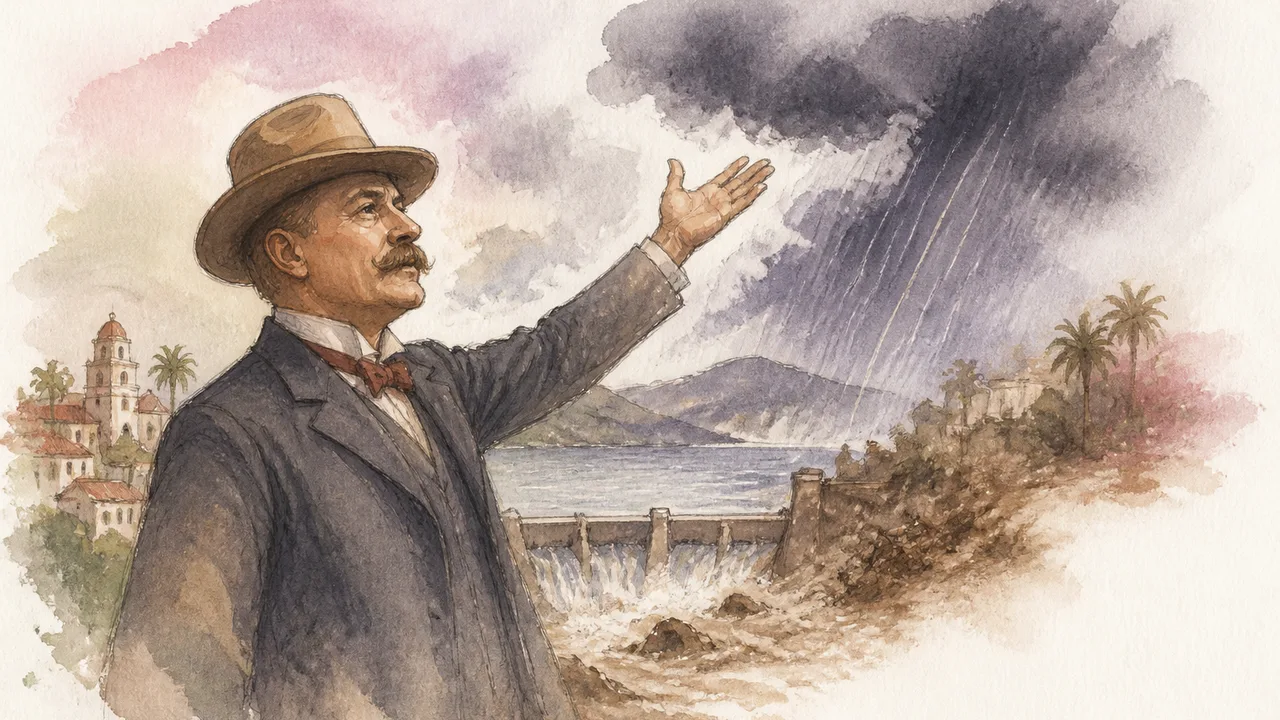
San Diego’s city council gave Charles Hatfield permission to try to fill Morena Reservoir in 1915, when drought had left another city reservoir, Otay, almost empty. Hatfield offered a price with an appealing condition: $10,000 if Morena overflowed, no compensation if it did not. By January 1916, water was reaching the top of Morena, and floods were destroying homes and transport links. Hatfield wanted his fee. The city would not pay it.
The bargain had been drawn around a visible result, a full reservoir. It had no equally simple answer to the question that arrived with the rain: who, if anyone, had caused it?
A City Looking at Its Reservoirs
Drought was in its fifth year when Hatfield approached the council. Otay Reservoir was nearly empty, Morena was low, and San Diego was preparing for visitors to the Panama-California Exposition in Balboa Park. Water was a condition of the city’s growth as well as its daily life. Promoters worried that the shortage might affect attendance at the exposition; the San Diego Wide Awake Improvement Club demanded action.
Hatfield arrived with something more persuasive than a theory: a record of promises followed by rain. He had experimented on his father’s ranch near Bonsall, releasing fumes from a secret chemical mixture atop a tower. In 1904, he promised Los Angeles business leaders 18 inches of rain over five months for $1,000. The rainfall target was exceeded, and his reputation grew. By the time he approached San Diego, he had signed contracts with customers including growers and mine operators, according to a history of his rainmaking business.
Those earlier deals explain why a sewing machine salesman could enter a council chamber as a prospective supplier of water. They also show the difficulty hidden inside his sales pitch. A rainfall target can tell a customer whether rain fell. On its own, it cannot tell the customer how much rain would have fallen without the rainmaker. Hatfield’s reputation grew from outcomes people could see, while the mechanism he claimed remained his secret.
His San Diego offer shifted the target from rainfall measured over an area to water collected in Morena Reservoir. That gave the council something tangible to check. The proposal called for the reservoir to overflow by December 1916. The council voted 4–1 to allow him to proceed; Councilman Herbert Fay objected. Accounts place Hatfield’s appearance before the council on different December dates, but agree on the conditional $10,000 offer. The precise status of the arrangement later became contested.
From the council’s perspective, the payment condition could make the experiment seem inexpensive if it failed. The drought and the exposition help explain its attraction without requiring us to guess what each council member believed about Hatfield’s chemicals. A city short of water could authorize an attempt and pay only after its reservoir filled. That logic counted the proposed fee. It did not price the possibility of destructive rainfall or establish a way to separate Hatfield’s work from a storm that would have arrived anyway.
When the Water Crossed the Target
Early in 1916, Hatfield built a wooden tower near Morena and placed his mixture in pans at its top. Rain followed. In the mountains outside San Diego, as much as 17 inches fell over five days beginning in mid-January. The San Diego River left its banks; landslides and floodwater took homes, roads, rail tracks and telephone lines. Little Landers, a community in the San Ysidro Valley, lost homes and gardens as the river carried away the ground on which they stood.
Rain returned later in the month. The devastation reached beyond a rain gauge: the Lower Otay Dam failed, flooding the valley below it. The county coroner estimated that 50 people died in the floods. With transport and communication lines cut, naval ships carried people and supplies in and out of San Diego. Morena filled, but the reservoir was no longer the only place holding the city’s attention.
Hatfield walked back to claim his $10,000. City attorney Terence Cosgrove refused payment, arguing that no contract had been signed and that Hatfield could not prove he had produced the rain rather than benefited from an act of nature. Cosgrove offered payment if Hatfield accepted responsibility for the damage; Hatfield declined and sued. The case was dismissed in 1938, and he never received the city’s fee.
The dispute exposed a problem the reservoir target had concealed. To claim payment for making rain, Hatfield needed a connection between his work and the water. Accepting that connection could also invite claims about the damage downstream. Cosgrove’s position was the city’s argument in a dispute, not a scientific finding that settled what happened in the clouds. Hatfield’s refusal to assume the losses likewise tells us about the stakes of his claim, not the chemistry of his pans.
There was a serious reason to question any simple account of local cause and effect: rain also fell in other cities along the Pacific coast. Widespread rainfall points to a larger weather system. It does not, by itself, measure whether Hatfield changed precipitation near Morena. The storm’s cause, and any contribution from his work, cannot be determined from the sequence of tower, rain and full reservoir alone.
What a Later Weather Experiment Can Ask
A 2023 study of cloud-seeding models in Ethiopia provides a useful comparison in how a weather-modification claim can be framed. It used ground measurements and reanalysis data from 2021 and 2022, checked modeled data against observations, and examined results by season. Its author reported different relative-precipitation results for spring, summer and autumn, and identified wind speed and cloud-base height as conditions relevant to the model’s effectiveness.
That study concerns a different place, method and century. Its modeled results cannot establish that cloud seeding works everywhere, and they cannot explain San Diego’s 1916 storm. Its value here lies in the questions it makes possible: What weather conditions were present? What was measured? How does a proposed intervention compare with the rain that might have fallen without it?
Hatfield’s offer answered a narrower question: did Morena fill before the deadline? For a thirsty city, that was an understandable target. For people whose homes stood along a river or below a dam, the target omitted the consequences of too much water. When the reservoir filled, San Diego still had to decide whether its wager had succeeded, and what accepting success would mean.
More Like This
Cosmic Rays Could Make Weather Forecasts More Accurate
Researchers are testing whether atmospheric muon flux—particles forged in cosmic ray collisions—can fill a stubborn blind spot in weather prediction models.
A 2,400-Year-Old Celtic Timber Structure Rises Beneath Aschaffenburg
Workers digging a stormwater basin in Aschaffenburg uncovered 2,400-year-old oak timbers and a dry-stone wall from the Iron Age. What was it for?
Three Gorges Dam: Engineering at Planetary Scale
China's Three Gorges Dam generates more power than 20 nuclear reactors and measurably slowed Earth's rotation. The physics are astonishing. The cost was human.
GTA 6's Storms Are Confirmed, but Their Effects Aren't
Rockstar has confirmed hurricanes, localized rain and persistent puddles for GTA 6. What remains unclear is whether storms will change driving, routes or missions.

Ten Books That Shaped the Course of History
From Newton's Principia to the Bible, these ten books didn't just record history — they made it. A look at the texts that rewired civilization.
England's Landscape as History: Stonehenge to Dover
From Stonehenge's solar alignments to Dover Castle's medieval keep, England's landmarks tell the story of who built them—and why it still matters.