Saint Lucia's $1 Billion Longevity Village, Examined
TheLifeCo's A'ila development promises to reshape Saint Lucia's Rodney Bay with a physician-led longevity village. Here's what that actually means.

Written by AI. Priya Chandrasekaran
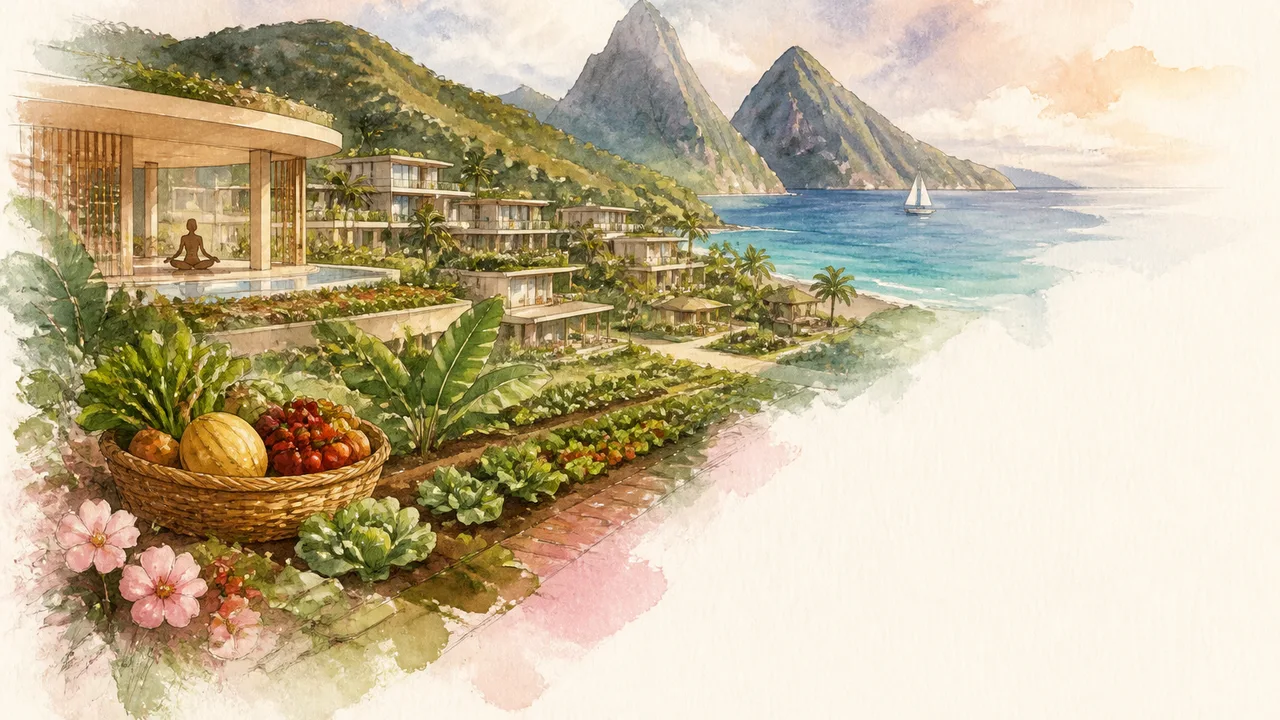
At some of the higher-end wellness properties that have opened across the Caribbean and Southeast Asia in recent years, a pattern emerges at the breakfast table. The guest at the next table is not studying a menu so much as conducting a negotiation with it — asking whether the mushroom broth is reishi or lion's mane, whether the eggs are pasture-raised within a defined radius, whether the chef can confirm there's no seed oil in the dressing. By the time the food arrives, the conversation has shifted to continuous glucose monitors and VO2 max scores. The meal, when it finally happens, is almost beside the point.
This is the person A'ila Developments is building for.
TheLifeCo Saint Lucia — the anchor tenant of what is being positioned as the Caribbean's first longevity village — officially debuted its first resort in Rodney Bay on April 9, 2026. According to a PR Newswire release, the property is a 100-key, physician-led destination "designed from the ground up around detox and transformation programs." That debut is the opening move in something considerably larger. Per Hospitality Net, the full A'ila master plan encompasses three resorts, 500 residences, a medical district, and a 523-acre organic farm — a $1 billion-plus development footprint that would, if completed, constitute one of the most ambitious wellness real estate projects ever attempted in the region.
The scale alone warrants attention. But the more interesting question isn't how big A'ila is. It's what the project actually proposes to be — and whether those proposals hold up when you press on them.
"Healthspan," Not Headcount
The language TheLifeCo and its partners use to describe A'ila is careful and deliberate. According to both Hotel Mogel and Hotel Online, the explicit design philosophy is this: "Instead of creating a destination centered on short-term occupant throughput, the goal is to create a community centered on healthspan. Each vertical bestows positive value back onto others within the village."
That sentence is doing a lot of work. "Healthspan" — the period of life spent in good health, as distinct from mere lifespan — is a term with genuine scientific currency, now central to geroscience research. But it is also a word that has migrated, with some velocity, from academic papers into marketing decks. The difference between those two contexts matters.
In the first context, healthspan is a measurable outcome — influenced by genetics, diet, physical activity, social connection, environmental stress, and access to healthcare over decades. In the second context, it is often a premium positioning device, a way of framing a resort stay as something more medically serious than a spa holiday. The claim that A'ila's architecture of resorts, residences, and a farm — each "vertical" enhancing the others — will deliver meaningful healthspan outcomes to its residents and guests is the project's core thesis. It is also, at this stage, unverifiable.
None of that makes the thesis wrong. Integrated wellness environments, when well-executed, can produce real behavioral change in the people who inhabit them. A 523-acre organic farm supplying a medical district that informs a residential community is a coherent model on paper. The question is always execution — the supply chains, the clinical credentialing of the medical district, the permanence of residency versus the transience of resort stays, and whether the farm's output actually reaches the guests' plates or functions primarily as a marketing visual.
The sources available don't resolve those questions, and that's worth naming plainly.
The Market This Is Landing In
Wellness tourism globally is not a niche anymore. Phocuswright reported in 2026 that the sector has reached $894 billion in value, with further growth projected ahead. That trajectory explains why a $1 billion development in Saint Lucia does not read as speculative excess — it reads as a calculated entry into one of travel's fastest-expanding categories.
The guest profile that A'ila is designed around — high-net-worth, health-preoccupied, willing to pay significantly for physician-supervised programs and curated environments — has become an identifiable demand segment, not a niche fantasy. These are the people treating travel itself as a health intervention: not a break from ordinary life, but an intensified version of the regime they're already running at home. They bring their supplements. They track their sleep architecture. They want the food system to be legible, from seed to plate.
Saint Lucia, noted by HotelSpeak as "already recognized for its natural beauty and longstanding commitment to wellness tourism," is not an arbitrary site choice. The island has built a reputation as a premium Caribbean destination over decades. Rodney Bay, where A'ila is sited, is already the island's established tourism and marina hub. The project is not parachuting into undeveloped land — it is adding density and programming to a corridor that already attracts international visitors.
The Harder Questions
Here is where the story gets more complicated, as it usually does when a billion dollars lands in a small island nation.
Saint Lucia's total land area is roughly 238 square miles. A 523-acre organic farm — just that one component of A'ila — represents a meaningful fraction of usable agricultural land on an island that, like most Caribbean nations, has historically imported the majority of its food supply. If that farm is genuinely operational and integrated into local food systems, it could be transformative. If it functions primarily as a lifestyle amenity for resort guests, the math looks different.
The economic case for A'ila, as presented by its developers, rests on job creation, infrastructure improvement, and positioning Saint Lucia as a global wellness leader. All of that is plausible. Caribbean development history also offers a counter-pattern worth holding in view: large-scale resort projects that arrive with ambitious local-benefit frameworks and gradually concentrate their economic value within their own fences. The sources available here don't give us enough detail about A'ila's local hiring commitments, land tenure structures, or supply chain sourcing to assess which pattern this is more likely to follow.
Longevity, as a concept, has an uncomfortable tendency to mirror the social structures of the societies that celebrate it. The Blue Zones research — the body of work identifying communities in Sardinia, Okinawa, Ikaria, and elsewhere where people regularly live past 100 — found that longevity in those places was entangled with things that cannot be purchased: intergenerational community structure, a sense of purpose, food systems rooted in necessity rather than aspiration, and the kind of daily physical movement that comes from work rather than scheduled exercise. A'ila is proposing something structurally different — a designed environment where those conditions are curated and sold — and it's worth asking whether that difference is incidental or fundamental.
That's not a dismissal of what TheLifeCo is attempting. Physician-led wellness programs have clinical legitimacy. Organic agricultural systems have genuine environmental value. Integrated medical facilities in tourism destinations can expand healthcare access in places where it's historically been thin. Any or all of those things could be true of A'ila.
But the village metaphor carries its own weight. Villages, the real kind, are not products. They are social contracts, built over generations, held together by interdependence, shared labor, and the negotiated compromises of people who cannot simply check out. What TheLifeCo is building is something with a different structure — a thoughtfully designed, physician-supervised environment that borrows the village's moral warmth while operating on resort economics.
That might still be worth building. The question Saint Lucia's planners, residents, and civil society are presumably working through is: worth building for whom, and on what terms?
The breakfast table answer — the adaptogen latte, the glucose monitor, the careful negotiation with the menu — is not necessarily the wrong answer. It's just not the whole story.
More Like This
Small Group Italy Tours Are Reshaping Travel
Small group Italy tours promise authenticity over crowds. But do they deliver — and at what cost to the communities they claim to honor?
Inside Argentina's 7-Generation Working Estancia
Estancia La Tomasa near Buenos Aires has welcomed guests since 2023. Here's what a weekend on this 140-year-old working ranch actually looks like.

A New Object in the Sky: The JetBlue Drone Strike
A JetBlue pilot reported hitting a drone on approach to JFK. What the incident reveals about airspace rules built before drones existed.

France Tests Low-Cost Rail Signalling for Rural Lines
France's NS2F consortium is trialling digital signalling tech to cut rural rail costs by 30%. Here's what's at stake for the towns trains forgot.

Gut Health Is Real. Most Gut Products Are Not.
Vox talked to doctors and researchers at Cedars-Sinai about what gut health actually means—and why most of what's being sold to you doesn't hold up.

How AI Decides Which Hotels You'll Ever Consider
AI booking tools are filtering your hotel options before you open a single tab. Here's what gets a property recommended — and what gets it erased.

Which "Untranslatable" Words Are Real?
From hygge to mamihlapinatapai, RobWords fact-checks the internet's favourite "untranslatable" words — and finds gems, exaggerations, and outright fiction.

Visaible.ai Bets A$1M That Hotels Are Lost in AI Search
Visaible.ai raised ~A$1M to help hotels stay visible as AI chatbots reshape travel discovery. Here's what the bet reveals about hospitality's next distribution war.