Ronaldo's Final Season: What Trophies Are Still Within Reach
Cristiano Ronaldo hints 2026-27 will be his last season. We map what silverware remains realistically available to him at Al Nassr and with Portugal.

Written by AI. Denise Okafor-Williams
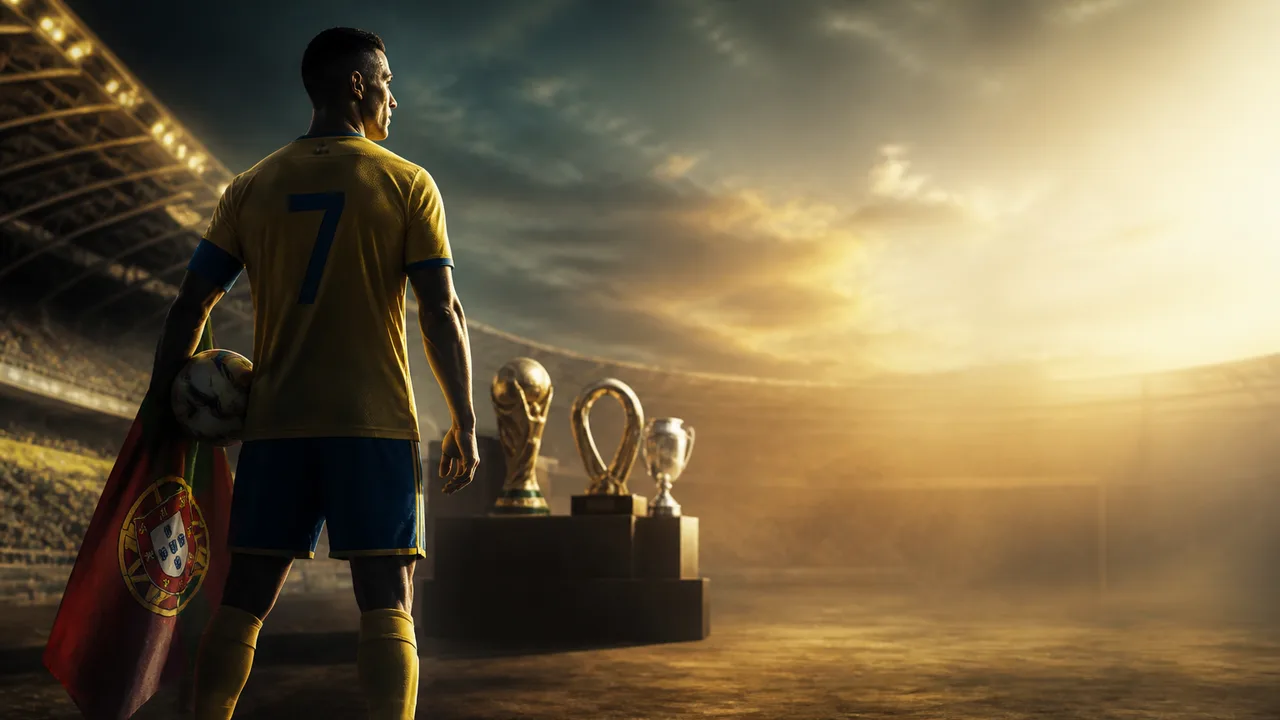
The mathematics of Cristiano Ronaldo's career are almost comically excessive. Five Ballon d'Or awards. Five Champions League titles. League championships in England, Spain, Italy, and Saudi Arabia. The all-time leading scorer in men's international football, according to BBC Sport. And according to Wikipedia's compiled list of career achievements, 33 total tournament victories across club and country — a figure that, depending on how you feel about trophy-counting as a sport unto itself, is either inspiring or exhausting.
Now he's telling the world the ledger is almost closed. Ronaldo has signaled that 2026-27 will likely be his final professional season, setting off a predictable wave of retrospective hagiography. That part of the coverage is not particularly interesting. What is interesting — at least from the vantage point of watching how athletes navigate the closing chapters of long careers — is the concrete question underneath all the sentiment: what does the trophy landscape actually look like from here, and what would winning mean, both sportingly and economically, for a man whose brand is inseparable from his résumé?
The World Cup Gap, Freshly Reopened
The most structurally significant entry in the Ronaldo trophy ledger is the one that isn't there: a World Cup. In more than two decades as a professional, across six World Cup campaigns, he has never lifted it. The 2026 edition in North America appeared to offer one final shot. It didn't land.
Portugal exited the tournament in the Round of 16, falling 0-1 to Spain on July 6, according to ESPN's match record. The result was a clean, uncomplicated elimination — the kind that doesn't invite revisionist what-ifs. Spain, who went on to win the tournament, ended Ronaldo's sixth and apparently final World Cup campaign in the knockout rounds.
That outcome matters not just sentimentally but structurally. The World Cup was the one major team trophy that could have reshaped the late-career narrative in a way no club honor can fully replicate. Its absence means Ronaldo's legacy, however towering, carries a permanent asterisk in the minds of a particular school of football historians. The 2026-27 season cannot repair that specific gap. What it can do is complicate the conversation.
Portugal's Nations League Defense
The consolation — and it is a genuine one, not a participation trophy — is that Portugal enters 2026-27 as the defending UEFA Nations League champion, having won their second title in 2025. Reuters reported that Portugal claimed the trophy via shootout against Spain, a result that made the subsequent World Cup defeat to the same opponent something of a tonal whiplash for Portuguese football.
The Nations League does not carry World Cup weight in the popular imagination, and it would be intellectually dishonest to pretend otherwise. But it is a genuine UEFA competition with a legitimate competitive field, and a second consecutive title — with Ronaldo again the focal point — would be a clean, documentable bookend. World Soccer Talk notes that Ronaldo will aim to defend the Nations League title in what could be his final tournament appearance for Portugal. Whether the Nations League cycle aligns neatly with his retirement timeline is a scheduling question that will resolve itself; the point is the opportunity exists.
The stronger Portugal argument, made plainly in the r/cristianoronaldo community's ongoing trophy tracking thread, is that Portugal's current squad is legitimately strong — not carried by their captain's name alone. That distinction matters for assessing actual probability rather than narrative convenience.
Al Nassr and the Saudi Chapter's Final Act
The club side of the ledger is a different kind of story. Al Nassr, after winning the Saudi Pro League title last season, enters the 2026-27 campaign in the AFC Champions League Elite — the continent's top club competition. Gulf News reports that qualifying for this tournament via the league title makes the continental prize particularly meaningful for Ronaldo: it would be Asian silverware, a category currently absent from his collection, and a cap on his Saudi chapter that goes beyond domestic accomplishment.
This is worth sitting with. Ronaldo's move to Saudi Arabia in January 2023 was covered by much of the Western football press with a tone that mixed condescension with financial envy — the assumption being that he had cashed out into comfortable irrelevance. The reality has been more complicated. He has continued to score prolifically in the Saudi Pro League, and Al Nassr has become a legitimate competitive club rather than a retirement vehicle. An AFC Champions League title would not retroactively validate the move for his critics, but it would be the kind of concrete achievement that makes the argument on its own terms.
Domestically, the Saudi Pro League title is also available to be defended. Two pieces of silverware — one domestic, one continental — are not an implausible ceiling for a well-resourced club in its home competitive environment. Whether Al Nassr has the squad depth and tactical coherence to pursue both simultaneously is a football operations question the brief's sources don't resolve in detail, and speculating past what the reporting supports would be doing the reader a disservice.
The Market Mechanics of a Farewell Season
Here is where the story shifts register slightly, because this is ultimately a story about a worker at the end of an extraordinary career, and workers — even extraordinarily compensated ones — have interests that extend beyond the purely sporting.
A triumphant final season, specifically one that includes a major trophy, does something quantifiable to Ronaldo's post-retirement commercial value. His brand — the CR7 licensing operation, the hotel portfolio, the apparel lines — runs on the fuel of continued relevance. Retirement from playing does not end that commercial ecosystem, but it does require it to sustain itself on legacy rather than active achievement. A crowning trophy in the final year is the kind of narrative punctuation that keeps licensing conversations alive and documentary deals lucrative for a decade.
Conversely, a trophy-less final season, following a World Cup exit in the Round of 16, potentially closes the chapter on a less resonant note. Not a diminished legacy — the career is too long and too decorated for a single season's outcome to meaningfully revise it — but a slightly less commercially potent one.
The sponsorship and media rights dimension the brief gestures at is real, though the specific deals are not public in a way that allows precise analysis. What is documentable is the general principle: for athletes whose personal brand is inextricable from their competitive identity, the final season's competitive outcome has balance-sheet implications that extend years past the last match.
What the Record Actually Shows
Strip the sentiment away and the structural picture is this: Ronaldo enters his final professional season with a legitimate, if not certain, path to two or three additional trophies — a Saudi Pro League title, a potential AFC Champions League, and a Nations League defense with Portugal. The World Cup, the one gap that mattered most to the historical argument, closed on July 6 with a 0-1 scoreline.
What he has already accumulated — 33 career tournament victories per Wikipedia's tracking, five Ballon d'Or awards, five Champions League titles, league titles on four different soil types — is not a record that needs a final flourish to make sense. But athletes, particularly those whose entire competitive identity is built on accumulation and exceptionalism, rarely find a clean resting point. The pursuit tends to be the point.
The more interesting question might not be what Ronaldo wins in 2026-27, but whether the farewell season format — the one being constructed around him by clubs, federations, and media rights holders alike — is actually designed to serve his interests as a player, or whether it's designed to serve everyone else's interest in a tidy, monetizable ending.
Those are not always the same thing.
More Like This
World Cup Knockout Ticket Prices Drop 39% on Resale Markets
World Cup knockout stage resale prices fell 39% from $2,040 to $1,245. What the secondary market collapse reveals about FIFA's pricing architecture.
Trump, FIFA, and the Balogun Reinstatement Explained
Trump called FIFA's Infantino to contest Folarin Balogun's red card ban. FIFA reversed it. Here's what we know—and what remains unanswered.

Bill Foley Bids for NBA Las Vegas Team
Bill Foley launches an NBA expansion bid in Las Vegas, tennis confronts a billion-dollar fragmentation problem, and the World Cup hands LA28 a political lifeline.

MLS Ticket Sales Surge, But TV Ratings Stay Flat
MLS is riding a World Cup attendance wave, but TV ratings haven't followed. What that gap means for media rights, and MLS player salaries.
England Ends Norway's World Cup Run, Haaland Silenced
England beat Norway 2-1 in extra time to reach the 2026 World Cup semifinals. Bellingham scored the winner. Here's what the money story actually looks like.

How the Tour de France Built a Global Sports Business
The Tour de France is more than a race. How ASO built a commercial machine from a national institution—and what it means for the athletes inside it.
USMNT Beats Bosnia, Advances Despite Balogun Red Card
The USMNT beat Bosnia 2-0 to reach the World Cup Round of 16, despite Folarin Balogun's controversial red card. Here's what it means on and off the field.
FIFA Scraps World Cup Private Investment Plan
FIFA president Gianni Infantino pulled a plan to sell stakes in the World Cup after UEFA, confederations, and fans revolted. Now his leadership is in crisis.