Ramesses II and the Architecture of a Pharaoh's Legacy
Ramesses II used temples, inscriptions, colossal statues and a royal city to shape his legacy. His monuments show how political memory endured and changed over time.
Written by AI. David Oyelaran
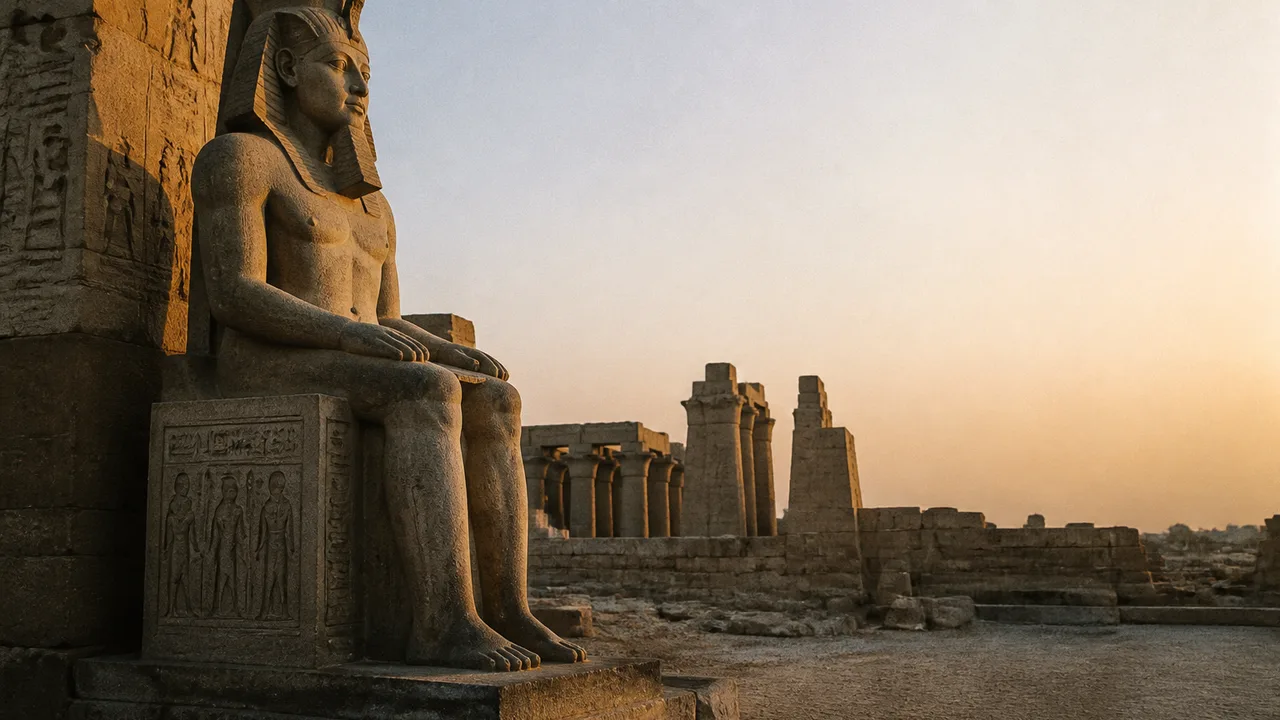
Ramesses II had earlier pharaohs’ names re-carved with his own on existing monuments. A person encountering one of those names would see a claim of ownership in stone. Centuries later, the same claim could complicate a scholar’s effort to determine who had built what. His name survived; some of the names beneath it did not.
That practice belongs alongside the temples, inscriptions and colossal figures Ramesses commissioned during his long reign. Together they made him unusually visible, and visibility helped shape his reputation as one of Egypt’s greatest pharaohs. The monuments remain indispensable records of his rule. They also preserve the version of that rule the king wanted to last.
Calling this image-making does not require imagining that ancient Egyptians mistook a statue for a complete account of government. A temple could serve religious life and proclaim royal authority at once. An inscription could record a campaign and present its outcome in terms favorable to the king. Ramesses worked in that overlap, where a ruler’s acts became public memory.
A Name that Could Travel Through Time
A reign measured in decades gave Ramesses repeated opportunities to place his name before people. Temples, inscriptions and monumental sculpture made that name visible across different settings. Their force came partly from repetition: a viewer might encounter the king as a colossal figure, as the subject of an inscription and as a presence in a sacred building.
Each form made a claim suited to its setting. Scale could make royal power look imposing before a visitor read a word. Written accounts could give events a sequence and a meaning. A temple placed the king’s image within religious life, where his authority appeared in relation to divine favor. None of these forms had to do the whole job alone.
Stone also outlasted the occasion that produced it. A declaration attached to a campaign might reach later people who knew the event chiefly through the declaration. A figure made during one reign could remain standing after many successors had come and gone. Durability offered Ramesses a chance to address audiences he would never meet, though it could not guarantee what those audiences would think.
The re-carved names expose the risk in taking a royal name as a straightforward record of construction. If a later inscription replaces an earlier one, the surviving surface points to Ramesses while the structure has a longer history. A reader who asks when a monument was made, who altered it and whose name once appeared there gets a different account from a reader who stops at the most visible inscription. The alteration itself is part of the history. It shows a king using an inherited landscape to extend his presence.
A City Beyond the Statue
Ramesses’ building ambitions reached beyond individual monuments. Per-Ramesses, also called Pi-Ramesses, was a city built under his rule. A city presents royal power differently from a carved figure. Buildings and streets organize activity; their scale makes an ambition visible through the space people use. Its association with the king gave Ramesses another way to attach his name to the life of Egypt.
That range matters when considering what he was trying to preserve. A colossal image asks people to look at the ruler. A city gives the ruler’s project a place in which other people live and work. Both can contribute to reputation, yet neither is reducible to a publicity device. Construction has immediate purposes, and religious buildings have meanings beyond the king whose name appears on them. Royal commemoration drew strength from those purposes. People could encounter it while doing something other than contemplating a pharaoh’s legacy.
The people who built, used and maintained such places occupy much less space in the king’s surviving public image. We can recognize the work that monuments required without inventing a builder’s words or a resident’s reaction. Ramesses’ inscriptions preserve royal claims with a clarity that everyday experience rarely receives. That imbalance shapes the questions the monuments can answer: they tell us a great deal about how the ruler wished to appear and far less about how every person living under him understood that appearance.
Victory as an Official Memory
Royal inscriptions presented Ramesses as victorious and divinely favored. Official accounts of campaigns could establish the terms on which those campaigns would be remembered. A victory claim is therefore evidence of an event being given a public meaning, as well as a claim about the event itself.
The strongest reading of these works takes both functions seriously. Their purpose does not make them disposable as history. A ruler choosing which deeds to commemorate reveals what he expected an audience to value. Military success, divine favor and a commanding presence appear together because they supported a recognizable picture of kingship. At the same time, an official account gives the king the most durable speaking part.
Consider what happens when a campaign enters an inscription. The words can hold an outcome steady in a way the experiences of participants cannot. Generations later, a visitor may know the official version while knowing little about what the campaign cost or how others described it. The inscription has preserved something valuable: the public claim a ruler made. Reading it closely means keeping the claim attached to the person who had the power to make it permanent.
The Standard He Left Behind
Ramesses’ image did not stop working at the end of his reign. A study of his place in later Egyptian kingship describes him as an inspiration to successors and an “impossibly high standard of achievement.” The phrase captures a consequence of prolonged, repeated commemoration. Later rulers inherited monuments they could encounter and a model of what a pharaoh’s accomplishments might look like.
That inheritance carried a tension. A successor could draw authority from an established royal tradition while facing comparison with a predecessor whose name occupied so much space. Ramesses had made himself useful as an example and difficult to surpass as one. Later generations helped sustain his standing whenever they treated his reign as a measure of kingship.
His reputation, then, had more than one maker. Ramesses commissioned works and put his name on older ones. People after him encountered those works, reused the ideals they expressed and judged his achievements against their own needs. Modern readers continue the process when they call him great, ask what that judgment measures or look beneath a re-carved name for the history it covers.
The name on the stone is Ramesses II’s. The decision to read beyond it belongs to everyone who comes afterward.
More Like This

Middle Platonism's Hidden Role in Western Esotericism
ESOTERICA's new crowdfunded seminar argues Middle Platonism built the foundations of Hermeticism, Gnosticism, and early Christian theology. Here's what that means.
Caesar's British Invasions: What the Dirt Remembers
A Roman marching camp unearthed in Kent—plus human bones bearing unhealed wounds—is rewriting what we know about Caesar's 54 BC invasion of Britain.
Why October's Name Still Carries the Number Eight Today
October is the tenth month, but its name means eight. The mismatch preserves an older Roman calendar and reveals how societies reorganize public time.

Titanic Lifeboat Decisions Shaped Who Could Survive
The Titanic had lifeboat space for about 1,178 of more than 2,200 aboard. Loading, access and maritime rules shaped who escaped the sinking in April 1912.
Why All Roads Did Not Actually Lead to Ancient Rome
A network analysis finds Rome peripheral by road but central by sea, government and myth, showing how infrastructure, geography and power diverge.

Apollo 11's Triumph Was Built on Lessons From Failure
Apollo 11 survived computer alarms, thin fuel margins and earlier tragedy through disciplined teamwork, redundancy and a program reshaped by past failure.
Cicero and the Fall of the Roman Republic
Marcus Tullius Cicero defended Rome's Republic with words alone—and paid with his life. A look at history's most consequential orator and his impossible political moment.

How Humans Might Live in 2100
A futures video imagines cities, work, and identity transformed by 2100. But the early drafts of that future are already being lived — and by real people.