Pupil Changes Differ Between Inner and Spoken Speech
University of Tsukuba researchers report different pupil responses during inner and spoken speech. The finding may help study language, but cannot read thoughts.

Written by AI. Olivia Meng
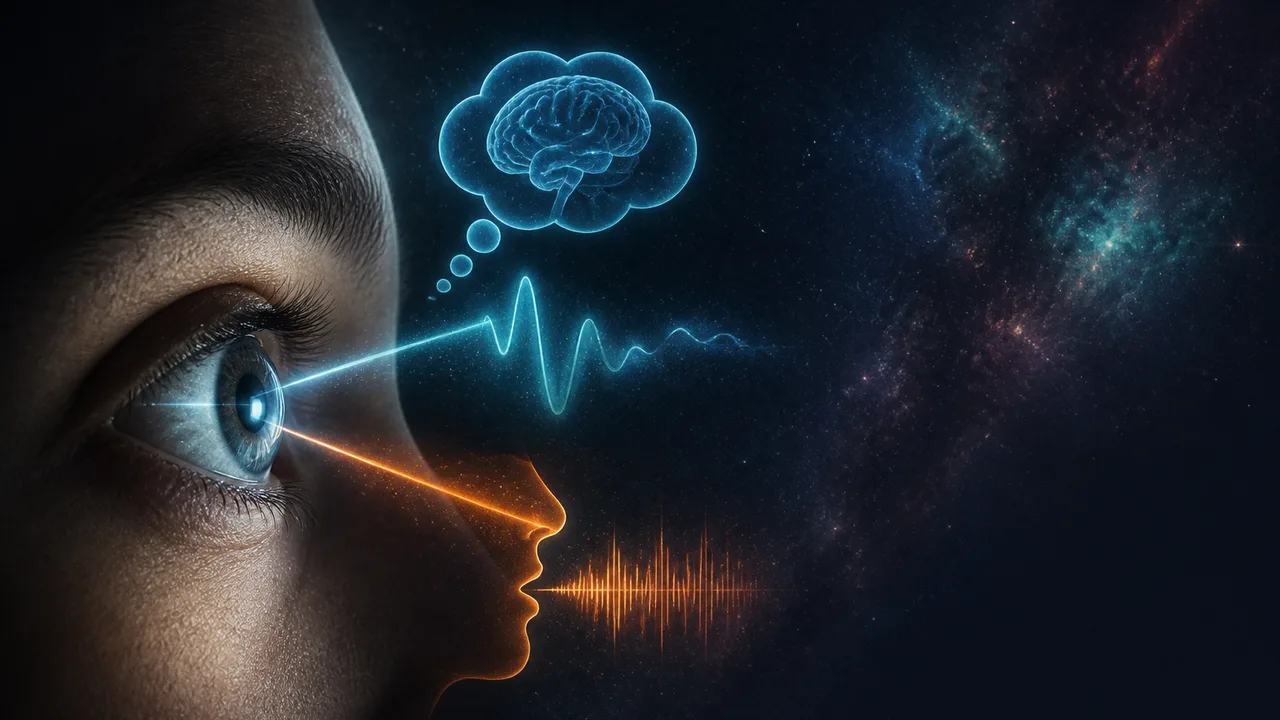
University of Tsukuba researchers found that pupils dilated during speech spoken aloud, while responses during silent, inner speech were smaller and varied with the task. The reported contrast offers a way to investigate a familiar but elusive activity: talking to yourself without making a sound.
A pupil is an unusually accessible window onto mental activity. Its most obvious job is to regulate incoming light, but its size can also change with cognitive effort and other aspects of attention. That makes it useful in an experiment and difficult to interpret outside one. The same dark circle that responds to a demanding task responds to conditions that have nothing to do with language.
The researchers' result is therefore a research clue, with a defined limit: without effect sizes, participant counts and details of controls for lighting, effort and emotion, its reliability across people and settings cannot be judged from the reported finding. A difference between groups of responses would not, by itself, identify anyone's private words.
What the Eyes Can Add to a Speech Experiment
Spoken language gives researchers several things to measure. They can record the sound, time the response and observe the physical act of speaking. Inner speech removes the sound. Someone can report that they silently said a word or phrase, but an observer cannot check that report against a recording of the imagined utterance.
Pupil measurements offer another observation. A camera can track changes in diameter while a participant follows instructions to speak aloud or speak inwardly. If the two tasks repeatedly produce different patterns under comparable conditions, researchers gain an indirect marker of how the tasks engage the person doing them. The marker does not have to reveal the words to be useful. It might help locate when a task demands more attention, or test whether changing the instructions changes the response.
The three-experiment finding showed consistent dilation during overt speech, without comparable consistent dilation during inner speech. That sits alongside the university's narrower observation that inner-speech responses varied by task and remained smaller than responses to overt speech. Put together, those descriptions point to a reliable direction in the reported comparison, rather than a simple rule that silent speech never affects the pupil.
That last qualification changes how one would design the next experiment. “Speak to yourself” can mean mentally repeating a supplied word, choosing your own words, counting, rehearsing a conversation or thinking through a problem. These activities could differ in effort even if every participant describes them as inner speech. The instructions are part of the phenomenon under study, not a procedural footnote.
Why Talking Aloud Might Produce a Larger Response
Producing audible speech recruits processes that a silent task may engage differently. A person must plan an utterance, move the muscles used for speech and monitor what comes out. Speaking can also change breathing. Those are plausible contributors to a pupil response, though the pupil alone cannot assign a share of the change to any one of them.
Silent speech has its own demands. Mentally rehearsing a difficult phrase may require more concentration than saying an easy one aloud. A task that asks someone to generate words may differ from one that asks them to repeat words already given. If a larger pupil response appears during one version of inner speech and a smaller one during another, the instructions could help researchers separate the work of forming an utterance from the work of vocalizing it.
Pupil size is sensitive to mental effort as well as light, a property that has made it useful in experiments on attention and language. Sensitivity is the advantage here. Lack of specificity is the price. An increase during spoken speech could reflect speech production, greater effort, arousal or a mixture of influences. Asking participants to perform carefully matched tasks, while keeping illumination and visual conditions stable, would narrow those possibilities.
The comparison also has a built-in asymmetry. An aloud response leaves an audible trace that can be checked. A silent response depends more heavily on whether a participant followed the instruction and on what that participant counts as “saying” something internally. Repeating a word in one's head, visualizing its spelling and considering its meaning are different tasks, even if they all take place in silence. An experiment must decide which of those activities it wants to test.
A Signal with Several Possible Causes
Imagine two people whose pupils expand by the same amount. One might be speaking aloud; the other might be silently working through a demanding problem. Even within a single person, a change in lighting could overwhelm a subtler task-related change. The shape and timing of a response may carry information in a controlled comparison, but a measurement needs its experimental context to have an interpretation.
That distinction is familiar across studies of human behavior. Heart rate can rise during exercise or anxiety. The measurement is accurate in either case; the circumstances explain it. Pupil diameter presents a sharper version of the same interpretive problem because light, attention and emotional state can all change it while a person is trying to use language.
There is also a difference between finding an average pattern and identifying an individual event. A study may detect that one condition produces larger responses than another across repeated trials. A single pupil measurement from one person offers far less context. Even a successful classification of silent versus aloud tasks under laboratory instructions would answer a limited question about those tasks. It would not disclose whether someone was rehearsing a shopping list, composing an apology or thinking of nothing verbal at all.
The strongest case for this line of research is modest and useful. Inner speech is difficult to observe directly, and a repeatable physiological response could give researchers another way to test how it changes across tasks. The next questions are concrete: Does the difference persist when speaking and silent rehearsal are matched as closely as possible? How much does it vary from person to person? Do task demands alter the timing as well as the size of the response?
For now, the eye offers an observable consequence of a comparison between speaking aloud and speaking inwardly. The words themselves remain with the person who thought them.
More Like This

Stroke Risk Peaks in the First Three Months After a Cancer Diagnosis
New research in Cancer finds stroke risk rises 2.5-fold in the first three months after a cancer diagnosis, especially with pancreatic and lung cancers.

A Victorian Train Delay Exposes Space Weather Risk
A disputed Victorian train delay links geomagnetic activity to telegraph faults, showing how space weather affected systems before satellites and power grids.

Montana's JM Reef and America's Platinum Supply Problem
The JM Reef in Montana is America's only platinum and palladium source. What that means for clean energy, emissions tech, and supply chain security.

Magnetic Shielding for Space Radiation: What's Possible
A new study assesses neodymium permanent magnets as radiation shields for spacecraft. Here's what the physics allows, what it doesn't, and why this problem won't go away.

Three Gorges Dam: Engineering at Planetary Scale
China's Three Gorges Dam generates more power than 20 nuclear reactors and measurably slowed Earth's rotation. The physics are astonishing. The cost was human.

Utah's Giant Solar Project Is Real—and Complicated
Utah's Green River Energy Center pairs 400 MW of solar with 1,600 MWh of battery storage. Here's what the press release leaves out.