The Prophecy of the Popes: History, Hoax, and Why It Endures
The 900-year-old Prophecy of the Popes is almost certainly a Renaissance forgery. Understanding why people still believe it tells us more than the document itself.

Written by AI. James Morrison
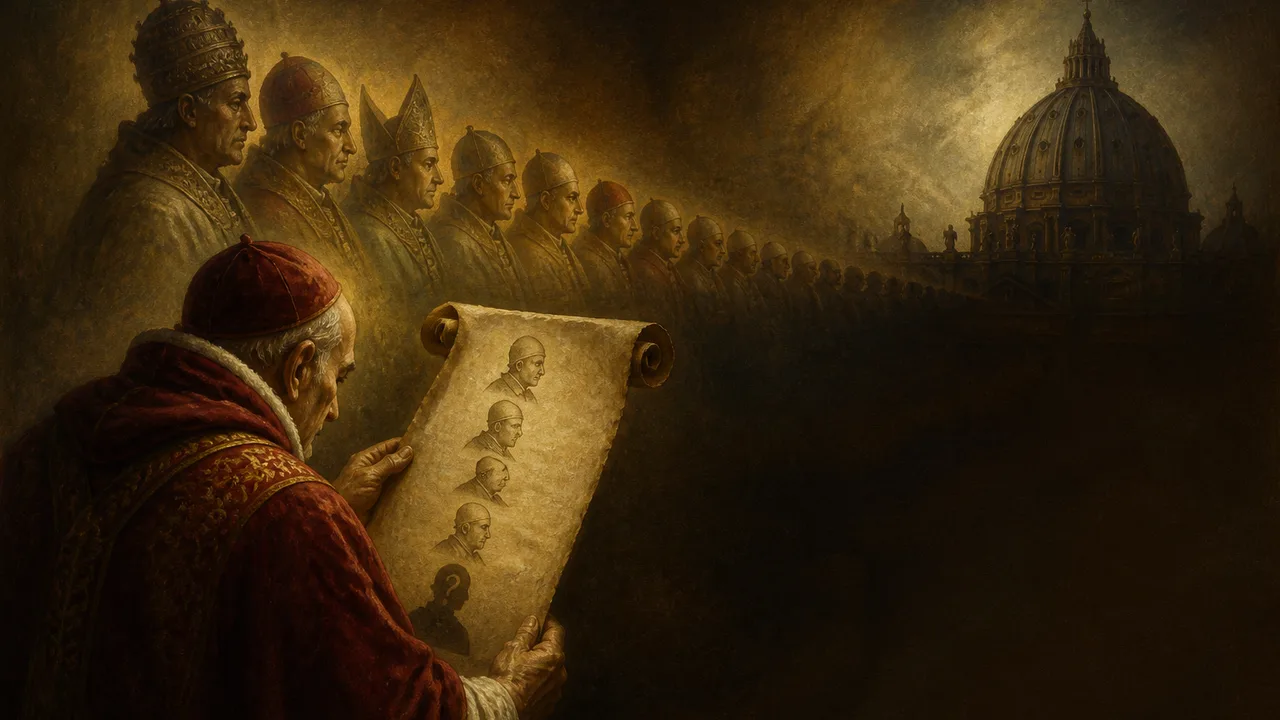
There is a document sitting at the edge of Catholic institutional memory that is 112 cryptic Latin phrases long, attributed to a 12th-century Irish archbishop, and currently circulating on the internet with renewed urgency because its sequence of papal descriptors appears to end — conclusively, terminally — with the man who sat in the Chair of Peter until his death in April 2025.
The document is called the Prophetia Sancti Malachiae Archiepiscopi, de Summis Pontificibus — the Prophecy of Saint-Archbishop Malachy, concerning the Supreme Pontiffs. Most scholars regard it as a late 16th-century fabrication. None of that has slowed its audience.
What It Actually Says
The prophecy, as EWTN Vatican explains, purports to describe every pope from 1143 until the end of time, each assigned a short Latin motto said to capture some essential characteristic of his pontificate. Ex castro Tiberis — "from a castle on the Tiber" — for one pope. Aquila rapax — "rapacious eagle" — for another. The final entry, entry 112, is different in kind from the rest: not a terse motto but a narrative passage describing a figure called "Peter the Roman," who will feed his flock through great tribulation before Rome is destroyed and the dreadful Judge judges his people.
Cryptic Accounts notes that the tradition holds Malachy received this sequence as a divine vision during a visit to Rome around 1139, presenting it to Pope Innocent II before it allegedly vanished into the Vatican archives for four centuries. The format — 112 entries, each a capsule, each numbered — is what gives the document its peculiar authority. A numbered list with an end point hands anxious readers something a vague oracle never can: a scoreboard. You can check your position. You can count down.
That psychological architecture is worth sitting with, because it explains the prophecy's durability better than any assessment of its actual content.
The Conclave of 1590 and the Fabrication Problem
Here is where the document's history gets operationally interesting, and where the case for forgery moves from probable to near-certain.
The prophecy first surfaced publicly not in the 12th century but in 1595, published by a Benedictine monk named Arnold Wion in a work called Lignum Vitae. Wion attributed the text to Saint Malachy of Armagh, the Irish reformer and archbishop who died in 1148. The document had supposedly been discovered in the Vatican archives. The most frequently cited scholarly hypothesis holds that the prophecy was actually composed around 1590, during one of the most contentious and politically charged papal elections in Catholic history.
That conclave followed the death of Pope Sixtus V. Among the leading candidates was Cardinal Girolamo Simoncelli, whose supporters needed a reason — a divinely ordained reason — to argue that his elevation was cosmically foreordained. Simoncelli was a man who had spent decades climbing the church's hierarchy, who understood that a conclave could turn on a whispered argument in an anteroom as easily as on theology, and whose entire political future now hinged on whether a room full of exhausted cardinals could be persuaded that Providence itself had weighed in on his behalf. The prophecy's motto for the relevant pontificate appeared to fit Simoncelli's profile. When Gregory XIV emerged from that conclave instead, Simoncelli walked away from the moment history had supposedly written for him — and the document became, retroactively, a failed influence operation dressed in prophetic clothing.
This is the structure of the fraud, if fraud it was: compose a "prophecy" that predicts, with apparent accuracy, every pope up to the present, then introduce it as newly discovered ancient wisdom at the exact moment its final legible entry favors your candidate. The mottos for popes before 1590 can be tortured to fit almost any pontificate with sufficient creativity; the mottos after 1590 become progressively more ambiguous, more difficult to anchor to specific papal biographies without interpretive gymnastics. All That's Interesting makes this pattern explicit: the pre-1590 entries read as history written backward, while the post-1590 entries read as what they probably are — generic phrases that believers then map onto whoever occupies the chair.
Pope Francis, the Final Slot, and the 2025 Conclave
Euronews reported in March 2025 that Francis's prolonged illness had triggered a fresh wave of online interest in the Malachy prophecy, specifically because Francis — Jorge Mario Bergoglio — appeared to occupy the 112th and final position in the sequence. The connection believers draw is partly linguistic: Francis belongs to the Franciscan tradition, Francis of Assisi was himself Italian-born of a father named Pietro, and the "Peter the Roman" of the final entry can be stretched, with sufficient motivation, to fit that biography.
EWTN News is careful to note that Francis "appears, at least at a glance, to be the last pope described" — a qualification that matters. The Catholic Encyclopedia, cited by both EWTN outlets, does not endorse the prophecy's authenticity; it treats it as a historical artifact of religious culture, not a doctrinal document. The Church itself has never assigned the Malachy prophecy any official standing. It is folklore wearing the clothes of revelation.
Francis died in April 2025. The conclave that followed elected a new pope. The sequence that was supposed to end has, by any structural logic of the document, ended — which means the prophecy's believers now face the same interpretive problem every failed apocalyptic countdown eventually produces: reinterpretation or abandonment. The Mirror notes that the doomsday endpoint some interpreters had attached to the prophecy pointed toward 2027. What that means for a conclave that has already produced a new pope who exists outside the prophecy's 112-entry framework is, at minimum, a question the prophecy's architects did not anticipate — because they could not have.
The Information Operation That Keeps Running
What I find genuinely worth examining here is not whether a 12th-century archbishop had a divine vision, but why a document this easily debunked maintains this much cultural velocity.
The Malachy prophecy is structurally identical to the genre of information operation that military and intelligence analysts call "pretext fabrication with historical backstory" — a document introduced to justify a present-day action by anchoring it in apparent antiquity. The fact that this particular operation was aimed at a papal conclave rather than a troop movement does not change its mechanics. Someone in 1590 understood that a numbered list, attributed to a recognized saint, planted in an archive credible enough to pass initial inspection, could move political outcomes. They were not entirely wrong. They simply lost the conclave.
That the document then acquired a life of its own — circulating for four centuries, accumulating believers, generating fresh interpretive cycles every time a pope fell ill or a conclave opened — is the part the original fabricator almost certainly did not plan for. Disinformation, once released, does not answer to its authors.
The 1970s parallel is instructive. Hal Lindsey's The Late Great Planet Earth, which mapped Biblical prophecy onto Cold War geopolitics and predicted imminent apocalypse, sold roughly 28 million copies in the decade after its 1970 publication. The appetite it fed — for a cosmic framework that assigned every news event a place in a predetermined sequence — was not a fringe pathology. It was a mainstream American response to Vietnam, Watergate, and the oil shock. A numbered sequence leading to a terminal event didn't offer comfort so much as it offered the one thing genuine chaos never provides: the feeling that someone, somewhere, is keeping score. That the score was fabricated mattered less than the scoreboard's existence.
The Malachy prophecy runs on the same fuel. A new pope now occupies a chair the prophecy's sequence formally cannot accommodate. The document has, by its own internal logic, expired. What the next interpretive cycle looks like — how believers absorb a 113th pontificate into a framework that allows for only 112 — is a question about human cognition and institutional narrative, not about medieval manuscripts.
Those questions are more durable than any prophecy. They will still be running long after 2027.
More Like This
Ray Dalio's Framework for Tracking Empire Decline
Ray Dalio argues empires follow measurable, repeating cycles of rise and fall. His framework deserves scrutiny—and raises questions relevant to today's geopolitics.
Unraveling Rome's Dodecahedron Mystery
Exploring the enigmatic Roman dodecahedron, its theories, and historical significance in modern archaeology.
FBI's Struggle Against Omega 7: A Tale of Terrorism and Intrigue
Explore the FBI's complex investigation of Omega 7, a Cuban exile terrorist group, amid community challenges and evolving tactics.
Neil deGrasse Tyson Explains Why Astrology's Arguments Don't Hold Up
Neil deGrasse Tyson explains why precession and a missing 13th sign expose astrology's fatal flaw — and what that reveals about how we ignore inconvenient evidence.
Unexplained Calls: Echoes from the Past
Explore eerie stories of calls from the dead, their impact on military and emergency responses.
A Physicist Calls UFO Disclosure a Distraction
Physicist Brian Keating tore through the latest government UFO release and found nothing. His argument: the timing alone makes it suspect.
April 1865: How the Civil War's End Was Decided
The History Channel's documentary on April 1865 examines how decisions made in a single month determined whether the Civil War's end would bring peace or prolonged guerrilla conflict.
The Nine Days of Bismarck: A Battle That Changed Naval War
How nine days in May 1941 destroyed Germany's mightiest battleship, sank the Royal Navy's iconic HMS Hood, and ended the battleship era for good.