The Primordial Lithium Problem Cosmology Can't Solve
Big Bang nucleosynthesis predicts 3–4x more lithium-7 than astronomers observe. A new arXiv preprint revisits beryllium-7 decay rates to find out why.

Written by AI. Amelia Nwofor
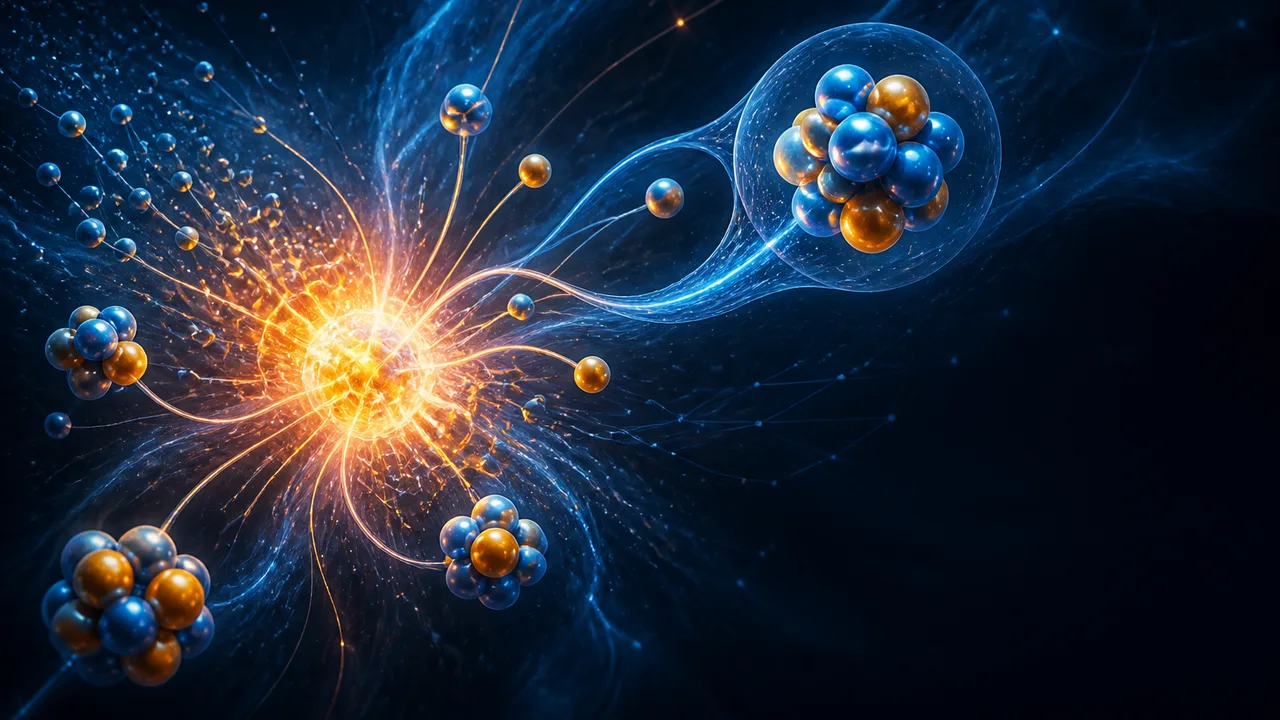
The Big Bang model is, by most measures, one of the most successful predictive frameworks in the history of science. It told us the universe is expanding before we confirmed it. It predicted the cosmic microwave background before we found it. It calculated the primordial abundances of hydrogen, helium, and lithium from first principles — and got hydrogen and helium essentially right.
Lithium, though. Lithium keeps being a problem.
Standard Big Bang nucleosynthesis (BBN) predicts roughly three to four times more lithium-7 than astronomers actually observe in the oldest, most metal-poor stars in our galaxy's halo. That's not a rounding error. That's not measurement noise around the edges. It's a persistent, reproducible, decades-long mismatch between one of our best cosmological theories and what the universe is actually doing. As Astronomy & Astrophysics lays out in a recent comprehensive review, CMB measurements of baryon density feed directly into nucleosynthesis calculations — and when you run those calculations forward, you get lithium abundances that stubbornly refuse to match what metal-poor halo stars show. The tension, as A&A notes, persists.
The cosmological community has been arguing about why for a long time.
What BBN Actually Predicts, and Why That Matters
Before getting into beryllium, it helps to understand why BBN is such a remarkable — and therefore pressure-bearing — theory.
Standard BBN is, as a 2023 arXiv preprint on the lithium abundance problem (arXiv:2304.08032) describes it, effectively a parameter-free theory. The baryon-to-photon ratio of the universe — the key input into nucleosynthesis calculations — is now pinned down with high precision by CMB anisotropy measurements. You don't get to fiddle with it. That's what makes BBN so powerful as a test: once you fix the baryon density, the predicted light-element abundances fall out of the physics with essentially no free parameters left to adjust.
Hydrogen? Nailed it. Helium-4? Nailed it. Deuterium? Getting there. Lithium-7? Off by a factor of three to four. Every time.
This is the primordial lithium problem in its baldest form: not a theory that's vague enough to absorb the discrepancy, but a precise theory whose precision makes the discrepancy glaring.
The Beryllium-7 Angle
Here's where the nuclear physics gets interesting. Lithium-7 doesn't form directly in the early universe in significant quantities. The dominant production pathway runs through beryllium-7 (⁷Be), which forms first and then decays into lithium-7 after BBN ends, once the universe has cooled enough for electron capture to occur. So if you want to understand where the lithium surplus comes from — or where it might be lost — you need to look hard at ⁷Be.
That's exactly what a recent preprint, arXiv:2601.12438, "Revisiting ⁷Be Weak and Radiative Transition Rates in Big Bang Nucleosynthesis: Implications for the Primordial Lithium Problem", sets out to do. The paper revisits the weak and radiative transition rates of ⁷Be during BBN — essentially asking whether the nuclear reaction network that governs how ⁷Be behaves in the first few minutes of cosmic time has been calculated correctly, and whether there might be destruction channels for ⁷Be that the standard model has been missing or underweighting.
The logic is clean: if ⁷Be can be destroyed more efficiently than current models assume — through reactions that haven't been adequately measured or accounted for — then less of it survives to become lithium-7, and the observed abundance starts to make more sense. The paper's approach is to go back to the nuclear transition rates themselves, the fundamental inputs to the BBN reaction network, and interrogate them.
What makes this approach worth attention is that it operates entirely within established physics. No new particles, no exotic physics beyond the standard model. The bet is that the answer might be hiding in nuclear data that's less precisely measured than cosmologists assumed.
Why This Hasn't Been Solved Already
A fair question, and one that the history of this problem makes complicated.
The lithium problem has attracted proposed solutions from multiple directions. On the astrophysical side, some researchers have argued that the discrepancy reflects stellar physics rather than cosmology: old metal-poor stars might have depleted lithium from their surfaces through mixing and diffusion over billions of years, so the abundance we measure today undershoots the primordial value. This is a genuine possibility, but it struggles to explain why the depletion would be so uniform across stars with different masses and evolutionary histories that the "Spite plateau" — the flat, nearly constant lithium abundance observed across a wide range of these stars — holds as well as it does.
On the nuclear physics side, researchers have repeatedly examined whether specific reactions in the BBN network might be off. The ⁷Be + d and ⁷Be + He-3 reactions have received particular scrutiny. So far, laboratory measurements have not found the rate enhancements that would be needed to close the gap through this route alone.
As the A&A review notes, no universally accepted solution has emerged despite sustained experimental and theoretical effort. The arXiv paper arXiv:2601.12438 acknowledges this same frustrating record, noting in its HTML full text that the tension persists despite updated experimental nuclear reaction rate measurements. That's not a knock on the researchers — it's an honest accounting of where the field is.
Some proposals have reached further. A proposal available on ResearchGate suggests a non-exotic electromagnetic mechanism involving light glueballs forming within color superconducting quark clusters — an approach its authors describe as operating within the standard model of particle physics, though it involves speculative extensions to nuclear structure. The publication status of that proposal is unclear from the available information; it's worth noting ResearchGate hosts both peer-reviewed work and preprints, and readers should assess it accordingly.
The breadth of proposed mechanisms — stellar depletion, exotic nuclear resonances, physics at the edge of the standard model — is itself diagnostic. When a problem has been attacked from this many angles without resolution, the remaining explanations tend to either be subtle or require genuinely new physics. Neither possibility is boring.
What Makes the ⁷Be Rate Revisitation Different
The arXiv:2601.12438 paper isn't the first to look at ⁷Be transition rates, but the framing is worth taking seriously. Weak transition rates — governing processes like electron capture and positron emission — are notoriously difficult to measure directly under Big Bang conditions, because those conditions (temperatures in the range of billions of kelvin, timescales of minutes) are impossible to recreate in a laboratory. Researchers rely on theoretical nuclear models, constrained by whatever laboratory analog measurements are available.
The key question the paper asks is whether those theoretical models have been applied consistently and whether the available experimental constraints actually pin down the rates well enough to trust the BBN output. If there's genuine theoretical uncertainty in those rates that has been underestimated, the predicted lithium abundance carries an error bar that's larger than usually acknowledged — and closing the gap with observations might require less exotic physics than the community has been assuming.
This is the kind of methodological question that doesn't generate headlines but can genuinely shift a field. It's also the kind of question that's hard to evaluate from the abstract alone. The proof is in how tightly the nuclear uncertainties can actually be bounded, and whether the paper's revised rates move the predicted lithium abundance meaningfully in the right direction — or whether they leave the factor-of-three gap intact.
The Stubborn Utility of an Unsolved Problem
Here's the thing about the lithium problem that doesn't get said enough: its persistence is arguably more valuable to cosmology than a quick solution would have been.
A factor-of-three discrepancy in a parameter-free theory, surviving decades of scrutiny from nuclear physicists, stellar astrophysicists, and particle theorists, is a precise pointer at something we don't understand. That might turn out to be a subtle nuclear rate we miscalculated. It might turn out to be stellar physics that's more complicated than we appreciated. Or it might be a thread that, pulled carefully, reveals physics beyond the standard model.
The A&A review frames the CMB's role in BBN calculations as what makes the tension so sharp: baryon density is not a free parameter anymore, which means the lithium problem can't be wished away by adjusting inputs. It has to be explained.
The arXiv:2601.12438 preprint represents one more careful attempt to explain it from within standard physics. Whether it succeeds — or narrows the gap enough to change the conversation — depends on exactly how well its revised nuclear rates hold up against experimental data. That's not something an abstract alone can settle.
But if the ⁷Be rates are cleaner than the current models suggest, and the predicted lithium still comes out three times too high, then the cosmology community will have systematically eliminated another conventional exit and moved one step closer to something genuinely strange.
More Like This

Could We Have Detected Dark Matter at Last?
Scientists may have detected dark matter's signal in the Milky Way, hinting at potential breakthroughs in understanding the universe.

Rethinking Inflation and the FLRW Model
Explore the complexities and challenges of cosmological models, including inflation theory and the FLRW model.

Galaxies That Challenge Our Cosmic Timeline
James Webb Space Telescope finds galaxies too evolved for the young universe, challenging current cosmological models.

Primordial Black Holes as Dark Matter Candidates
After decades of failed WIMP searches, physicists are turning to primordial black holes as a serious dark matter candidate. Here's what the evidence actually shows.

The Top Quark and the Fate of the Universe
Physicist Kate Shaw explains how measuring the top quark's mass with precision could reveal whether the universe is stable—or sitting on a quantum knife-edge.

A Dead Star May Confirm a 90-Year-Old Quantum Theory
A magnetar's extreme magnetic field may finally confirm vacuum birefringence — a quantum prediction nearly 90 years old that we've never been able to test on Earth.

Donald Hoffman: Evolution Hid Reality From Us
Cognitive scientist Donald Hoffman argues on StarTalk that evolution gave us a VR headset, not a window—and the math behind Darwin backs him up.

Gravity's Strangest Effects, From Time to Cosmic Voids
From gravitational time dilation to the Dipole Repeller and LIGO's detections, here's what gravity actually does—and what it still can't explain.