Premium Hospitality Is Remaking the Sports Venue Business
Sports venues are racing to expand luxury hospitality—but as premium revenue targets climb, the question of who gets left behind grows harder to dismiss.
Written by AI. Marcus Tate
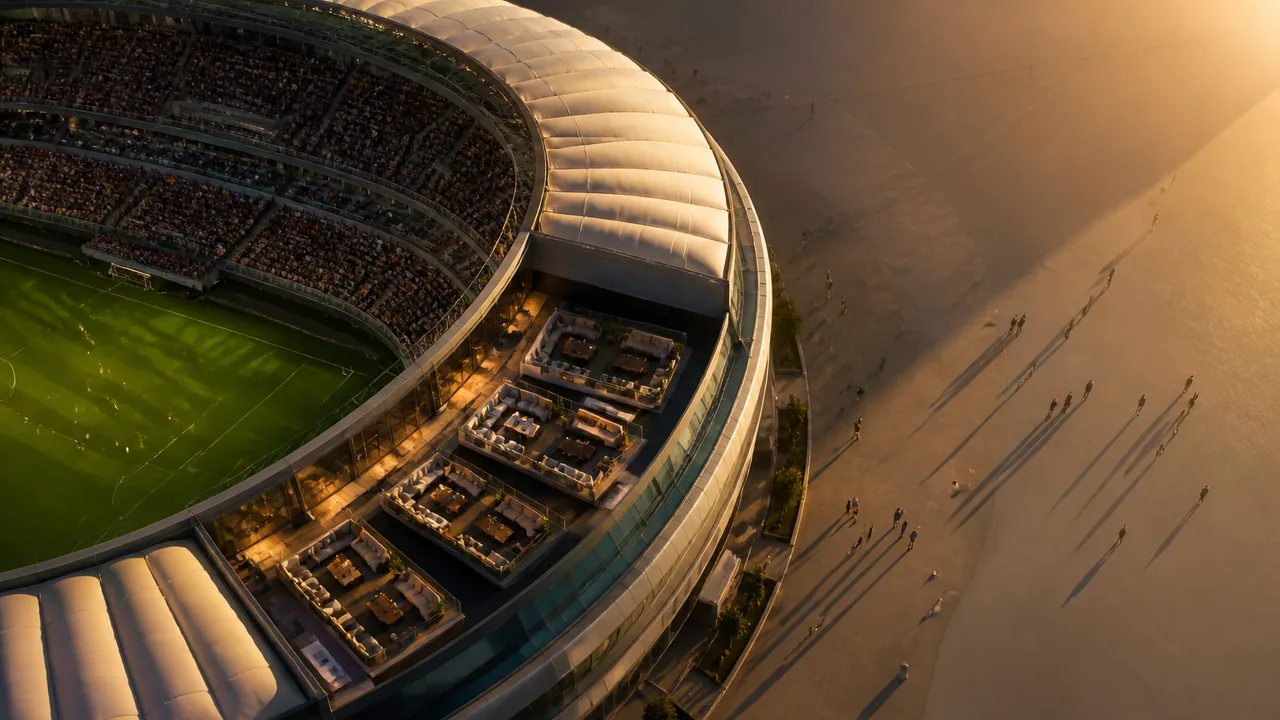
Photo: AI. Rio Sanchez
The Roman Colosseum had box seats. The amphitheater at Pergamon, built in the 2nd century, had them too. The instinct to sell proximity and comfort to people willing to pay for it is, apparently, as old as organized spectacle itself. What's changed in the modern era is the sophistication of the extraction—and the speed at which the floor of "premium" keeps rising.
That tension between aspiration and access sat at the center of a recent Sports Business Journal Inside the Industry panel, which brought together SBJ publisher Abe Madkour, reporter Austin Karp, celebrity chef Spike Mendelsohn, Monumental Sports and Entertainment Chief Commercial Officer Jim Van Stone, and On Location Experiences COO Ed Horne to map the current state of premium hospitality in live sports. The conversation was largely bullish—the participants are, by and large, practitioners and beneficiaries of the trend—but the structural questions they raised deserve closer examination than the panel's enthusiasm always allowed.
The Capital Argument for Premium
The business logic is not subtle. New stadium construction now routinely runs $3 to $4 billion, according to figures cited in the discussion. At that price point, teams and ownership groups are not building monuments to sport; they are building revenue platforms that happen to host games. Premium spaces—clubs, ultra-premium suites, all-inclusive zones, show kitchens, private bar experiences—generate margins that standard bowl seating cannot approach. Madkour noted that every sports team he speaks with currently believes they need 30 to 40 percent more premium inventory in their buildings. That is not a preference; it is a capital-allocation signal.
On Location's Horne framed the broader commercial logic: "The ability to be able to have a driveway-to-driveway opportunity, really elevating what the experience is beyond the game. All of that means that the design of the venue needs to reflect what people are after and what they want to see." The driveway-to-driveway concept is worth unpacking. It describes a total service envelope that begins before a fan reaches the venue—parking pre-arranged, traffic routed, security expedited—and ends when they leave. The game is the middle of the product, not the whole of it. For the operators selling this service, that framing is liberating: you can charge for every minute of the clock, not just the two or three hours of competition.
The revenue projection that anchors the panel's bullishness is striking. The buy/sell/hold segment put a specific number on the table: premium offerings currently account for roughly 50 percent of sports ticketing revenue and, the panel suggested, could reach 70 percent within a decade. All three panelists voted to buy that trajectory. Madkour added one qualifier that carries real weight: "I hope it doesn't go past 75 percent because you don't want to price out fans past that point."
That's a telling hedge from someone who has watched the industry for three decades. It acknowledges a structural ceiling that enthusiasm alone doesn't dissolve.
What Premium Actually Means Now
The product has evolved considerably from the box-seats-with-cold-cuts model that defined arena suites through most of the late 20th century. Van Stone's renovation of the United Club at Capital One Arena in Washington illustrates the current design philosophy: not a single premium tier but a layered environment with distinct experiential zones, a day-flight aesthetic on one level transitioning to night-flight on another, curated culinary programming, and the explicit goal that every guest in the building "feels like they're a premium seat holder." That last phrase matters. The aspiration isn't exclusivity for its own sake; it's the feeling of exclusivity distributed across more price points.
Mendelsohn, who opened Arena Bar and Eats at Capital One Arena, described how the consumer experience now begins well before arrival: "Now it starts at home. You're on your social, you're reading about your experience, it's game day, how are you going to get there." The game-day journey has been reconceptualized as a content experience with a physical culmination, rather than a trip to watch an athletic event. Teams are designing for both modes simultaneously.
The democratization argument runs through the panel's framing of newer, lower-tier premium products. Mercedes-Benz Stadium in Atlanta built what Karp described as "neighborhoods" throughout the venue—large communal bar areas where fans can gather socially without paying for a private suite. The Toronto Blue Jays created an entry-level premium zone at Rogers Centre, targeted at younger audiences looking for an all-inclusive beverage and social environment rather than the game itself as the primary draw. The Professional Bull Riders, noted with some amusement by Karp, now offer "shoot suites" positioned directly above the chutes—premium sightlines in a sport not typically associated with luxury hospitality.
The common thread is segmentation: a GA-plus tier for the 20-something who wants an open bar and a Lyft credit after the game; a mid-level club for the season-ticket holder who wants dining options and early entry; and an ultra-premium product—the Lexus Vault at Capital One Arena being the episode's showpiece example—where annual commitments run $2 million to $3 million and the service wraps around personal preferences with a concierge, a dedicated mixologist, a private tunnel entrance, and court-side positioning. At that level, the operator's challenge is anticipation. Host Tarik El-Bashir's story about his mother requesting popcorn mid-event—only to have an attendant materialize instantly with pre-packed bags—captures the hospitality ideal: the ask should never need to be made twice, or at all.
The Friction Points the Panel Glossed Over
The panel's optimism is understandable given the participants' vantage points, but a few structural tensions didn't get the scrutiny they deserve.
First, the broadcast problem. As premium spaces draw fans away from their seats and into clubs and restaurants, the televised product suffers visually. Karp noted that television producers "hate a visual of a stadium that looks pretty empty during a game"—and that NFL club levels frequently sit vacant in the second half as fans linger over food. A sold-out game with empty lower sections is, from a broadcast standpoint, an optics problem that affects the product sold to the network paying billions for rights. Teams have every financial incentive to fill premium spaces; networks have every incentive to show full bowls. That tension doesn't disappear because the business case for premium is compelling.
Second, the NPS data Madkour mentioned is worth sitting with. Several teams, he noted, have found that satisfaction scores in their premium areas run lower than in the general seating areas—meaning people paying the most money are sometimes the least satisfied. At $2 to $3 million per suite per year, unmet service expectations are not a minor inconvenience; they are a retention crisis. The panel acknowledged this but moved past it quickly. The gap between the experience being sold and the experience being delivered is the industry's most consequential operational problem at the moment.
Third, the pricing trajectory raises a question the panel's consensus framing didn't fully engage: what happens to the median fan? Madkour voiced the concern directly—"I worry also about pricing out the common fan who works all week to go to a game and is happy with their hot dog and their beer"—but the panel's overall posture was that tiered products and a la carte upgrades will extend premium access broadly enough to prevent meaningful exclusion. That may be true. It may also be the preferred narrative of an industry that has strong financial incentives to believe it. The two are not mutually exclusive.
Horne's vision of where access is heading is the clearest articulation of the premium frontier: fans receiving pre-event emails telling them which player they'll meet, what swag is waiting at their seat, and how they'll exit the building. Ultra-personalization, he suggested, is where most pro teams are aiming to land their premium tier. That is a genuinely different product than a suite with hot dogs, and it commands a genuinely different price.
The Deeper Structural Question
The Roman Empire is instructive, though perhaps not in the way the panel's trivia segment intended. Box seats in the Colosseum weren't just a hospitality upgrade—they were an institutionalized expression of social hierarchy built into the architecture of public spectacle. The front rows were for senators; the upper tiers were for the plebs. The venue encoded the pecking order.
Modern premium hospitality is more fluid, more brand-agnostic, and more available to anyone with sufficient income regardless of social standing. The 25-year-old tech worker in an all-inclusive outfield zone and the corporate executive in a $3 million vault suite are both "premium customers" in the current taxonomy. That's a real difference from ancient Rome.
But the underlying dynamic—designing spaces that make some people feel like they are having a categorically different experience from others in the same building—is as old as the Colosseum itself. The question the sports business hasn't fully answered is whether the rising premium tide actually lifts all boats, or whether it gradually prices out the fans who came for the game rather than the experience around it. The industry's financial incentives point one direction. The answer may not.
More Like This

Bill Foley Bids for NBA Las Vegas Team
Bill Foley launches an NBA expansion bid in Las Vegas, tennis confronts a billion-dollar fragmentation problem, and the World Cup hands LA28 a political lifeline.

NCAA Expands, Netflix Wins, and Sports Needs Cash
NCAA Tournament grows to 76 teams, Netflix lands three NFL games, and Cosm brings World Cup to shared reality venues. The week's sports business, mapped.
Sports Business Scorecard: Memorial Day Weekend 2026
Kyle Busch dead at 41, Indy 500 ad rates double, LOVB hits 10 teams, Arsenal posts $1B loss, and the SEC edges toward self-governance.

College Sports at a Crossroads: Gambling, Revenue, and Apparel
The Sorsby injunction, Utah's Under Armour split, and the cap-busting revenue arms race dominated NACDA 2026. Here's what it all means.
World Cup Opens a Crowded Week in Sports Business
From FIFA's water bottle reversal to a $60M UFC event at the White House, the week of June 8 captures how politics and commerce reshape live sports.

Blackstone's Career Ladder, From Analyst to Partner
From a $90K analyst seat to Schwarzman's billion-dollar paycheck: how Blackstone's career ladder works—and why private credit is quietly rewriting it.

Knicks Merch Records, Izzo's Board Blast, ManU's Amazon Deal
From Fanatics order surges to Tom Izzo's trustee takedown to Manchester United's record Amazon deal—Tuesday's sports business landscape, mapped.

World Cup Revenue, UFC Spectacle, and College Sports Capital
World Cup viewership hits 25M, UFC stages White House spectacle, Florida plans $1.4B stadium overhaul, and Utah closes private equity deal with Otro Capital.