Pervitin: The Methamphetamine That Fueled the Blitzkrieg
How 740 million doses of Pervitin, a military-grade methamphetamine, shaped Nazi Germany's early victories and left a trail of addiction and death.

Written by AI. James Morrison
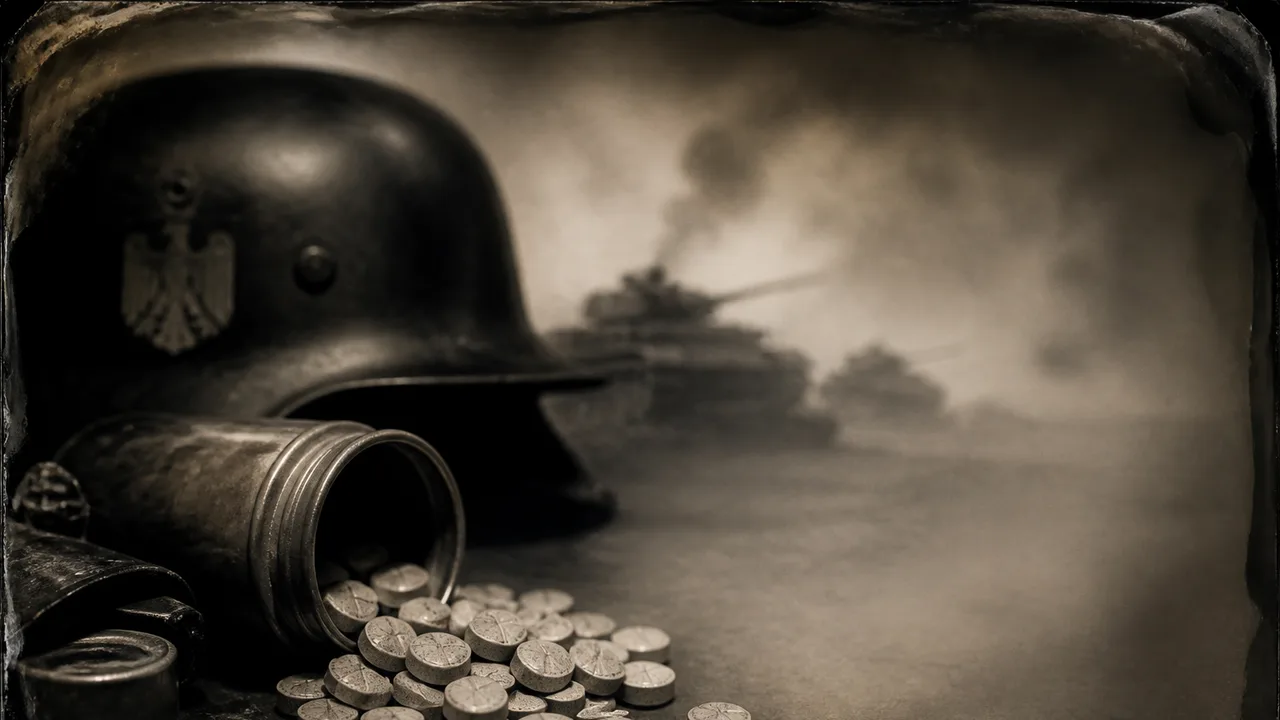
Photo: AI. Otieno Okello
There is a version of the Blitzkrieg story that gets told cleanly: superior tactics, audacious planning, a demoralized enemy caught flat-footed. Erich von Manstein's scythe-cut through the Ardennes. Erwin Rommel's panzer divisions sprinting ahead of their own supply lines. The Wehrmacht moving at a tempo that Allied commanders simply could not process fast enough to counter. That version is true, as far as it goes.
What it leaves out is the pill.
A new documentary from the Wonder channel, How a Secret "Miracle Pill" Created Hitler's Super Soldiers, works through declassified German military archives, CIA health files, and pharmaceutical company records to reconstruct the role of Pervitin, a methamphetamine manufactured by the Berlin firm Temmler Werke, in powering Nazi Germany's early campaigns. The scale, once you sit with it, is genuinely difficult to absorb. Temmler's own production files, once classified, show the company manufactured approximately 740 million doses of the drug during the war.
From Pharmacy Shelf to Battlefield
Pervitin was not invented for soldiers. Temmler patented the compound in 1937 after a decade of research and marketed it to the German public as a mood elevator. It worked. The pills went on sale in 1938, required no prescription, and cost about what aspirin did. A Berlin confectioner began selling chocolates infused with 18 milligrams of Pervitin extract, roughly equivalent to six standard pills. The documentary notes that housewives shared them at tea parties.
The military's interest came through Otto Friedrich Ranke, head of the physiology institute at the Military Academy of Medicine. Ranke recognized what he had: a stimulant that appeared to eliminate fatigue, sharpen concentration, and sustain performance across extended sleepless periods. He tested it against caffeine and other compounds by keeping young soldiers awake for 36-hour stretches while giving them mathematics problems to solve. The Pervitin group consistently outperformed the others.
When Germany invaded Poland on September 1st, 1939, Ranke wanted small-group field trials. What he got instead was an entire theater of war. High command had already decided to distribute Pervitin not to select units but to whole battalions. Luftwaffe pilots, panzer crews, infantry supply columns, all of them. As DW reports, the Nazis deployed chemically enhanced soldiers against Poland in 1939, and the following year distributed roughly 35 million tablets for the invasion of France alone.
The Arithmetic of Sleeplessness
What the drug bought, in purely operational terms, was time. An army that does not need to sleep can keep moving when a conventional force must halt. The 56th Panzer Corps reportedly covered 240 kilometers in 48 hours during the opening of Operation Barbarossa, the invasion of the Soviet Union. Drivers who would otherwise have been rotating off duty, pilots who needed to fly back-to-back sorties, tank commanders maintaining pressure through the night: Pervitin compressed the normal biological ceiling on sustained operations.
The documentary's account of Rommel's behavior during the French campaign is worth pausing on. On May 16 and 17, 1940, Rommel's diary shows he did not sleep for a single hour. His superiors ordered him to slow down; he cut his radio connection and kept advancing, waving white flags in the darkness to confuse French defenders. High command in Berlin, receiving no transmissions, feared he had been destroyed. The documentary's analysts note that his logs describe listening to "the clickety-clack of caterpillar tracks as though in a dream," and suggest he was almost certainly experiencing the auditory hallucinations characteristic of high-dose methamphetamine use. The desert fox, on that particular night, may have been more pharmaceutical than tactical phenomenon.
"You can't say that Pervitin was the reason for Germany's victory," one analyst in the documentary observes. "However, it was probably a contributing factor." That hedged assessment is honest. Strategy, surprise, and the particular vulnerability of French defensive doctrine all mattered enormously. But as Der Spiegel has reported, the drugs were explicitly "part of a plan to help pilots, sailors and infantry troops become capable of superhuman performance." The intent was pharmacological enhancement of combat capability. Whether it worked as designed is a different question from whether it was designed that way.
The Costs the Wehrmacht Hid
The field reports coming back to Ranke after Poland were, in his own word, euphoric. What he was not prepared for was what came next. Men were requesting Pervitin from their families when army stocks ran low. Letters survive from German soldiers in Poland asking parents to send tubes of the drug. The documentary describes a soldier named Heinrich Bull writing home specifically to request a resupply. The army had not issued an addictive substance; it had issued methamphetamine, and the distinction between those two things turned out to matter enormously.
The Reich's chief medical officer, Leonardo Conti, saw the problem forming before most of his colleagues would admit it. He pushed for prescription requirements and warned that Pervitin was dangerous for many users. He was not taken seriously. Doctors handed out prescriptions freely, and the Wehrmacht's response to mounting evidence of addiction and side effects was to order production increases, not reductions.
The side effects documented by military physicians read like a clinical profile of chronic methamphetamine abuse. Loss of appetite and thirst, suppression of survival instincts, psychotic episodes, skin rashes, tooth decay, violent behavioral swings. Luftwaffe pilots reported hallucinations. The documentary describes an "aviator syndrome" of waxen complexions, depression, and aggression. The deaths caused by Pervitin were recorded as cardiac failures.
"Drugs were given to soldiers without telling them what they were, what they were composed of, or what side effects there could be," the documentary states. That is not a pharmaceutical program. It is a command decision to treat soldiers as a consumable input.
The D-IX Project and Sachsenhausen
By 1944, with the war turning irreversibly against Germany, the Wehrmacht's pharmacological ambitions had not contracted. They had escalated. The Kriegsmarine's midget submarine program, the Seehund, required crews to remain functional for four days and four nights continuously. Pervitin's effects lasted roughly two days. That gap generated the Dosis Project, a classified series of ten drug formulations built around the Pervitin molecule. The ninth variant, D-IX, combined Pervitin with cocaine and two other compounds.
Testing moved from sailors to concentration camp prisoners at Sachsenhausen, located 30 kilometers north of Berlin. Prisoners already assigned to the camp's "walking commando," a punishment detail that forced inmates to march 40 kilometers daily on varied terrain while carrying 20-kilogram backpacks to test military boot durability, were given D-IX pills or chewing gum. A Dr. Richert recorded their height, weight, age, and dosage, then tracked how far they walked and for how long. Inmates on D-IX covered more than 80 hours of continuous walking before collapse.
The documentary describes Richert's files as purely empirical: no names, only measurements. The prisoners were variables, not people. That framing is precise and important. This was not incidental cruelty in the context of a war crime. It was systematic medical research conducted on human beings who had been stripped of the legal standing to refuse.
What the Americans Concluded
In August 1941, researchers at Wright-Patterson Air Force Base in Ohio ran their own classified evaluation of Pervitin, comparing it against caffeine and Benzedrine. The results confirmed German findings: Pervitin was superior to all competing stimulants on pure performance metrics. The U.S. Air Force declined to adopt it anyway. The side effects, their analysts concluded, were incompatible with sustained military utility. The Wehrmacht had reached the opposite conclusion, and the documentary presents this divergence without editorializing. The reader can draw their own inference about what each decision reflects.
After 1945
Germany's defeat did not retire the drug. Conti's wartime prohibition was lifted after the war, and Pervitin returned to German pharmacies as a prescription medication, remaining legally available for another 25 years before final classification as a narcotic. The military's use of it stayed classified for decades. Researchers, the documentary notes, are still working through the archival record; reliable production figures only became available when Temmler's once-secret files were opened.
The molecule itself never disappeared. It circulates today as crystal methamphetamine, manufactured underground in the Czech Republic among other places. Its price per gram has increased 250-fold since 1939. The users, the documentary observes, have no idea about the history embedded in the compound they're using.
That last detail is not a rhetorical flourish. It is a legitimate historical observation about how completely a thing can be normalized across generations. A drug developed in Berlin, mass-produced for the Wehrmacht, tested on concentration camp prisoners, and blamed for freezing German soldiers to death in the Russian snow is now a street commodity in American cities and European capitals, stripped of every association it ever had.
The open question is not whether Pervitin shaped the early Blitzkrieg. The evidence on that is reasonably strong, even if the precise magnitude of its contribution remains, as the documentary acknowledges, a matter of ongoing scholarly debate. The harder question is what it means that a regime simultaneously promoted racial purity as an ideology and chemically modified its soldiers to compensate for human biological limits, keeping the contradiction secret even from the men whose bodies bore the cost.
More Like This

Unraveling Rome's Dodecahedron Mystery
Exploring the enigmatic Roman dodecahedron, its theories, and historical significance in modern archaeology.
Unveiling the Intricate Engineering of Runways
Explore the hidden complexities of runway design and how these choices impact safety and military operations.

The Real Story Behind the 1925 Nome Serum Run
The 1925 Nome serum run wasn't just Balto—it was 9,500 years of sled dog evolution, desperate medical crisis, and mushers who knew the odds.

Audie Murphy: Soldier, Icon, and Haunted Man
Audie Murphy was America's most decorated WWII soldier. His battlefield heroism and Hollywood fame masked a man deeply scarred by combat and survivor's guilt.

Prehistoric Drugs That Shaped Human Civilization
From 9,000-year-old fermented rice wine to 5,700-year-old peyote buttons, archaeology is rewriting the story of why humans built civilization.

Ancient Pathogens That Still Live in Human Bodies
From Toxoplasma in the brain to herpes in the nerves, prehistoric pathogens still live in us. Here's what modern medicine can—and can't—do about them.

The Crusades: Two Centuries of Holy War Explained
From Pope Urban II's 1095 call to arms to the fall of Acre in 1291, the Crusades reshaped Christianity, Islam, and the medieval world permanently.
Gettysburg's Command Failures and What They Still Cost Us
Dr. Roy Casagranda's Gettysburg lecture reveals how four command archetypes from 1863 shaped the battle's outcome—and what they still tell us about military leadership today.