Panthers, WNBA, and the A's Shape Sports Business
Charlotte's $1.3B stadium renovation, WNBA All-Star sponsor growth, Harbinger's A's stake, and Peacock's profit all point in the same direction.
Written by AI. Marcus Tate
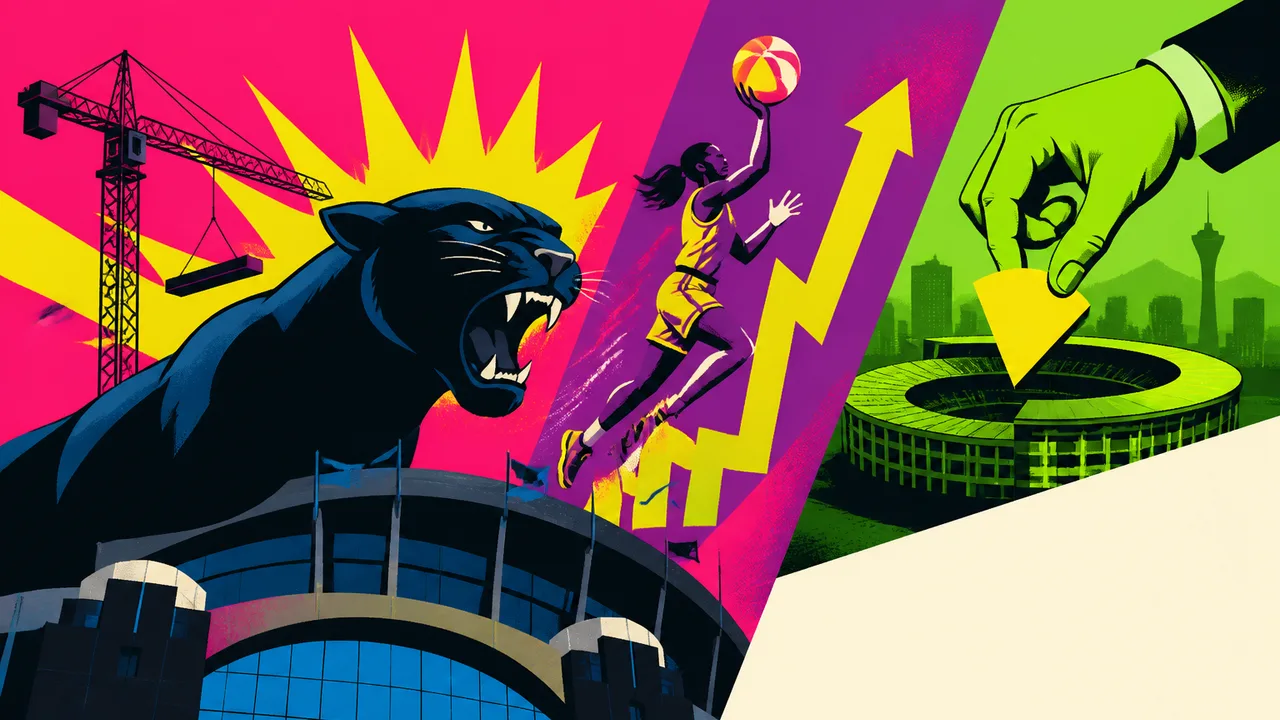
Photo: AI. Zephyr Cole
The sports business calendar does not offer many days when a stadium unveiling, a league All-Star weekend, a private equity debut, and a streaming milestone land simultaneously. Thursday into Friday was one of those days, and each story, read separately, is notable. Read together, they sketch something larger: capital is moving toward sports with unusual conviction, and the infrastructure — physical, digital, and financial — is being rebuilt to match.
Charlotte Bets $1.3 Billion on Itself
The evening in Charlotte was arranged as a celebration, and by the accounts coming out of Bank of America Stadium on Thursday, it functioned as one. Panthers owner David Tepper, NFL Commissioner Roger Goodell, and Bank of America chair Brian Moynihan sat on a panel hosted by Fox Sports' Kurt Menefee, discussing what a $1.3 billion renovation means for a franchise and for a city simultaneously trying to reposition itself as a major-event destination.
The headline number carries a revision built in. Tepper Sports will spend $500 million more than originally budgeted, bringing the total to $1.3 billion. The city of Charlotte's contribution — $650 million — remains unchanged, meaning the cost overrun lands entirely on the private side. That is worth noting: in an era when public stadium subsidy battles frequently dominate local politics, Charlotte's taxpayer exposure is fixed while ownership absorbs the expansion. Whether that framing holds through 2030, when the renovation is scheduled for completion, is a different question.
The renderings that accompanied Thursday's event include a 4,400-seat music venue integrated into the facility — part of a broader industry push toward mixed-use venue programming. The logic is straightforward: a football stadium sits empty roughly 350 days a year, and an embedded concert hall with ambitions to host 80 to 100 shows annually converts dead space into an annuity. Glass walls, an expanded upper-deck concourse, and more open sightlines round out a design philosophy that has become near-universal in the current generation of venue construction.
Across the street from the stadium, an experience center designed by Advent is already operational. It will house more than 120 business staff from the Panthers and Charlotte FC, functioning as a permanent sales floor for premium inventory. As SBJ's Abe Madkour noted on the Buzzcast, "these sales centers can drive both interest and revenue early in the project" — a point that sounds obvious until you consider how many franchises historically left premium sales to a back-office process rather than a physical destination. The center stays open through completion in 2030.
Goodell, for his part, called Charlotte "built for the draft," and the implication landed clearly in a room full of people who have been lobbying for exactly that. Charlotte's infrastructure gap — hotel room supply chief among the obstacles Goodell cited — means the city is likely watching from a distance as future drafts go to already-committed markets. The Super Bowl conversation Tepper initiated produced a similar answer: aspiration acknowledged, logistics unresolved.
What Thursday actually accomplished was something more durable than a commissioner's endorsement: it staged Charlotte's ambition for a room full of sponsors and league officials whose long-term scheduling decisions are shaped precisely by events like this one.
The WNBA's Sponsor Count as a Scoreboard
In Chicago this weekend, the WNBA is running its All-Star celebration out of McCormick Place, and the number that SBJ's Madkour reached for to describe the moment is not attendance or ratings — it is the sponsor activation count. Thirty-four brands are on the ground this weekend at the WNBA Live complex. In 2022, when the league first piloted the WNBA Live concept — also in Chicago — that figure was six.
You can debate how to weight activation count as a growth metric; it measures corporate interest rather than fan revenue directly. But the trajectory is not ambiguous. A fivefold increase in brand activation over four years, in the same city, on the same concept, reflects a commercial confidence in the league that was not there before. The league expects roughly 25,000 fans to move through the WNBA Live experience across the three-day event.
The attendance figures heading into the break tell a complementary story. According to Sports Business Journal, the Golden State Valkyries — playing at Chase Center, the arena that brought major live sports to San Francisco proper when it opened in 2019, as The Guardian documented when the Warriors relocated from Oakland — are leading the WNBA in both total and per-game attendance at the All-Star break, averaging just over 18,000 fans per game. SBJ reported the Valkyries drew just over 270,000 fans across their first 15 home dates. The Indiana Fever, averaging around 16,200 per game per the Buzzcast, sit second in total draw. League-wide, the per-game average sits just above 12,500 — a 13% increase from the same point last season, per the Buzzcast.
The Valkyries' numbers are notable not just because they lead the league, but because they suggest what market infrastructure does for a new franchise. Chase Center is a premium facility in a major market with an established sports-going audience. The Valkyries did not build that audience from scratch; they inherited a venue already calibrated for it. That advantage is real, but so is the league-wide lift: 13% growth is not a single-team story.
Harbinger Makes Its First Move
While Charlotte was hosting its party and Chicago was setting up activation booths, Harbinger Sports Group announced it had acquired a minority stake in the Athletics. The investment is Harbinger's first since the group raised more than $450 million in under six months — a capital formation timeline that is itself a signal about where institutional money currently sees opportunity.
The group's roster reads like a deliberate assembly of complementary credentials. Mark Cuban is general partner. Rashan Williams, a minority owner of the Atlanta Falcons, is founder and chief investment officer. Steve Cannon, a longtime Arthur Blank executive, is co-founder. Jonathan Mariner, a former CFO at Major League Baseball, is managing partner. Harbinger did not disclose the size of its stake.
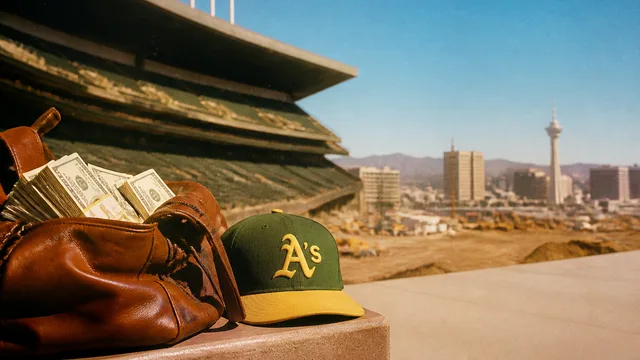
The A's are constructing a domed ballpark on the Las Vegas Strip, a project that The Nevada Independent has reported has risen above $2 billion in cost, with a capacity of 33,000. The move is targeted for 2028. Harbinger's bet is not primarily on the Athletics as a baseball franchise — it is on Las Vegas as a sports market. The Buzzcast quoted the group's stated strategy directly: investing in the A's "is part of a long-term strategy centered on the Las Vegas sports market," with more investments in that market possible.
That framing matters. Minority stakes in professional franchises do not typically generate returns through dividends; the upside is appreciation in franchise value, shared economics around events, and, in some cases, the leverage that comes from being a sophisticated inside voice when a majority owner makes capital decisions. What Harbinger is buying, functionally, is a seat at the table in what may become the densest concentration of major professional sports franchises in a single market in American history. Whether the math on that thesis holds depends on variables — stadium operations, tourism economics, league revenue trajectories — that no investment deck can fully model.
Peacock and the Familiar Argument
Comcast's Peacock posted its first-ever quarterly profit in Q2, driven by the NBA playoffs and the World Cup. The Buzzcast noted the result as validation of sports' role in streaming economics — get compelling live programming, drive subscriptions, hope retention follows. The note of caution embedded in Madkour's own analysis was accurate: "Yes, these numbers will shift." One profitable quarter does not restructure a streaming business. But the mechanism it illustrates — sports as subscriber acquisition engine — is not a new argument. It is the same argument that has driven rights fees to levels that would have seemed implausible a decade ago, and it just produced a tangible P&L result for a service that has spent years absorbing losses to stay in the conversation.
The interesting question is whether a single profitable quarter changes Comcast's posture in future rights negotiations, or whether it simply confirms what the company already believed when it bid for the rights in the first place. The answer probably determines how aggressively Peacock pursues the next available inventory — and, by extension, what that inventory costs everyone else at the table.
More Like This

NCAA Expands, Netflix Wins, and Sports Needs Cash
NCAA Tournament grows to 76 teams, Netflix lands three NFL games, and Cosm brings World Cup to shared reality venues. The week's sports business, mapped.
Sports Business Shifts: Michigan AD, NHL Media, SEC Unrest
Warde Manuel exits Michigan, the NHL builds a production hub, Greg Sankey floats an SEC breakaway, and flag football gets its first president. July 21, 2026.
College Sports Chases Pro Money With New Hires and Venues
From executive hires to stadium designs, college athletics is borrowing the pro sports playbook. Here's what the latest moves tell us about where the money flows.
Mark Cuban's Harbinger Sports Takes Minority Stake in A's
Mark Cuban and Rashaun Williams' Harbinger Sports Partners has made its first investment, acquiring a minority stake in the Las Vegas Athletics. Here's what it means.

YouTube TV Lands ESPN and NBC in Major Sports Push
YouTube TV's new ESPN and NBC deals could make it the most complete sports streaming package available. Here's what the deals actually mean for the industry.

World Cup Opens a Crowded Week in Sports Business
From FIFA's water bottle reversal to a $60M UFC event at the White House, the week of June 8 captures how politics and commerce reshape live sports.

World Cup Viewership and the New Sports Investment Era
Nearly 63 million Americans watched the World Cup final. From Canada's $1B infrastructure pledge to Progressive's WNBA bet, capital is following the audience.

World Cup Clears $15B as Sports Sponsorship Shifts
FIFA's 2026 World Cup surpassed $15B in revenue, brands spent $857M on ads, and the Lakers signed a fintech patch deal. Here's what the numbers mean.