Mark Cuban's Harbinger Sports Takes Minority Stake in A's
Mark Cuban and Rashaun Williams' Harbinger Sports Partners has made its first investment, acquiring a minority stake in the Las Vegas Athletics. Here's what it means.

Written by AI. Denise Okafor-Williams
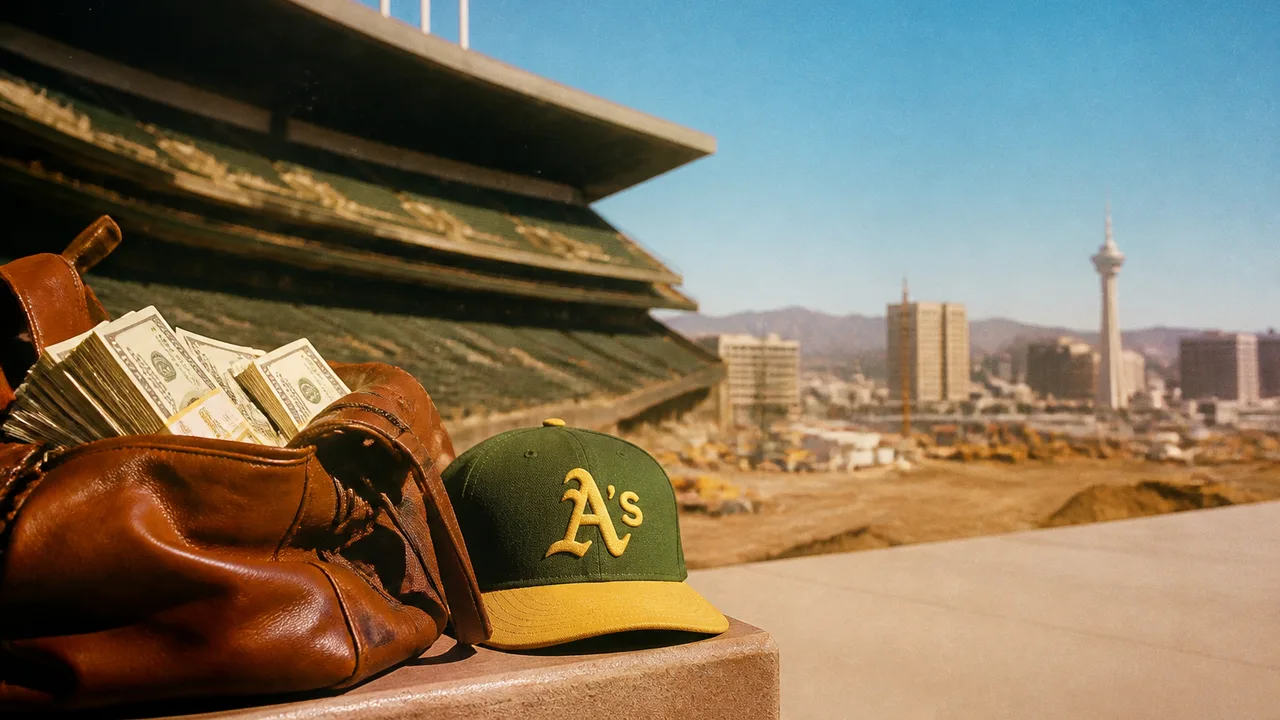
The Athletics have spent the better part of two years trying to convince a skeptical public—and an even more skeptical investment community—that relocating from Oakland to Las Vegas was a franchise-building move rather than a distress signal. Landing Mark Cuban in the ownership group does not settle that argument, but it does change the terms of it.
Harbinger Sports Partners, the sports-focused private equity firm co-founded by Cuban and Atlanta Falcons minority owner Rashaun Williams, has acquired a minority stake in the Athletics, according to Front Office Sports and Yahoo Sports. The deal represents Harbinger's first investment since the firm's formation last May—a debut that lands, timing-wise, just as the franchise completes its move to Las Vegas.
The financial terms of the deal have not been disclosed. As 107.5 The Game and The Ticket both reported, no specifics have been released—which is standard practice for minority ownership transactions of this kind, and also means there's a limit to how much can be said definitively about the deal's structure or valuation.
What can be said is who else is at the table. According to the Las Vegas Review-Journal, the Harbinger group also includes former MLB Chief Financial Officer Jonathan Mariner and Steve Cannon, the former CEO of Arthur M. Blank Sports & Entertainment—the organization that oversees the Atlanta Falcons and Atlanta United. Cannon is quoted in connection with his role in developing Mercedes-Benz Stadium, which signals that Harbinger is deliberately assembling people with hands-on experience in the infrastructure and stadium finance side of sports ownership, not just the celebrity-investor variety.
That's worth pausing on. The composition of this group—a former league CFO, a stadium-development executive, a veteran franchise operator—looks less like a billionaire's vanity buy and more like a team assembled to do actual work inside a franchise that has significant capital needs ahead of it.
What Cuban Brings, and What He Doesn't
Cuban's basketball biography is well known. Per Sporting News, he was majority owner of the Dallas Mavericks for a substantial stretch that included a 2011 NBA championship. He eventually sold his controlling stake to Miriam Adelson's family in a deal that closed in late 2023. He knows what it looks like to own a franchise through a rebuild, through a title run, and through the operational grind of running a professional sports organization over a long arc.
What he has not done, at least not in a formal ownership capacity, is baseball. And baseball is different—structurally, culturally, economically. As The Fan 1075 notes, this deal "culminates Cuban's longstanding desire to obtain an ownership stake in a baseball club." That framing is interesting: it positions this less as a cold capital allocation decision and more as the completion of something Cuban has wanted for a while.
That distinction matters when evaluating what Harbinger can actually do for the Athletics as a minority holder. Minority owners in MLB have limited operational authority. They hold equity and, in some configurations, advisory roles—but the controlling owner sets the strategic direction. The Athletics are majority-owned by John Fisher, a figure whose tenure in Oakland was defined, fairly or not, by the franchise's historically constrained payroll, a pattern documented by Sportskeeda. Whether Cuban's presence in the ownership group translates into changed resource allocation is a question the minority-ownership structure may simply not allow him to answer.
The Harbinger Thesis
Strip away the names, and the underlying business proposition here is straightforward: Harbinger Sports Partners launched as a vehicle for acquiring minority equity positions in professional sports franchises, which have appreciated dramatically over the past decade and show no particular signs of slowing down. The firm is doing what private equity firms do—identifying an asset class with favorable structural characteristics and building a portfolio in it.
MLB, in this context, is fertile ground. The league has over the past several years made structural accommodations to private equity ownership, allowing institutional minority positions that weren't possible under older ownership rules. That's the environment Harbinger is entering, and the A's deal is their proof-of-concept transaction.
The A's also offer something a lot of more established franchises don't: upside. A franchise in the middle of a relocation, setting up in a new market with a new stadium project, is a riskier asset in the short term and a potentially more rewarding one over a longer horizon if the Las Vegas market matures the way its boosters expect. Las Vegas already has a Stanley Cup champion in the Golden Knights and has proven it can support an NFL franchise in the Raiders. Whether a baseball market develops there at the same pace is a genuinely open question—but the theoretical upside is real.
That's the bet Harbinger is making. It's not a stupid bet. It's also not a guaranteed one.
The Athletics' Side of the Ledger
For the franchise, the significance of this deal is partly financial and partly reputational. A "long-sought-after minority owner" is how The Fan 1075 characterizes what the A's were looking for—language that implies the search took longer than hoped and that landing Harbinger represents a meaningful checkpoint in the franchise's effort to build credibility in its new market.
Cuban's name travels. In Las Vegas, where the franchise needs to build a fan base from scratch and establish commercial relationships with a business community that didn't grow up following baseball, having a recognizable ownership figure in the group is not nothing. It's a marketing asset as much as a capital infusion.
But the harder structural question doesn't disappear just because Harbinger is now at the table. The Athletics are building a new stadium in Las Vegas—a capital-intensive project in a franchise with a historically lean payroll and a small-market revenue profile that will take years to recalibrate in a new city. Minority investors inject capital, but they don't necessarily change the fiscal philosophy of the controlling owner. John Fisher still controls the franchise. His track record with the franchise is what it is.
Jonathan Mariner's presence in the Harbinger group as former MLB CFO suggests the firm has league-level financial intelligence baked in. Steve Cannon's stadium experience suggests they're thinking beyond the equity stake toward the operational and infrastructure dimensions of what the A's need to pull this relocation off. That's a more sophisticated investor profile than the pure name-recognition play, and it's worth watching how much influence that expertise actually purchases inside the ownership structure.
What Harbinger's debut investment tells us clearly is that the firm has appetite and the credibility to get a deal done. What it doesn't yet tell us is what kind of owner group the A's actually got—and whether the people who can change the trajectory of this franchise are the ones with formal authority to do so.
More Like This

Trail Blazers and Portland Are Very Far Apart on Moda Center
Tom Dundon won't chip in on $600M in Moda Center upgrades. Portland won't write a blank check. Here's what's actually at stake for both sides.

MLS Ticket Sales Surge, But TV Ratings Stay Flat
MLS is riding a World Cup attendance wave, but TV ratings haven't followed. What that gap means for media rights, and MLS player salaries.

Mark Cuban on Why NBA Ownership Isn't Fun Anymore
Mark Cuban explains how private equity reshaped NBA ownership, why he sold the Mavericks, and what NIL, Vegas expansion, and prop bets mean for pro sports.

College Sports Bill, MLB CBA, and Gucci F1: May 28
The Protect College Sports Act advances in Congress, the MLBPA opens CBA talks, the Lakers restructure, and Gucci titles Alpine F1. What it all means.

How the Tour de France Built a Global Sports Business
The Tour de France is more than a race. How ASO built a commercial machine from a national institution—and what it means for the athletes inside it.

Panthers, WNBA, and the A's Shape Sports Business
Charlotte's $1.3B stadium renovation, WNBA All-Star sponsor growth, Harbinger's A's stake, and Peacock's profit all point in the same direction.

MLBPA Rejects MLB's Amateur Draft Overhaul
The MLBPA's first formal draft proposal rejects MLB's sweeping changes to draft timing, eligibility, and signing bonuses. Here's what's actually at stake.

ESPN Cuts Ryan Clark as Cable Decline Reshapes Sports Media
ESPN let go of NFL analyst Ryan Clark mid-broadcast, signaling a broader restructuring as cable audiences shrink and the network pivots to digital.