US Soccer Builds a Commercial Engine for 2026 and Beyond
US Soccer executives outline a $1.2B commercial foundation and long-term growth strategy as the 2026 FIFA World Cup approaches North America.
Written by AI. Marcus Tate
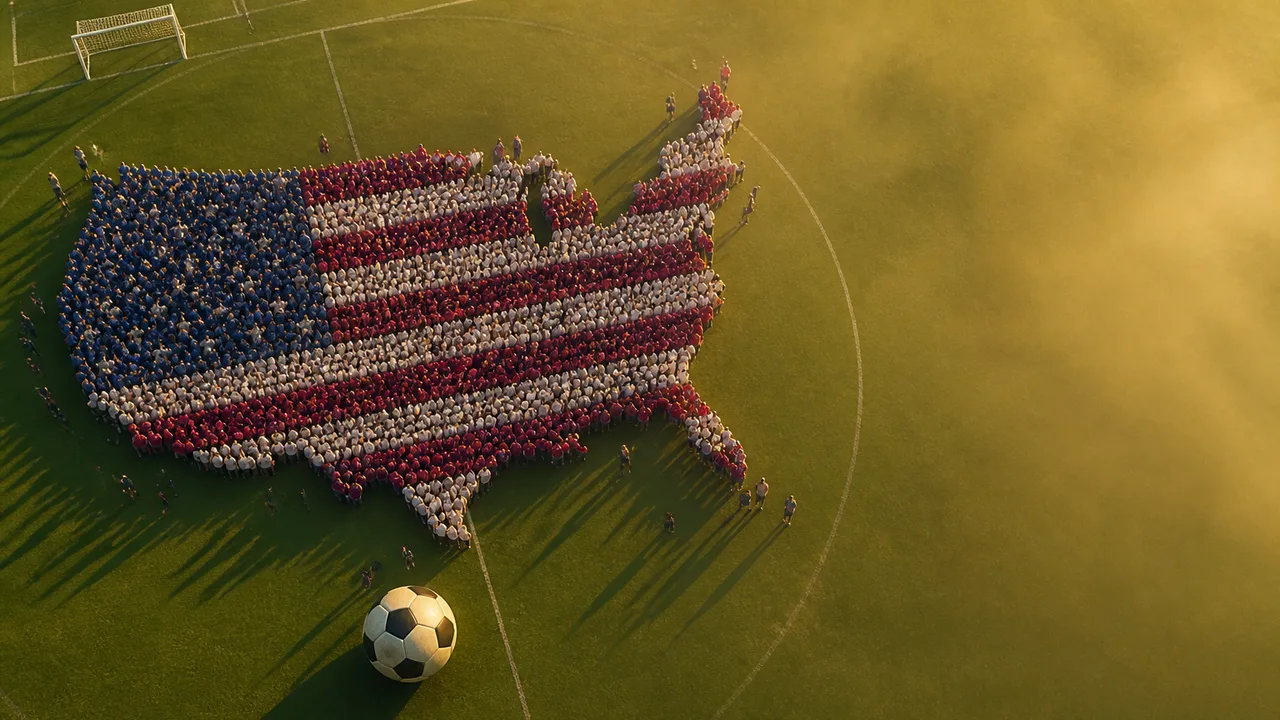
Photo: AI. Rio Sanchez
Outside Bank of America Stadium in Charlotte, a few weeks before the 2026 FIFA World Cup kicks off across North America, thousands of fans in red, white, and blue filled the plaza for a USMNT warmup match. Nearly all 27 of US Soccer's corporate sponsors had activations running in the surrounding footprint. Sports Business Journal's Alex Silverman, reporting from the scene, called it "a very festive scene" and "just a taste of what we're going to see when the World Cup descends on North America."
That description — a taste of something larger — is essentially the organizing principle of US Soccer's current commercial posture. The federation isn't treating 2026 as a revenue event. It's treating it as a proof-of-concept moment for a business it has been methodically reconstructing since 2021.
The Architecture of the Commercial Rebuild
When US Soccer's Chief Commercial Officer David Wright describes the sponsorship program, he dates the structural shift to a deliberate strategic review four years ago. "In 2021, we went through a thorough process and thought really critically around what's best for the sport holistically and what makes sense for US Soccer," Wright told SBJ. The result, as he frames it: 26 blue-chip, industry-leading partners "waking up thinking about growing the game at all levels."
That framing — partners invested in the sport's growth, not just buying logo placement — is a meaningful distinction if it holds. Traditional sports sponsorship operates on impressions and brand adjacency. What Wright is describing sounds closer to a stakeholder model, where sponsors have enough skin in the game to behave like partial owners of the sport's commercial future. The $1.2 billion in contracted revenue that Wright cites as the foundation's headline figure suggests the federation has sold that vision effectively. Whether the partners actually behave that way over a multi-year arc is a different question, and one the organization will have a harder time controlling once the tournament spotlight dims.
The number itself deserves some scrutiny. Contracted revenue is a forward commitment, not cash in hand, and "contractor revenue" as a category can encompass deals of varying term lengths and guarantee structures. Still, $1.2 billion represents a level of commercial visibility that US Soccer hasn't operated with before, and Wright is candid about what it enables: "There's a level of visibility that we've not had before, which allows us to really think critically about the business."
That kind of optionality — being able to think critically rather than reactively — is genuinely significant for a federation that has historically operated on narrower margins and with a more fragmented commercial identity.
The Philanthropy Thread
Alongside the commercial story, Chief Advancement Officer Leah Burton is making a parallel argument about the federation's philanthropic moment. The alignment of a major international tournament with a maturing donor development program is, by Burton's account, producing real leverage. "Being able to align a donor with something that they truly care about and having US Soccer be a place where they see that impact in action" — that's the pitch, as she describes it.
The deliverables Burton points to are concrete: a national training center, competitive coaching staff development, and grassroots accessibility programs. These aren't abstract mission statements. They're capital-intensive projects that require long-term donor commitment rather than one-cycle checkwriting, which suggests the advancement team is trying to build a philanthropic infrastructure that survives the World Cup cycle rather than depending on it.
Burton's framing is explicitly long-horizon: "This isn't just about one moment. We're really looking at the next five years and the generational moment for a sport in our country." The federation is using World Cup enthusiasm as a conversion mechanism — turning casual attention into durable donor relationships. Whether that conversion rate holds once the tournament ends and US Soccer returns to its default media profile is an open question, but the strategy at least reflects awareness that short-cycle fundraising produces short-cycle results.
What Comes After the Spotlight
The most interesting part of the SBJ conversation is the brief but candid look beyond 2026. When Wright is asked directly where the biggest growth opportunities lie — partnerships, media, consumer products — he doesn't commit to a single vector. Instead, he points to the foundation and then gestures toward media and content as the longer-term lever: "As content consumption continues to evolve, there's going to be significant opportunity as we think about 2031 and beyond."
That's a reference to the 2031 Women's World Cup, which the United States is co-hosting, and it signals that the federation is already thinking in multi-tournament cycles rather than isolated events. The media rights dimension is worth watching closely. US Soccer's current broadcast agreements — the federation holds deals with Turner Sports and HBO Max for the men's national team, while women's matches have been distributed across TNT, HBO Max, and Telemundo — will face renegotiation in a media landscape that looks materially different today than when those deals were signed. Streaming fragmentation, the rise of direct-to-consumer sports distribution, and the continued growth of soccer's American audience all create real upside in the next rights cycle, particularly for a federation that will host two World Cups within a five-year window.
The consumer products category is less developed in the conversation but shouldn't be dismissed. US Soccer's licensed merchandise business has historically underperformed relative to the sport's cultural footprint in the country. Tournament cycles have briefly spiked jersey sales and licensed goods, but the federation hasn't built the kind of year-round retail identity that would capture sustained consumer spending. That's partly a function of team performance — it's difficult to sell merchandise for a program that misses World Cups, as the USMNT memorably did in 2018 — but it's also an infrastructure gap that a well-capitalized commercial team could close.
The Structural Question the Executives Don't Address
What's notably absent from these conversations is any discussion of the labor side of the commercial equation. US Soccer's 2022 settlement with the USWNT, which resolved the long-running equal pay dispute and established equal pay across both national teams, was a landmark moment that reshaped the federation's public identity. But it also established new financial commitments that run alongside the commercial growth story. How the revenue gains flow through to player compensation — particularly as the contracted revenue base expands — remains an ongoing structural question within the federation's economics.
Similarly, the grassroots accessibility programs that Burton highlights are a genuine need: youth soccer in the United States remains heavily concentrated among families who can afford club costs that routinely run into five figures annually. The funding question for those programs — how much comes from philanthropy versus federation operating revenue versus sponsor activation budgets — shapes how durable those accessibility commitments actually are.
None of this undercuts the commercial progress US Soccer's leadership is describing. A $1.2 billion contracted revenue base, 26 active corporate partners, and an incoming World Cup hosting role represent a genuinely stronger position than the federation occupied a decade ago. The question Wright and Burton are implicitly asking their stakeholders to bet on is whether this moment is a threshold — a permanent step up in the sport's American commercial infrastructure — or a particularly bright point in a cycle that will eventually cool.
The 2031 Women's World Cup gives them another scheduled peak. What they build in the valley between those peaks is where the real test lives.
More Like This

Sports Business Scorecard: Arenas, Concessions, and the NHL's New Map
Mavericks pick Valley View for a new arena, Bears remain in stadium limbo, and the Commanders bet on cheap concessions to deepen season-ticket loyalty.
Ted Turner, PWHL Detroit, and a Turbulent Sports Media Day
Ted Turner's death, PWHL's Detroit expansion, FanDuel's CEO ouster, and ESPN's NFL rights silence made May 7 a defining day in sports business.

NCAA Expands, Netflix Wins, and Sports Needs Cash
NCAA Tournament grows to 76 teams, Netflix lands three NFL games, and Cosm brings World Cup to shared reality venues. The week's sports business, mapped.

How True Sea Moss Scaled From $20M to $140M
How True Sea Moss's CMO Luka Kvaratskhelia used Meta discipline, cohort data, and category education to build a $140M bootstrapped DTC brand.
World Cup 2026 Economics: Who Pays, Who Profits
FIFA will make billions from World Cup 2026. Host cities will foot the bill. Dynamic pricing and immigration fears are leaving ordinary fans—and Main Street—behind.

How APL Turned an NBA Ban Into a Brand Identity
APL's NJ Falk breaks down the six storytelling threads behind one of e-commerce's most unlikely brand-building moves—starting with an NBA ban.
Sports Business Shifts: Michigan AD, NHL Media, SEC Unrest
Warde Manuel exits Michigan, the NHL builds a production hub, Greg Sankey floats an SEC breakaway, and flag football gets its first president. July 21, 2026.

World Cup Clears $15B as Sports Sponsorship Shifts
FIFA's 2026 World Cup surpassed $15B in revenue, brands spent $857M on ads, and the Lakers signed a fintech patch deal. Here's what the numbers mean.