Ontario Wildfire Smoke Chokes Cities Across North America
Roughly 100 uncontrolled Ontario wildfires are sending smoke 1,000 miles into the U.S. Midwest and Northeast, ranking Toronto worst air quality globally.

Written by AI. Olivia Meng
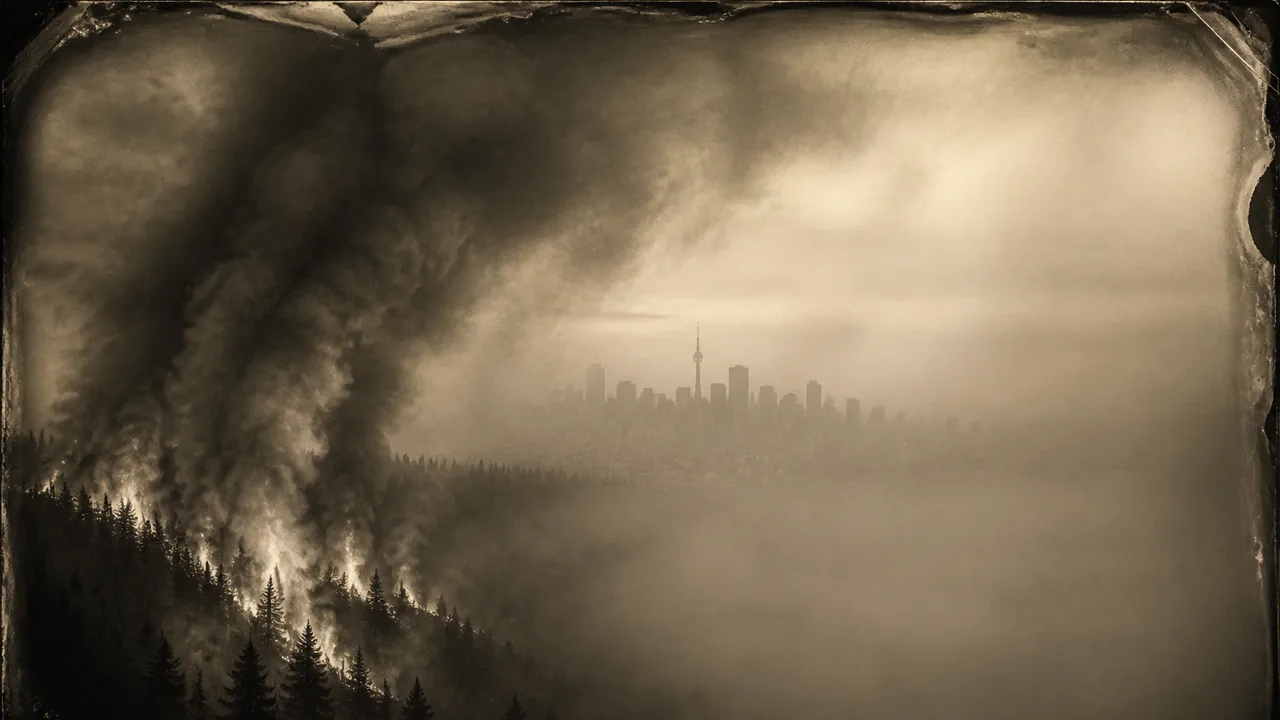
The skies over Toronto turned the color of a bruise this week. Not a dramatic, cinematic orange — though that came too — but something more unsettling: a flat, yellowish haze that swallowed the skyline and left the city smelling like a campfire no one had lit. It is not a metaphor. It is the actual air.
Al Jazeera reports that Toronto's air quality ranked worst among all major cities in the world this week, as smoke from wildfires in northwestern Ontario blanketed the skies and spread into the northeastern United States, triggering multiple health warnings and evacuations. That ranking — worst on Earth — deserves a moment of stillness before we move on to the meteorology.
A Thousand Miles of Smoke
The mechanics of this week's event are as clarifying as they are grim. CNN reports that a heat dome is positioned with its northern edge directly over northern Minnesota and southern Ontario — the precise geography where the fires are burning. That placement is not incidental. Heat domes suppress convective mixing, meaning smoke stays low and concentrated rather than dispersing into the upper atmosphere. Winds then funnel it southeast, directly into populated corridors.
Wired reports that roughly 100 fires are raging out of control in Ontario, sending smoke streaming some 1,000 miles to the south and east. A NOAA-21 satellite image acquired on the afternoon of July 14, captured by NASA's Earth Observatory, shows the plumes billowing southeast across southern Ontario, into Quebec, and across the U.S. border. Satellite data like this is now the primary tool agencies use to track what is, functionally, a transnational air quality emergency.
USA Today's tracker shows smoke that has already spread across the Great Lakes is forecast to continue moving toward New Jersey and the broader Northeast. The Weather Network reports that conditions in Kingston and Peterborough may improve by Thursday evening, with the Greater Toronto Area following — though that relief is temporary and geographically patchy.
Why Ontario's Forests Are Burning Like This
The what is well-documented. The why requires a longer look.
Canada's boreal and mixed forests have spent decades being reshaped by compounding stressors. Warmer, drier summers extend the fire season at both ends. Droughts reduce soil moisture and leave surface fuels desiccated. And mountain pine beetle infestations — enabled by winters no longer cold enough to keep larval populations in check — leave standing dead timber across vast stretches of forest. A 2025 review published in the Canadian Journal of Forest Research documented the social and ecological scale of mountain pine beetle (Dendroctonus ponderosae) outbreaks during and after active infestations on North American forests, detailing how this mortality wave converts living forest into highly combustible fuel.
The result is not simply more fire. It is fire that burns hotter, moves faster, and produces more smoke per hectare than historical baselines would predict. The 2023 Canadian fire season — which sent smoke across much of the U.S. eastern seaboard and briefly made New York City the city with the worst air quality on the planet — was, at the time, described as unprecedented. 2026 appears to be testing that word again.
What "Worst Air Quality in the World" Actually Means
Air quality indices are useful tools, but they compress a lot of physiological reality into a single number. Fine particulate matter — PM2.5, particles smaller than 2.5 micrometers — is the primary hazard in wildfire smoke. These particles penetrate deep into the lungs and, in sustained exposure, into the bloodstream. The populations most at risk are the ones who are always most at risk: people with asthma or chronic obstructive pulmonary disease, the elderly, children, pregnant women, and outdoor workers who do not have the option of staying inside.
What strikes me about the Toronto ranking is what it implies about exposure duration and population scale. Episodic bad air days — a traffic-clogged afternoon, a localized industrial incident — are absorbed differently by urban health systems than multi-day regional smoke events affecting millions of people simultaneously. Public health advisories are proliferating across the affected region, but the infrastructure question is harder: how many people in these cities have HEPA filtration at home? How many have the flexibility to work indoors, or access to cooling centers with filtered air?
These are not questions the air quality index answers. They are the questions the index raises.
The Transboundary Problem
There is a particular political awkwardness embedded in a story about Canadian fires degrading air quality in American cities. The smoke does not stop at the border — a fact that tends to surface, briefly, in international climate discussions before receding again into the background of diplomatic courtesy.
The U.S. and Canada share a long-standing Air Quality Agreement, signed in 1991, that was designed primarily around acid rain and industrial emissions. Whether that framework is equipped for the era of recurring, large-scale wildfire smoke events — smoke that originates from one country's forest management and climate context and lands in another country's lungs — is a question worth asking directly. The honest answer, based on the current diplomatic record, is unclear. The political will to make transboundary air quality a genuine bilateral priority has not yet materialized in a form commensurate with the scale of the problem.
What has materialized is satellite imagery, air quality apps, and a growing public literacy about AQI numbers that would have seemed niche five years ago. That is something. Whether it is enough depends on what governments do with the public's attention while they have it.
The Repetition Is the Point
The 2023 fires. The 2024 season. Now 2026. Each event arrives with its own satellite images, its own sickly orange skies, its own cycle of health advisories and atmospheric explanation. Each event is described, accurately, as severe. What is harder to communicate — and what the repetition itself is trying to tell us — is that the baseline is shifting.
This is not a bad fire year against a stable background of manageable years. The fire seasons that feel extraordinary are becoming the fire seasons that are ordinary. The hundred fires currently out of control in Ontario are not an aberration in the statistical sense; they are a data point in a trend that is moving in one direction.
The meteorology of this week's event will resolve. The heat dome will weaken. The smoke will disperse. Kingston and Peterborough will see blue sky again. But the forests of northwestern Ontario will still be there, still drying, still burning — and next summer, the conditions that produced this week will not be harder to achieve. They will be easier.
That is the story that the satellite imagery is quietly telling, frame by frame.
More Like This
Renewables Hit 30% of US Electricity in Early 2026
EIA data shows renewables reached 30% of US electricity in early 2026, up from 27.8% a year ago. Here's what that number actually means—and what it doesn't.

Rethinking Cosmic Acceleration: A Local Illusion?
Exploring the debate on whether the universe's acceleration is a local phenomenon, challenging the concept of dark energy.

How the Asteroid Impact Ended the Dinosaur Era
Explore the catastrophic asteroid impact that ended the dinosaurs, its immediate aftermath, and the long-term environmental changes.

Cold Spark Machines Are Hot — Just Not How You Think
Cold spark machines are marketed as safe firework alternatives, but the science tells a more complicated story. Here's what's actually happening inside those sparks.

Subcritical Reactors: Nuclear Power's Safety Fix?
A new generation of subcritical reactors promises to make nuclear meltdowns physically impossible. But can they deliver on cost, scale, and timeline?
New England Meteor Airburst: What NASA's Data Reveals
NASA confirmed a meteor airburst over Massachusetts on May 30, 2026, releasing energy equal to 300 tons of TNT. Here's what the science actually shows.

Cosmic Rays: What Particles From Deep Space Reveal
Cosmic rays bombard Earth constantly, yet their origins remain partly unknown. Here's what a century of detective work has—and hasn't—resolved.

Arctic Sediment Flows Are Rewriting Climate Science
NASA imagery of Russia's Severny Island reveals how Arctic sediment flows are becoming one of science's most precise—and alarming—climate change indicators.