NFL Suspends Two Officials, Testing Its Conduct Standards
The NFL suspended Jeff Seeman for two games and Adrian Hill for one after player interactions. The penalties raise questions about oversight, assignments and appeals.

Written by AI. Elena Vasquez-Moreno
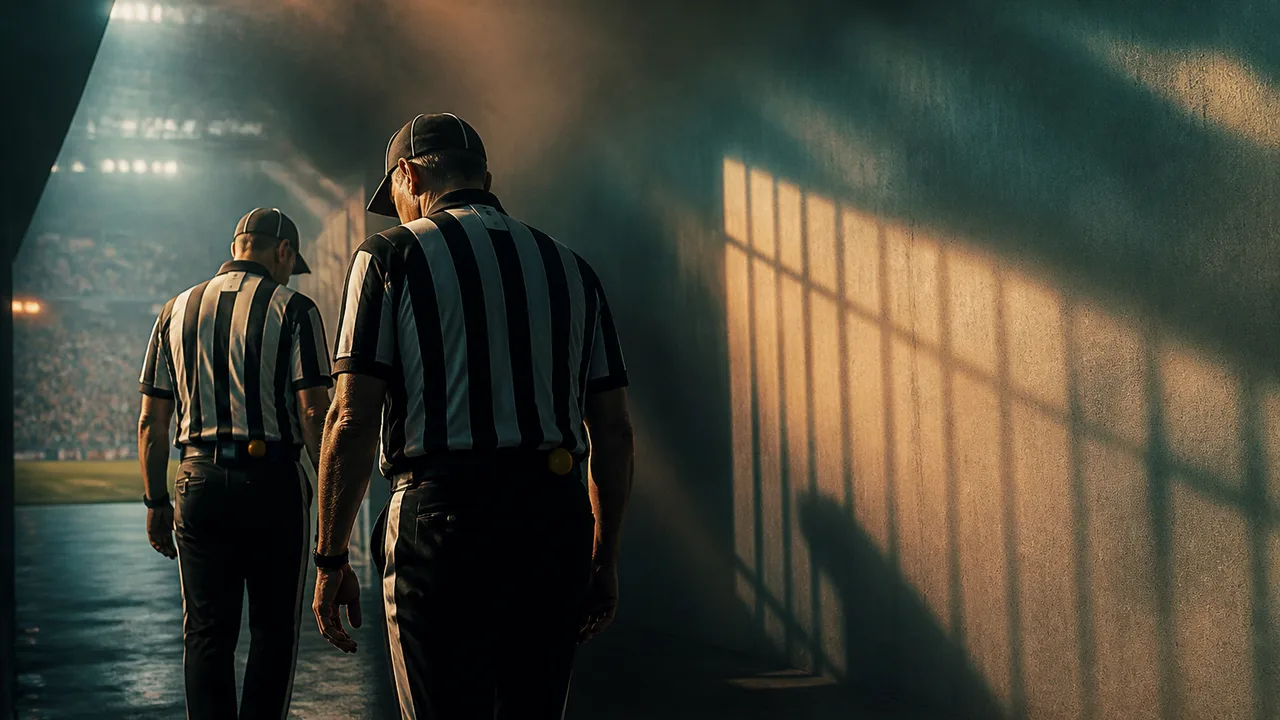
CBS cameras caught line judge Jeff Seeman appearing to direct profanity at Arizona Cardinals tight end Trey McBride during Sunday’s game against the New York Giants. By Monday, Seeman had lost two game assignments. Referee Adrian Hill, involved in a separate interaction with a player during the Miami-Minnesota game, had lost one.
The NFL suspended both officials for what it called “an instance of unprofessional conduct toward a player.” Seeman’s two-game term and Hill’s one-game term make this an unusually visible piece of officiating discipline. They also raise a question the league cannot answer with a penalty length alone: What conduct crosses the line for someone empowered to enforce it?
Two Incidents, Different Penalties
The officials’ positions are easy to blur and useful to keep straight. Seeman is a line judge, one member of a crew that makes calls and manages the game. Hill is a referee, the crew member fans usually recognize from penalty announcements. Calling both men referees obscures who did what, particularly when the incidents took place in different games.
Seeman’s interaction involved McBride in the Cardinals-Giants game. Hill’s interaction involved Minnesota Vikings linebacker Eric Wilson during the Dolphins-Vikings game, as reported by The Athletic. The league announced the suspensions Monday, October 5, after the Week 4 games. Its stated ground, “unprofessional conduct toward a player,” does not by itself explain the difference in penalty lengths or clarify whether either official can appeal.
That leaves two games and one game as the most legible parts of the decision. A longer suspension might reflect differences in conduct, context or the league’s assessment of each incident. Treating any one of those possibilities as the explanation would turn a missing account into an invented one.
There is a sound reason for the league to keep some personnel deliberations private. A public, word-by-word adjudication of a sideline exchange could invite disputes over tone and context that go well beyond the underlying conduct. Yet a broad label gives players, officials and fans little guidance about the boundary the NFL has drawn. The league has made the consequence visible while leaving its reasoning harder to evaluate.
The Person with the Flag Has a Different Obligation
NFL players and coaches work in an environment built to produce emotional confrontations. Officials work inside that same environment, but they carry an additional responsibility: they can penalize the people arguing with them. That authority changes the stakes of an exchange. A player who believes an official has become personally hostile may also wonder whether the next judgment call will be impartial, even if the official makes that call correctly.
This does not require an allegation that Seeman or Hill changed a ruling. Conduct standards can address the interaction itself. The league’s strongest case for discipline is that its officials need enough distance from players to exercise authority credibly through the rest of a game. A flag is supposed to settle a rules question, not extend an argument.
Officials also need room to manage tense, loud games. They communicate with players after penalties, during pileups and between plays, often while being challenged. A standard that punished every sharp exchange would be difficult to apply consistently. The NFL’s task is to distinguish a firm instruction from a personal confrontation, then apply that distinction whether a camera catches it or not.
Seeman’s case illustrates the visibility problem. The apparent exchange with McBride drew attention after the CBS broadcast captured it. Hill’s suspension shows the league acted on a second incident from the same week, rather than stopping with the interaction attracting attention. For an accountability system, that is a better starting point than waiting for a clip to circulate. It still leaves a practical test: Can players and officials recognize the same boundary before an incident becomes public?
Accountability Has a Schedule
A one-game or two-game suspension is concrete in a league organized around weekly assignments. Someone else must work the affected games, and the league must decide when the suspended official returns. Those choices have operational consequences for crews, even though the NFL has announced the penalties rather than a fuller account of how it will handle the assignments.
The suspensions also sit beside a much larger discipline system that fans know from player fines and suspensions. The comparison has limits. Players and officials occupy different roles, face different workplace rules and can commit very different offenses. Still, the public can reasonably ask for a consistent principle: the people enforcing standards of behavior should face standards of their own, with a process that can distinguish a bad moment from conduct requiring removal from games.
That process needs to be credible to officials as well as players. An official facing discipline has an interest in knowing the allegation, the basis for the penalty and the route for contesting it. Players have an interest in seeing complaints assessed even when the disputed behavior does not become a national talking point. Public disclosure need not include every internal conversation to show how the league handles those competing interests.
The NFL has a commercial interest here, too. Every game asks viewers to accept dozens of immediate judgments by people whose authority depends on appearing detached from the contestants. The league sells that contest to broadcasters, advertisers and fans. Suspensions can protect confidence in the product if they reflect a standard applied consistently; opaque penalties can instead leave each audience guessing what conduct the league would tolerate in the next game.
For now, the league has drawn one clear line: conduct toward a player can cost an official games. Seeman will miss two, Hill one. The next test will arrive with the next disputed interaction, when the NFL must decide whether the same line holds away from the cameras.
More Like This
Stephen A. Smith Tests Sports Media's Political Reach
Stephen A. Smith's 2028 speculation shows how sports media can convert recurring attention into political capital, while creating new risks for ESPN and its audience.

Rays Stadium, US Open Records and Prediction Markets
The Rays finally got their votes. The US Open set a prize record. And prediction markets got a legal gut-punch. Here's what it all means financially.
How an MLB Lockout Could Expand the Bananas' Market
A possible MLB lockout could give the Savannah Bananas more attention, venue leverage and ticket demand, while testing whether fans stay after MLB returns.
Dodger Stadium's 4th of July Fan Experience Reviewed
A Dodgers fan vlog captures rock climbing, a $22 burger, commemorative coins, and a Yamamoto gem against the Padres on Independence Day.

IOC Lifts Russia Ban, Opening Path to LA28
The IOC has provisionally reinstated the Russian Olympic Committee ahead of LA28, deferring final participation decisions to individual sports federations.

Marathon Running's Rise as a Commercial Powerhouse
From shoe sales to title sponsorships, marathon running has become a serious commercial enterprise. Here's who's profiting—and what the growth costs.