NASA Reworks Mars Sample Return Around Perseverance
NASA is starting a new Mars sample retrieval effort. The challenge is moving Perseverance's tubes off Mars while keeping costs, timing and science in view.

Written by AI. Nadia Marchetti
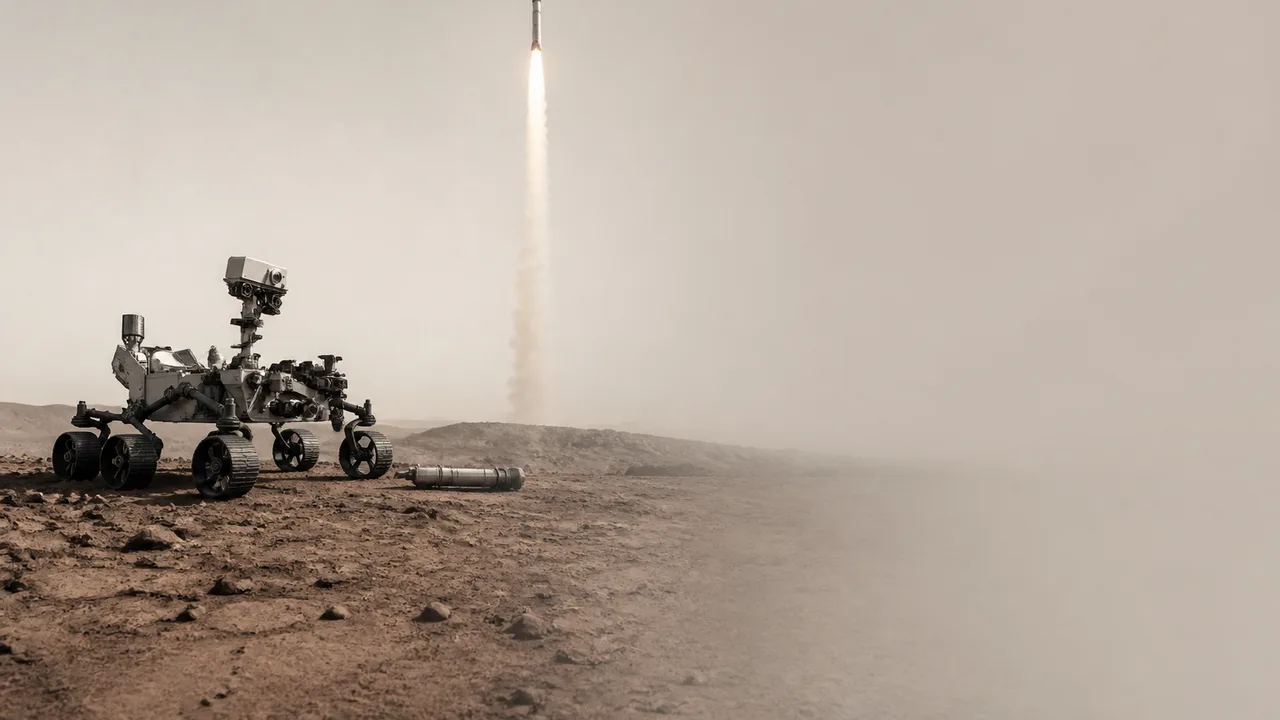
NASA has begun a new effort to bring Perseverance’s Mars samples to Earth, giving the mission a fresh name: the Perseverance Sample Retrieval Architecture. The name puts the rover at the center of the plan. The hard part remains everything that has to happen after a sample goes into a tube.
The renewed effort aims to retrieve material collected by Perseverance and return it for study in laboratories on Earth. NASA has not settled a final architecture or schedule. For now, the decision marks another attempt to make the journey workable, with cost, engineering complexity and timing all pressing on the design.
A sealed tube on Mars can preserve an extraordinary scientific opportunity. It cannot propel itself into space. A return mission must get to the samples, collect them, launch them from the Martian surface and transfer them to a spacecraft bound for Earth. Every handoff introduces another operation that has to work in sequence, far from a repair shop and too far from Earth for someone to steer it moment by moment.
That sequence explains why a change to the plan deserves attention even before NASA has chosen the hardware. A retrieval architecture determines which steps must cooperate, where the greatest risks sit and how much room a mission has to recover when something goes wrong. Its value will show up in those details, rather than in the new label.
Why Bring Mars Home?
Perseverance can investigate Mars where it stands. Earth laboratories can ask a wider range of questions of a returned sample, using instruments too large or demanding to send aboard a rover. They can also revisit the material as techniques improve. A rock returned once could support studies conducted years apart, by researchers asking questions that nobody had thought to put to Perseverance.
A result from one instrument may be interesting; a result checked by several methods can be much more informative. Researchers examining Martian material would want to know how a sample was collected, where it came from and whether anything encountered during collection, storage or return could complicate its interpretation. The tube is part of the scientific record, as well as a container.
The possibility of studying Mars for evidence relevant to past habitability gives sample return much of its appeal. It also raises the standard for a persuasive finding. Chemistry that looks suggestive at first might have more than one origin. Earth-based analysis gives researchers more tools to test competing explanations, but no instrument can replace sound knowledge of a sample’s history. The interesting question is not simply what a laboratory might detect. It is whether scientists could trace a finding back through the journey well enough to understand what it means.
A returned collection would let future methods tackle old material. Researchers would not have to predict every useful experiment before a spacecraft left Earth. That is an unusual strength in planetary exploration, where most instruments have to be selected years before they reach the place they will study.
The Chain Between a Tube and a Laboratory
The mission’s essential tasks sound straightforward when listed: collect, launch, transfer, return. Each verb hides a separate engineering problem. Retrieving the tubes requires a way to locate and gather them. Launching them requires a vehicle capable of leaving Mars. Transferring them requires the departing samples and a return spacecraft to meet and complete a handoff. The whole chain must deliver material suitable for the analyses that justify the trip.
Those steps are linked. A decision that simplifies retrieval might create demands elsewhere. A decision that reduces one spacecraft’s workload might shift complexity into a transfer operation. Fewer components can mean fewer things to build, but can also leave a single component responsible for more of the mission. The right comparison is between complete routes from tube to laboratory, including what happens if an operation misses its target.
Cost belongs in that comparison from the start. Teams can propose an elegant technical sequence that strains the budget, or an inexpensive-looking sequence that depends on several tightly coordinated successes. Timing adds another constraint: hardware, mission operations and the scientific value of the collected material all have to remain aligned through a long project. A credible plan needs more than a plausible drawing of where the spacecraft go. It needs assumptions that survive testing and budgeting.
This is where the strongest case for a redesign sits. NASA has a reason to keep pursuing the return because the samples could support science no rover can conduct alone. NASA also has a reason to rework an approach when the full sequence becomes too difficult or costly to execute. Those priorities pull against each other only if the revised plan saves resources by weakening the route to usable samples.
The scientific goal offers a way to assess any proposed trade. If a simpler retrieval method preserves the samples and gets them into laboratories, it may serve the mission well. If a saving makes it harder to know what happened to a tube along the way, scientists would have to account for that uncertainty in their analyses. Engineering and science meet at the container seal, the handoff and the record of where each sample has been.
What a Workable Plan Has to Show
The next milestones should make the architecture concrete. Readers can look for a defined method of reaching the collected tubes, a credible launch from Mars, a transfer to the spacecraft that will carry them home and a route to laboratory analysis. Alongside those choices, NASA will need to show how the mission’s budget and timing assumptions fit the work.
Each choice can be judged against a simple question: which failure does it prevent, and which new dependency does it introduce? If a plan changes how samples are collected, follow the consequences through launch and transfer. If it changes the transfer, ask what the change requires of the spacecraft on either side. A projected saving is most persuasive when the complete chain becomes easier to build and operate, rather than when difficulty moves to a later step.
The same discipline applies to the mission’s scientific promise. Mars samples are valuable because Earth laboratories can examine them repeatedly and in greater depth. A return plan should protect that opportunity through collection, transport and delivery. The destination is an instrument on a laboratory bench; the architecture has to account for every operation between that bench and Perseverance’s tubes.
NASA’s new effort begins with those tubes still on Mars. The test for the Perseverance Sample Retrieval Architecture will be whether its next set of choices can carry them, and their scientific history, all the way home.
More Like This

Neil Turok's Case for Quantum Gravity Without Strings
Neil Turok argues quadratic gravity—a 1970s idea—may solve quantum gravity without strings or extra dimensions. Here's what that claim actually rests on.

Statins May Cut Dementia Risk in Type 2 Diabetes
A major study finds early statin use after a type 2 diabetes diagnosis is linked to up to 15% lower dementia risk. Here's what the evidence actually shows.
America Wants Nuclear Cargo Ships by 2028: The Real Obstacles
A MARAD-Core Power agreement targets nuclear merchant ships laid down from 2028. The reactor is the easy part; lawyers, insurers and ports are not.

SpaceX Hits 600 Falcon 9 Booster Reuses
SpaceX reached 600 flight-proven Falcon 9 booster launches on July 13-14, 2026. Here's what that number actually means for spaceflight economics.
NASA Expands Lunar Infrastructure Plans Beyond Landers
NASA is backing lunar cargo deliveries, orbital transfer, surface systems and a proposed nuclear rover. How could the pieces support repeated trips to the Moon?

Curiosity at 5,000 Sols: What a Mars Rover Learns in 14 Years
NASA's Curiosity rover has passed 5,000 Martian days and climbed a kilometre of Mount Sharp. What the milestone reveals about the science behind the number.
Static Electricity Still Puzzles Scientists After Centuries
Static electricity has baffled scientists since ancient Greece. New research on carbon compounds and oxide surfaces may finally offer a clue to how tribocharging works.

The Physics of Sound: Ocean Acoustics and Musical Scales
A Royal Institution talk with Helen Czerski and Philip Ball asks whether underwater sound and the musical scale we use are governed by physics or cultural habit.