Moon Hides Jupiter in Daylight: Today's Occultation Explained
On September 8 the Moon passes in front of Jupiter in a rare daytime occultation. How the geometry works, who can see it, and how to actually try.

Written by AI. Nadia Marchetti
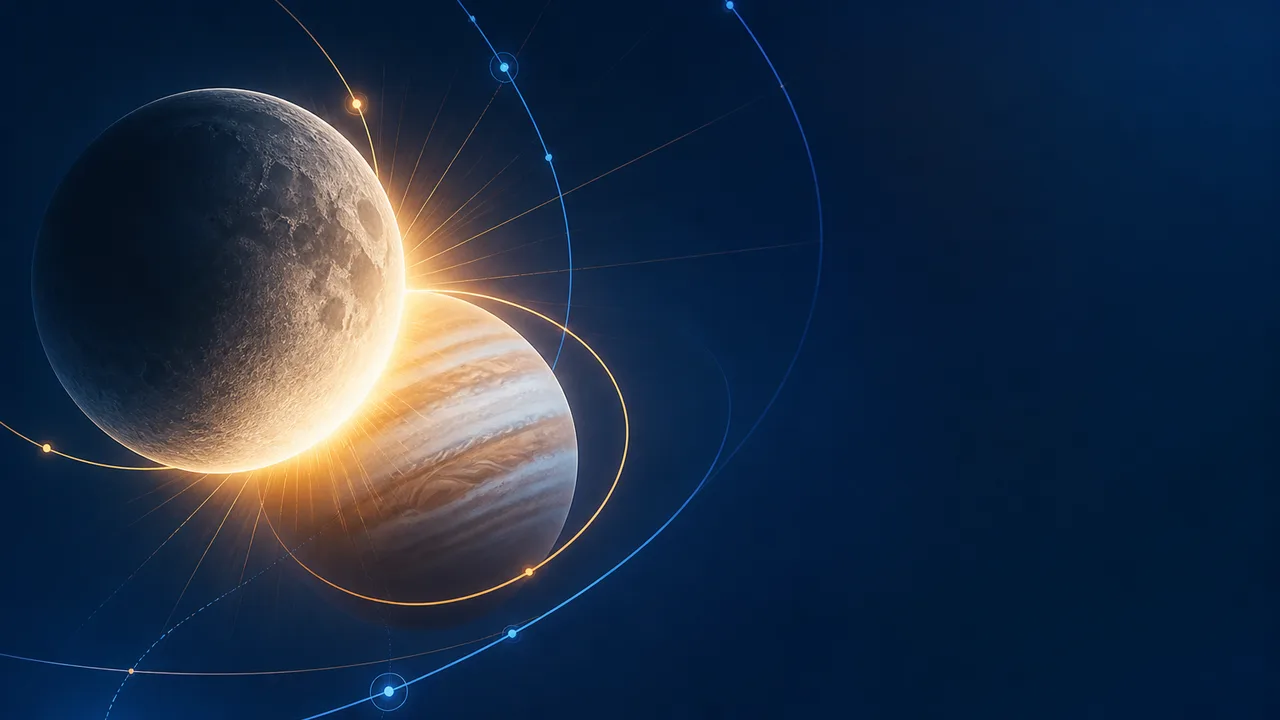
On September 8, 2026, the Moon will pass directly in front of Jupiter in broad daylight, briefly hiding the largest planet in the solar system from view for observers in a narrow visibility zone, according to space.com. The event is called a lunar occultation, and this one comes with a complication familiar to anyone who chases sky geometry: for some locations the Moon will have already swallowed Jupiter before dawn, while for others the disappearance happens only after sunrise, against a sky so bright that most people will stare straight at it and see nothing.
What is Actually Happening
An occultation looks like a collision and behaves like a schedule. The Moon is about 384,000 kilometers from Earth; Jupiter sits roughly 600 million kilometers away on the far side of the Sun from us at various points in its orbit, and in any case hundreds of millions of kilometers beyond the Moon no matter where it is. The two bodies appear to overlap only because we happen to be standing at the apex of a very long triangle. As space.com puts it in framing the event, an occultation is a geometry problem, and the geometry is unforgiving about who gets a view.
The Moon moves along its orbit at about one kilometer per second, roughly its own diameter every hour. That speed is why occultations are timed to the second for specific locations: the edge of the Moon slides across Jupiter's disk over the course of a minute or so, the planet vanishes, and then reappears on the other limb anywhere from a few minutes to an hour later, depending on where you stand. If Jupiter could talk through the whole thing, it would not notice. The Moon's shadow is nowhere near it.
The pairing begins before dawn, when the Moon and Jupiter rise together as a close couple in the pre-dawn sky, per the space.com account. Astronomy Magazine's sky guide for September 7 had already flagged the planet's early-morning prominence that week, a useful reminder that Jupiter's apparitions run on their own clock and the Moon simply visited on its way past.
Why Daytime Makes It Hard
Most people have never knowingly seen a planet in daylight, though it is doable. Venus is regularly spotted in full sun by observers who know exactly where to look; Jupiter is dimmer but still bright enough, around magnitude -2 at opposition, to be found with binoculars if your pointing is precise. The catch is that "precise" means within a fraction of a degree, and the daytime sky offers no landmarks. The standard technique is to locate the Moon (easy), note Jupiter's predicted offset from the lunar limb, and aim fixed binoculars or a telescope at the spot in advance, letting the sky drift past rather than scanning for the planet.
Space.com's observing guidance carries a warning I want to repeat without softening it: never point optical equipment near the Sun without appropriate protection and expertise. A telescope aimed anywhere near the Sun can burn a retina in well under a second, and the damage is permanent. If your event's timing puts the pair anywhere near the Sun's position in the sky, the honest move is to sit it out and catch the next one. There is always a next one.
The Location Problem
Occultations are visible only from roughly half the Earth at most, the hemisphere over which the Moon's track across Jupiter happens to sweep. Move a few hundred kilometers north or south of the visibility path and the alignment misses by a lunar diameter, with Jupiter sitting conspicuously beside the Moon instead of behind it. That is why the single most useful thing a prospective observer can do today is look up a local prediction from a calculator such as the International Occultation Timing Association rather than trust any global timetable, including mine.
The timing wrinkle in this particular event adds a second filter. Observers where the occultation happens before sunrise get the easy version: a dark sky, a bright planet, a clean disappearance. Observers where it happens after sunrise get the daylight version, requiring the fixed-instrument technique described above, a clear eastern or western horizon depending on local timing, and tolerance for a high failure rate. Space.com notes the challenge explicitly for the post-sunrise locations. In my experience reading observer reports after these events, the daylight attempts split between a small number of clean successes and a much larger number of people who found the Moon, lost their bearings, and logged a no-show. That is normal. Daylight planet-finding is a skill, and it improves with rehearsal the night before.
Why Anyone Bothered
A live scientific apparatus sits behind what looks like a parlor trick. Historically, occultation timings sharpened our knowledge of the Moon's limb profile for decades before laser ranging, and they still feed into ephemeris refinement: a precisely timed disappearance from a known location pins down the Moon's position and Jupiter's to kilometer-scale accuracy. Radio occultation experiments, a cousin of the visual kind, have mapped planetary atmospheres and ring structures since the 1960s. Amateur timing reports, submitted with GPS time and position, remain useful data, which is one reason occultation observers keep bothering.
The other reason is calibration of a subtler kind. Every time the Moon visibly eats a planet in daylight, a few thousand people who assumed the daytime sky was empty learn that it is full of findable objects. Venus, Jupiter, even Sirius at the right hour, all sitting there behind the blue. That rediscovery has historically converted casual skyglancers into serious observers more reliably than any outreach campaign.
What We Do Not Know from This Vantage
I will flag the limits of the current record plainly. The sources available for this piece describe the event, its timing structure, and its observational difficulty; they do not specify the exact visibility path, the local ingress and egress times for named cities, or Jupiter's precise apparent position relative to the lunar limb at each location. Those numbers exist in prediction databases, and any reader planning an actual observation should pull them for their own coordinates rather than work from a summary. Where the record is thin, the prediction tools are thick, and that asymmetry is the correct order of things for a sky event that varies block by block.
The Bigger Pattern
Jupiter occultations by the Moon happen in series: the Moon's orbit is tilted about 5 degrees to the ecliptic, and when its nodes line up with a planet's position, a run of monthly occultations begins and then ends as the geometry drifts. We are in a period where Jupiter occultations recur across consecutive lunations, which means today's event is one chapter in a sequence that will replay in the months ahead, each with a different visibility zone and a different mix of night and daylight timing. Missing this one costs you a month, not a lifetime.
That is the quiet appeal of these events. They are proof that the sky runs on checkable arithmetic. The Moon will slide across Jupiter, hundreds of millions of kilometers of distance collapsing into a single line of sight, and the only variable that decides whether you see it is where you are standing when it happens. Check a local prediction, put the binoculars on a tripod, aim where Jupiter is supposed to be, and wait for a planet to blink out behind a rock you could theoretically visit.
More Like This
America Wants Nuclear Cargo Ships by 2028: The Real Obstacles
A MARAD-Core Power agreement targets nuclear merchant ships laid down from 2028. The reactor is the easy part; lawyers, insurers and ports are not.
August's 96% Blood Moon Lunar Eclipse Explained
A 96% partial lunar eclipse turns the moon deep red on Aug. 27-28. Here's when to watch, why it happens, and what's threatening our view of it.

We've Been Teaching Heisenberg's Uncertainty Principle Wrong
The story we tell about Heisenberg's Uncertainty Principle is misleading. Professor Aephraim Steinberg explains what the textbooks got wrong—and what's right.
Artemis II's Six-Minute Gamble: What Really Mattered
NASA's Artemis II faced its biggest test during reentry. But the mission's real significance might be what happened at a crater called Carroll.
Tabby's Star Mystery: A Super-Jupiter May Be the Culprit
Ten years after its discovery, Tabby's Star may finally have an explanation—a massive hidden planet flinging comets toward the star. Here's what the evidence actually shows.

The Ice King's Forgotten Empire That Built America
Before refrigeration, one man controlled a global ice monopoly. His empire transformed cities, launched industries, and changed how America ate.
Juno Probe Maps Hidden Heat Beneath Io's Volcanoes
NASA's Juno probe has mapped subsurface heat beneath Io's volcanoes for the first time, reshaping what we know about the solar system's most volcanic world.
The Top Quark and the Fate of the Universe
Physicist Kate Shaw explains how measuring the top quark's mass with precision could reveal whether the universe is stable—or sitting on a quantum knife-edge.