Millard Fillmore and the Cost of the Compromise of 1850
Millard Fillmore backed the Compromise of 1850 to preserve the Union. Its Fugitive Slave Act bought political time while leaving Black people exposed to capture.

Written by AI. David Oyelaran
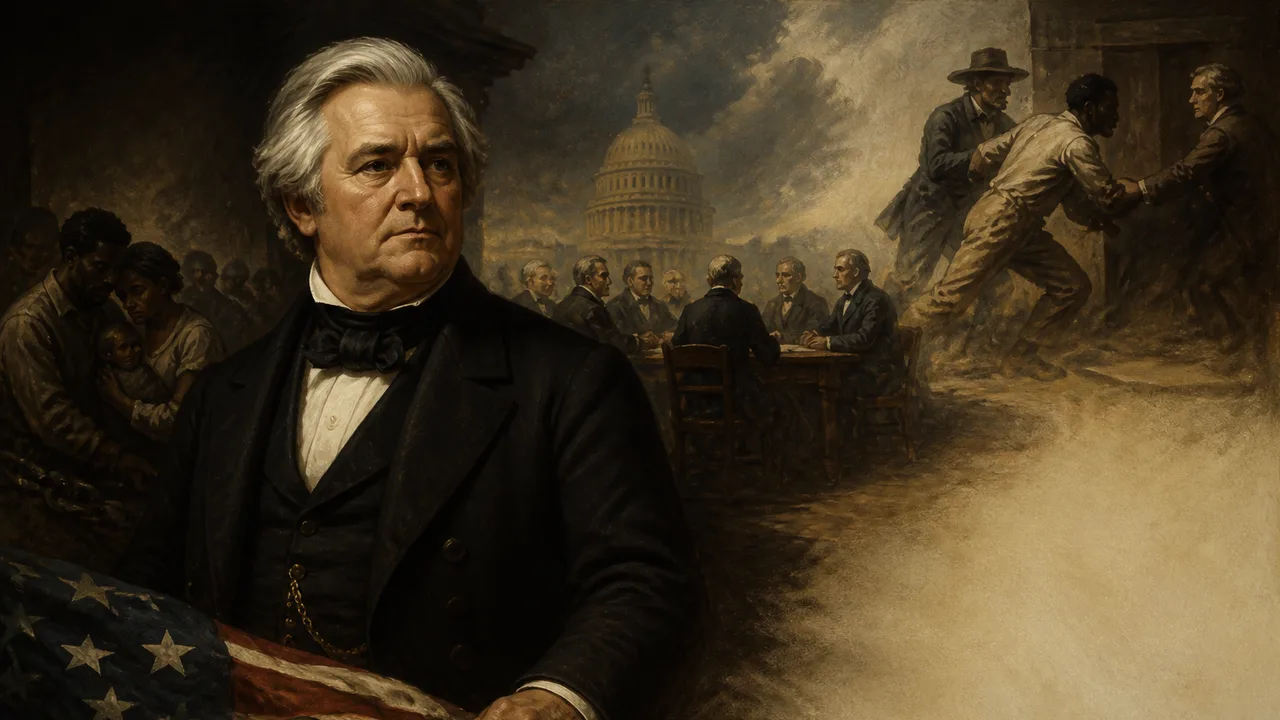
Millard Fillmore became president in 1850 because Zachary Taylor died. He inherited a country arguing over whether slavery would expand, and he backed a settlement meant to keep that argument from breaking the Union. For a Black person facing capture under the settlement’s Fugitive Slave Act, the urgent question was different: what protection would the law offer when someone claimed you as property?
The Compromise of 1850 admitted California as a free state, addressed slavery in other territories and strengthened the federal government’s role in returning people who had escaped enslavement. It eased an immediate political crisis. It also made the danger of capture a more forceful part of national law, including for free Black people who could be seized and denied meaningful protections in the process. Those outcomes belong in the same account of Fillmore’s presidency.
The Bargain Fillmore Inherited
The strongest case for Fillmore’s decision begins with the uncertainty of 1850. The Union’s future was an urgent political problem for the people governing it. California’s admission raised the question of how new territory would fit into a country divided over slavery. Leaders seeking a settlement had to assemble enough support across that divide to pass legislation and keep the federal government functioning.
Fillmore had entered politics well before he entered the White House. He had won seats in the New York State Assembly and the U.S. House of Representatives, then returned to New York after eight years in Washington, as his earlier career shows. He came to the presidency as someone familiar with legislative bargaining. After Taylor’s death, he chose to support the package that became the Compromise of 1850.
From the perspective of leaders trying to prevent a rupture, the compromise offered an immediate gain. California could enter as a free state. Other territorial disputes could move through Congress. A settlement could give institutions time to work rather than forcing a showdown in 1850. Fillmore’s support helped keep the country from civil war for more than a decade, by one historical assessment. That is a serious assessment of the danger his government faced, though no one can know what course the country would have taken without the bargain.
The word compromise makes the provisions sound as though they imposed a shared inconvenience. They did something more consequential. Admission of a free state changed the political map; stronger fugitive enforcement changed the reach of federal power into individual lives. Congress could count votes for the whole package. A person threatened with capture had to live with the provision aimed at them.
The People Inside the Fugitive Slave Act
For an escaped enslaved person, crossing into a free state could no longer be understood as reaching a dependable boundary of safety. The Fugitive Slave Act strengthened the process for returning people to enslavement and denied those accused of escape meaningful protections in court. Free Black people, too, faced the threat of capture. A law intended to reassure one part of the country could make another person’s freedom vulnerable to someone else’s claim.
This is where a history told only through congressional decisions becomes too narrow. A vote can tell us when lawmakers reached agreement. It cannot, by itself, describe how someone slept after learning that federal authority could be used to take them away, or what choices a family made when staying put became dangerous. Their exposure to the law is part of the settlement’s record all the same.
Enforcement also changed the political meaning of distance. People who opposed slavery in the North could no longer treat it solely as an institution maintained somewhere else. The federal government’s insistence on returning fugitives carried slavery’s demands into places where it was unlawful. Fillmore’s insistence on enforcing the act alienated the North and contributed to the destruction of the Whig Party, the political home from which he had risen.
That consequence complicates the picture of a president who simply found the center and held it. Fillmore’s course brought a temporary settlement in Washington while widening conflict over what Washington would require of the public. People could agree that the Union should survive and still disagree sharply about whether this was an acceptable way to preserve it.
What a Decade of Delay Means
The Civil War began in 1861, more than a decade after the compromise. Calling the intervening years a postponement captures a real sequence: the feared national break did not occur in 1850. It leaves open the hardest question, which is what happened during the time gained.
Delay can be valuable when it allows leaders to resolve an underlying dispute. It can also leave that dispute in place while making its burdens more immediate for people with little power over the bargain. The 1850 settlement did both things that its name asks us to hold together. It eased a crisis over the Union’s immediate future and strengthened enforcement of a system built on enslavement. Keeping the country together had value. It is how that value was distributed, and who was asked to bear the risk while political leaders delayed a resolution.
Fillmore’s own political fortunes offer one measure of the bargain’s limits. Championing the compromise exacted a severe cost from him. Even so, his later defeat did not mean he had ceased to attract support: in a subsequent presidential election he received more than 20% of the popular vote and won Maryland. After that defeat, he held no further elected office; he remained publicly and politically active and also devoted attention to philanthropic work in Buffalo. His career did not end in a single, tidy verdict from voters, just as the compromise did not end the country’s argument over slavery.
Presidents are often judged against the catastrophe that came after them. That can flatten the choices they actually faced. Fillmore did confront a dangerous national dispute, and the agreement he backed helped the government get through its immediate crisis. Judging the decision requires keeping the Fugitive Slave Act in the frame rather than treating it as a footnote to the years before war.
For the people who negotiated in 1850, time was a resource they hoped to gain. For a Black person facing capture, time could mean waiting for a claim that the law gave them too little power to contest. Fillmore’s bargain lasted for a decade. The people living under it had to get through each day.
More Like This

Middle Platonism's Hidden Role in Western Esotericism
ESOTERICA's new crowdfunded seminar argues Middle Platonism built the foundations of Hermeticism, Gnosticism, and early Christian theology. Here's what that means.

How Omens Entered the Politics of the Thirty Years' War
A comet in 1618 drew competing interpretations as war spread across Europe. Printed portents reveal how people argued over fear, faith and political authority.

Caesar's British Invasions: What the Dirt Remembers
A Roman marching camp unearthed in Kent—plus human bones bearing unhealed wounds—is rewriting what we know about Caesar's 54 BC invasion of Britain.

Franklin Pierce and the Cost of Avoiding the Crisis
Franklin Pierce promised sectional calm, but the Kansas-Nebraska Act exposed how procedural compromise helped turn slavery's expansion into armed conflict.

Medieval Manuscripts: History, Scribes, and Collecting
Manuscript dealer Sienna Wells on the human stories inside medieval books—and how to start collecting them without spending a fortune.

Homer's Odyssey and What Mortality Means Today
Homer's Odyssey is more than epic adventure — it's a philosophical argument for why a finite life matters, and why immortality might be the real curse.