Franklin Pierce and the Cost of Avoiding the Crisis
Franklin Pierce promised sectional calm, but the Kansas-Nebraska Act exposed how procedural compromise helped turn slavery's expansion into armed conflict.

Written by AI. James Morrison
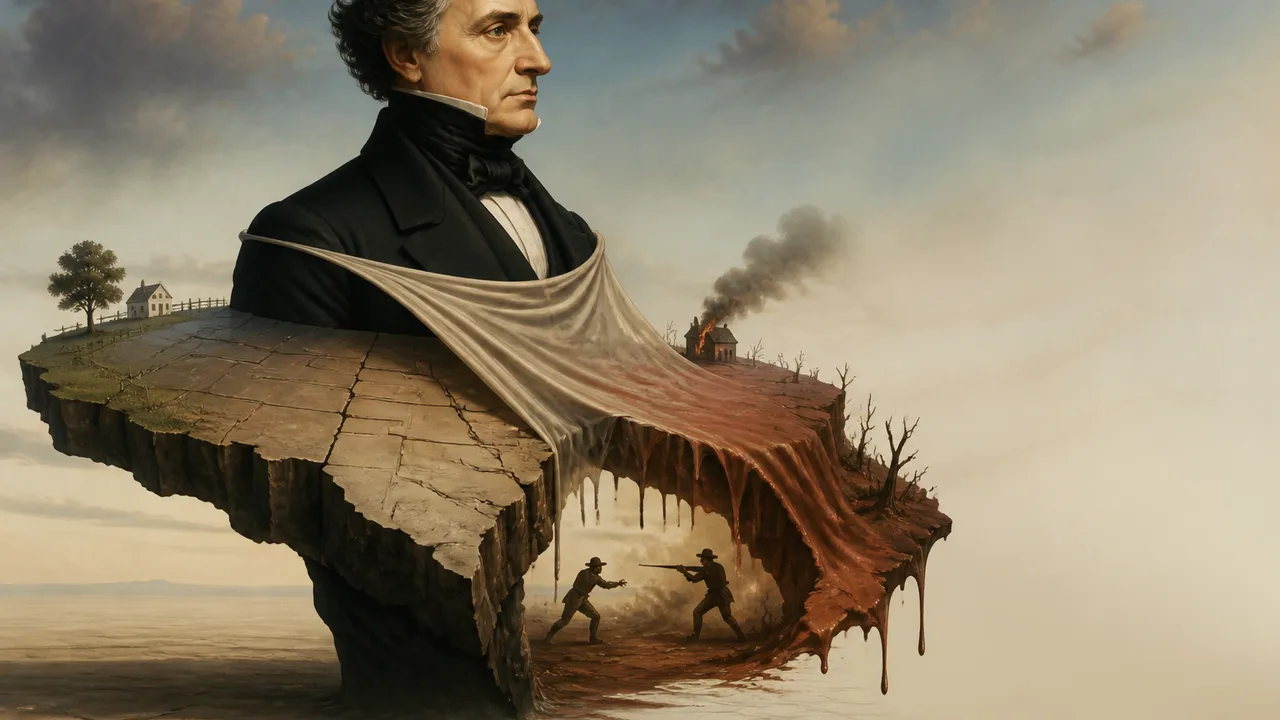
Franklin Pierce entered the White House in 1853 as a Northern Democrat acceptable to a party divided by slavery, geography and ambition. Four years later, his own party refused to nominate him for another term, Kansas had become a theater of political violence, and the institutional restraints on slavery's expansion had suffered a grave breach.
Presidential failure often gets compressed into character: a weak man met a strong crisis and folded. Pierce fits that judgment too conveniently. His administration made consequential choices, especially in Kansas, but those choices emerged from a political system that prized sectional harmony while refusing to settle what that harmony required. The country wanted peace at a price it would not name.
EBSCO Research describes Pierce's tragedy as holding office during a period of major crisis and conflict. The sharper question concerns what he did with that inheritance. His administration treated a dispute over human bondage as a problem that procedure, party loyalty and territorial government could contain. Kansas demonstrated the limits of that approach with rifles, fraudulent voting and two governments claiming legitimacy.
The Candidate Built for Ambiguity
Pierce arrived at the 1852 Democratic convention without the national following of the leading contenders. That made him useful. A compromise nominee carries fewer enemies because voters often know fewer of his convictions. Ambiguity can hold a convention together; it performs poorly as a governing doctrine.
His political background was substantial. Pierce had served in Congress, participated in New Hampshire politics and served during the Mexican-American War. According to his biographical record at Wikipedia, his political career began amid the rise of Andrew Jackson's Democratic movement. That tradition valued party unity, limited federal interference and suspicion of organized antislavery politics.
Pierce also entered office under the weight of family catastrophe. His 11-year-old son, Benjamin, had died in a train accident shortly before the inauguration, with Pierce and his wife present. Voice of America notes the repeated tragedies in his private life alongside his later reputation as an ineffective chief executive.
That loss belongs in any humane account of the man. It cannot establish why he supported one territorial policy, recognized one government in Kansas or rejected another. Grief may narrow a president's reserves; the documentary consequences still came through public decisions made by an administration, a Cabinet, Congress and a national party.
Popular Sovereignty Meets the Map
The Kansas-Nebraska Act of 1854 organized the two territories and placed the slavery question in the hands of their settlers under the doctrine of popular sovereignty. Senator Stephen A. Douglas of Illinois drove the legislation, seeking territorial organization and a route for western development. Pierce gave the measure presidential backing and signed it.
The law overturned a longstanding geographic restriction. The Missouri Compromise of 1820 had prohibited slavery in much of the Louisiana Purchase north of latitude 36 degrees 30 minutes, except Missouri. As World History Encyclopedia explains, the Kansas-Nebraska Act repealed that restriction and helped set off the violence remembered as Bleeding Kansas.
Popular sovereignty had surface appeal. Congress could stop trying to impose a single sectional answer, settlers could govern themselves, and national parties could preserve coalitions containing Northern and Southern wings. In its strongest form, the argument drew on democratic self-rule and the practical difficulty of governing distant territories from Washington.
Slavery exposed the doctrine's central defect. Enslaved people had no standing in the proposed act of self-government. Their liberty became a question for other people to vote upon. The policy also created a powerful incentive for proslavery and antislavery groups to shape the electorate before stable civil institutions existed.
The ballot box arrived on contested ground, escorted by migration campaigns, outside money and armed men. Proslavery Missourians crossed into Kansas to influence elections. Antislavery settlers organized communities and political institutions of their own. Disputes over residence and voting became disputes over which legislature, constitution and body of law possessed authority.
Congress had converted a constitutional crisis into a race for physical control of territory. In military terms, each faction understood that possession, population and organization could determine the political objective. Elections became operations. Towns became strongpoints. Newspapers, land companies and armed associations served as instruments in a struggle that federal law had failed to bound.
Bleeding Kansas and Federal Power
Bleeding Kansas never approached the scale of the Civil War that followed, but its pattern was recognizable as irregular conflict. Armed groups conducted raids, destroyed property, intimidated civilians and answered violence with reprisals. Political labels overlapped with local feuds and personal interests, as they often do when civil authority fractures.
Pierce faced more than public disorder. He had to decide which institutions the federal government would recognize. His administration accepted the proslavery territorial government and treated the antislavery Topeka government as an unlawful rival, even as allegations of electoral fraud undermined the recognized legislature's legitimacy.
That decision gave legal force to one faction's claim while the administration continued to speak in the language of process. Neutral procedure depends upon credible rules, eligible voters and an authority capable of enforcing judgments without serving one camp. Kansas lacked all three.
Pierce's defenders can point to genuine constraints. Presidents execute laws passed by Congress. Douglas, territorial officials, legislators, organized settlers and armed outsiders all exercised agency. A president who repudiated the Kansas-Nebraska Act after signing it would have shattered his party and invited another constitutional confrontation over federal and territorial power.
Yet presidential responsibility includes the use of recognition, appointments, enforcement and public argument. Pierce consistently interpreted those powers through the priorities of Democratic unity and Southern constitutional claims. The result narrowed his room to act when violence exposed the policy's failures.
How Much Blame Belongs to Pierce?
Popular assessments remain severe. Factinate offers the blunt verdict that Pierce accelerated the country's descent toward civil war. Voice of America likewise notes that he has come to be remembered among the nation's worst presidents.
Some scholarship draws a more favorable portrait. The Civil War on the Western Border project cites historian Peter A. Wallner's description of Pierce as a moderate who displayed “consistent legal and ethical conduct” while presiding over prosperity and growth. That interpretation directs attention toward the full administration rather than judging every department through Kansas alone.
Economic expansion, administrative competence and personal probity deserve a place in the ledger. They do not erase the hierarchy among presidential responsibilities. A government can manage ordinary business efficiently while losing control of the question that will define its age. Staff work rarely rescues a failed strategy.
Pierce also inherited a crisis decades in the making. The Constitution had protected slavery through political arrangements while leaving its expansion open to repeated conflict. The Missouri Compromise, the Compromise of 1850 and popular sovereignty each sought to manage sectional power. Every settlement depended upon enough Americans accepting delay. Kansas ended that acceptance for many Northerners and strengthened the emerging Republican argument against slavery's expansion.
The Danger of Procedural Peace
Pierce's presidency offers a case study in how institutions postpone confrontation. Delay can be prudent when it creates space for negotiation, lowers violence or permits a durable settlement. Delay becomes combustible when parties use the interval to organize, arm and capture the machinery that will decide the dispute.
The administration's policy moved the slavery question from congressional lines on a map to contested settlements on the ground. That transfer sounded democratic and decentralized. In practice, it asked fragile territorial institutions to decide an issue that had already destabilized national politics.
Pierce left office in 1857, succeeded by James Buchanan, with the Union still formally intact. Formal survival supplied little evidence of recovery. Bleeding Kansas had hardened sectional identities, discredited another compromise and shown how quickly electoral competition could become armed coercion.
Pierce reached Washington as a candidate of calm. Four years later, Kansas showed what deferred conflict does with an interval: it gathers voters, rival laws and weapons.
More Like This
Chamberlain, Hitler, and the Munich Agreement of 1938
Three flights in 15 days, one agreement that failed within months. A close look at Munich 1938 and what it still asks of us.

Unraveling Rome's Dodecahedron Mystery
Exploring the enigmatic Roman dodecahedron, its theories, and historical significance in modern archaeology.
Unveiling the Intricate Engineering of Runways
Explore the hidden complexities of runway design and how these choices impact safety and military operations.
Scattered Steel: Where the World Trade Center's Metal Went
A new book traces salvaged World Trade Center steel as it traveled through memorials, towns and institutions, raising hard questions about who controls memory.
South Carolina's 1860 Secession and the Civil War
On December 20, 1860, South Carolina voted unanimously to leave the Union. The document it produced tells us exactly why—if we bother to read it.
Andrew Johnson's Impeachment and What It Actually Settled
Andrew Johnson became America's first impeached president in 1868. The case was about a cabinet firing—but the stakes were the shape of democracy itself.

Audie Murphy: Soldier, Icon, and Haunted Man
Audie Murphy was America's most decorated WWII soldier. His battlefield heroism and Hollywood fame masked a man deeply scarred by combat and survivor's guilt.

The Crusades: Two Centuries of Holy War Explained
From Pope Urban II's 1095 call to arms to the fall of Acre in 1291, the Crusades reshaped Christianity, Islam, and the medieval world permanently.