Meta's Luna Glasses Test a Camera-Free Middle Ground
Meta's reported Luna smart glasses remove the camera but keep six microphones and AI, testing whether slimmer hardware can ease wearable privacy concerns.

Written by AI. Leo Santana
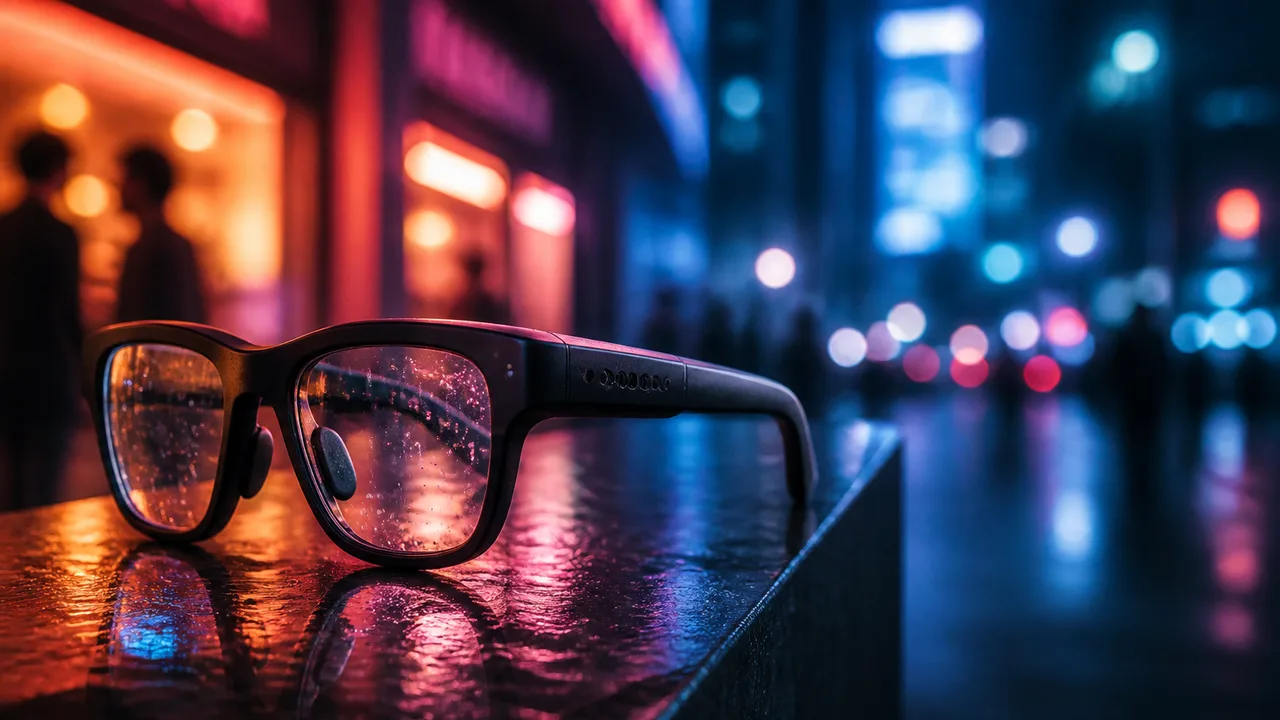
Meta reportedly plans to release camera-free smart glasses called Luna this fall, a product shaped as much by what has been removed as by what remains.
The Information's originating report, based on people familiar with the matter, says Luna has six microphones for speaking with Meta AI and its Muse agent, speakers directed toward the ears, and a side button for summoning the software. Removing the camera allows slimmer temple arms and a silhouette closer to ordinary eyewear. The reported product has yet to be announced, so its name, timing and final specifications could change.
That collection of choices turns subtraction into the main feature. The camera gave Meta's existing smart glasses their most obvious power, letting people capture what they saw without lifting a phone. It also made everyone within view part of the product experience, including people who never agreed to participate.
Luna narrows that social problem by removing the recording hardware. It preserves Meta's preferred interaction, a voice channel to its AI, while giving up visual capture. The result resembles an audio wearable disguised as conventional glasses, a pair of earbuds redistributed across the bridge and temples.
The LED Could Not Carry the Whole Social Contract
Meta's route to Luna can be traced through several design interventions during 2026. CNET reported that Meta CTO Andrew Bosworth had indicated interest in a cheaper, camera-free, audio-focused model in June. In late July, Meta updated its camera glasses so tampering with the recording LED would deactivate the camera. Engadget reported that another update in August closed a loophole that had allowed someone to begin recording and then cover the light.
The LED is an example of an affordance, a design feature that signals what an object can do or what it is doing. A recording light should let a bystander recognize the camera's state. On Meta's glasses, that tiny signal had to compete with bright daylight, unfamiliar behavior and a frame designed to resemble decades-old Ray-Bans. CNET's Scott Stein found the white light difficult to see in daylight, while some users had removed or camouflaged it before Meta's software response.
The history matters because it shows the limits of treating consent as an indicator-light problem. Software can detect physical interference. It cannot guarantee that a stranger notices a small lamp, understands it or feels able to challenge the wearer. The burden falls hardest on the person being observed, who must inspect somebody else's face closely enough to decode the hardware.
CNET also summarized reported misuse, including recording women during encounters and posting the footage. It relayed CNN's account of a woman who discovered that an airport conversation had appeared in videos online; she asked the man involved not to post their exchange, but he did.
Those incidents do not establish how most owners use Meta's glasses. They do establish a plausible harm enabled by a camera placed at eye level inside familiar frames. Product reputation grows from such visible cases rather than from average behavior alone. A device can sell while still making some owners reluctant to wear it and some bystanders uneasy around it.
YouTube reviewer Austin Evans told CNET that he rarely wears his Meta Ray-Bans because of the associated “bad vibes.” He argued that a camera-free version could slim the glasses and help remove the stigma. His experience cannot measure the wider market, but it identifies the design problem cleanly: wearable technology must be acceptable to people facing the wearer as well as the customer who paid for it.
Three Different Ideas of Smart Eyewear
Meta's reported lineup offers a more useful comparison than a distant tour through every failed headset. Its current Ray-Ban glasses, Luna and the rumored Phoenix augmented-reality glasses represent three answers to the same question: how much computing can a face carry before the object becomes socially or physically cumbersome?
The Ray-Ban models pair capture technology with a familiar fashion shape. That camouflage lowers the style barrier for the wearer, since the glasses do not resemble laboratory equipment. It raises the legibility barrier for everyone else, since a camera can be harder to identify. The same visual normality serves convenience and uncertainty at once.
Luna reportedly removes capture while pushing the disguise further. Slimmer temples make it look more like ordinary eyewear, and six microphones retain voice access to Meta's services. This is a middle category: visually unobtrusive, computationally connected and limited in what it can sense.
Phoenix points toward greater visual ambition. Android Central reports that Meta is developing the augmented-reality glasses for virtual workspaces, movie screens and a different form of video calling, with arrival currently expected in 2027. Those details also derive from reporting rather than a finished product announcement.
The comparison suggests Luna is a branch in Meta's roadmap rather than proof that the company has abandoned sensor-rich glasses. One branch sells ambient AI through sound. Another pursues images placed into the user's field of view. The products address different jobs, so Luna's reception would reveal demand for voice-first eyewear rather than settle the prospects of augmented reality.
Removing One Sensor Leaves Other Questions
Luna's strongest case is straightforward. A person who wants directions, audio and spoken AI assistance may have little need for a face-mounted camera. Removing it could reduce bulk and eliminate the device's ability to take visual recordings. That is a concrete privacy improvement for nearby people, assuming the shipped product matches the report.
Six microphones still make Luna a sensor-bearing device. The available reporting explains their function, enabling voice interaction, but does not establish when they activate, what audio reaches Meta, how long data is retained or what controls users receive. Those questions require documentation from Meta if Luna is announced. Readers should avoid assuming either continuous recording or complete privacy without those details.
The design also contains a subtler reputational problem. Reports describe Luna as closer to ordinary glasses, but they do not describe an external marker that would let a bystander identify it as camera-free. Someone seeing Meta-branded eyewear across a train carriage may still wonder whether it contains a lens. Removing the capability protects that person from visual capture; making the removal legible could help address the suspicion.
That distinction offers a practical test for Luna and future wearables. Examine what the device can collect, how clearly nearby people can read its capabilities, what happens when safeguards are obstructed, and whether its central function justifies its place on the face. Thin temples and a handsome frame solve comfort and styling. Trust requires an object that strangers can understand without performing a tiny forensic examination in daylight.
Luna may become Meta's most socially restrained pair of smart glasses. Its success will depend partly on whether people can see the restraint, even when the camera they are looking for is absent.
More Like This
Meta Puts Ray-Ban Smart Glasses Behind a Paywall
Meta is rate-limiting its Ray-Ban smart glasses AI features and charging $20/month for extended use. Here's what that actually means for buyers.

Plaud One AI Earbuds: Listening So You Do Not Have To
Plaud One earbuds record, summarize, and act on workplace conversations via 4G. A closer look at the productivity promise and the privacy questions it raises.
Meta's AI Glasses Will Recognize Your Dinner Guests
Meta has patented AI glasses that use facial recognition to identify people and auto-edit highlight reels. A look at what's filed, what's already in code, and what's missing.

Apple Watch Audio Intelligence and the Bystander Privacy Problem
Apple says don't worry about the new Apple Watch's listening features. Here's what the reporting actually establishes, and who never got a say in it.

Route 66 and the Landscape of American Memory
Peter Adler's documentary on Route 66 reveals a road that stopped being infrastructure and became something stranger—a canvas for competing American mythologies.

How HBO Turned Jon Snow Into a Logo
HBO's Game of Thrones didn't just simplify Jon Snow's character—it redesigned him into a merchandisable image. Here's what that visual shift cost the story.