Plaud One AI Earbuds: Listening So You Do Not Have To
Plaud One earbuds record, summarize, and act on workplace conversations via 4G. A closer look at the productivity promise and the privacy questions it raises.

Written by AI. Marcus Chen-Ramirez
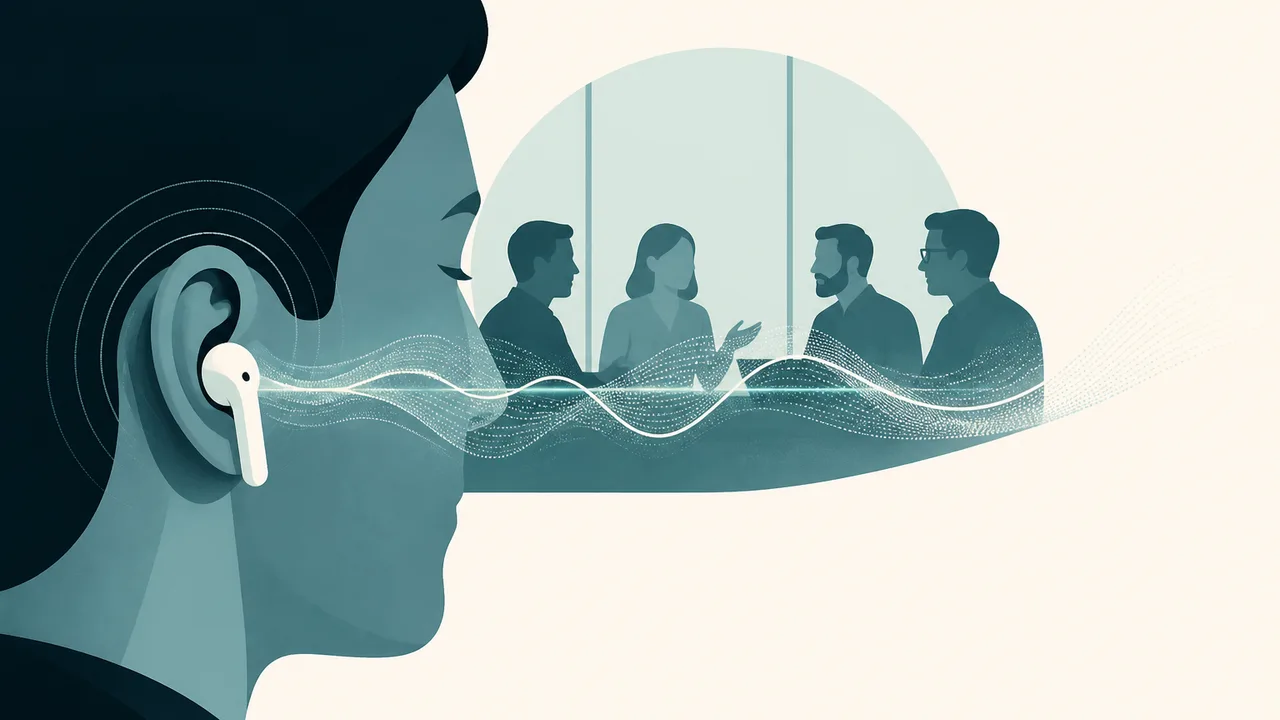
Picture a coworker glancing at their earbuds mid-meeting and nodding along. They are not listening to music. They are not on a call. Their earbuds are doing the listening for them, summarizing the conversation, and quietly queuing up follow-up actions. That is the pitch behind Plaud One, the latest device from Plaud, a company that has built its brand around AI-powered recording hardware.
The Plaud One are wireless earbuds, but calling them that undersells the concept significantly. According to Tech Republic, the earbuds can listen to, summarize, and act on workplace conversations through a 4G-connected charging case, with no smartphone required. That last part matters more than it might initially seem. Removing the phone from the loop means the device operates independently, which lowers friction but also removes one layer of user control that most people take for granted.
The Verge reports the device is priced at $250. The Next Web puts that figure in useful context: at a quarter of a thousand dollars, these sit in the premium wearable tier, targeting professionals who have already bought into the AI productivity stack and want their hardware to catch up with their software.
What It Actually Does
The core functionality, as Android Authority describes it, is a two-step loop: the earbuds take notes, then take action. In practice, that means the device records ambient and direct audio, processes it through AI to extract meaningful content, and then routes that content toward tasks like calendar entries, reminders, or summaries. ZDNet has a breakdown of the specific feature set, which includes real-time transcription and what the company describes as agentic behavior, meaning the AI does not just record and report but tries to initiate follow-up actions on the user's behalf.
Gizmodo frames this as Plaud "cranking AI productivity to max volume," which is a fair summary of the product philosophy. Plaud's earlier hardware, the NotePin and the Plaud Note card, were passive recording devices. The One adds an agentic layer and untethers the hardware from the phone. That is a meaningful architectural shift, not just a feature bump.
Engadget cuts to the audience plainly: these are earbuds for people who want to record every meeting and call. That sentence does a lot of work. It names the use case without flattering it. Some readers will see themselves in it and feel relief that someone built this. Others will read it and feel a quiet unease about the colleague who shows up to their next one-on-one wearing a pair.
The Consent Problem Is Not Theoretical
This is where the story gets genuinely complicated, and where a straight productivity narrative starts to strain.
Recording a conversation without the other party's knowledge or consent is not a gray area in much of the world; it is a legal matter that varies sharply by jurisdiction. The Next Web specifically flags Germany and France as jurisdictions where covert recording can cross into criminal territory. That is not a footnote. It is a structural challenge for any device whose core value proposition is ambient listening.
Plaud is presumably aware of this. Companies selling recording hardware typically include consent disclaimers in their terms of service and leave compliance to the user. That is a reasonable legal posture but a thin ethical one. The practical reality is that earbuds are socially invisible in a way that, say, a phone placed face-up on a conference table is not. Nobody sees the record light. Nobody knows what the case in your bag is doing. The social signals that once prompted a "mind if I record this?" are gone.
This is not a reason to conclude the device is net harmful. It is a reason to ask the question carefully. AI note-taking tools like Otter.ai or Fireflies.ai have wrestled with the same consent dynamic in software form for years. The difference with Plaud One is the hardware integration: the recording is baked into an object you wear, which normalizes it in ways that a laptop app does not.
The Productivity Case, Taken Seriously
Set aside the consent questions for a moment and consider what Plaud is actually solving for. The problem of meeting overhead is real and well-documented. Studies by organizations including Microsoft and various workplace researchers have found that workers spend significant portions of their weeks in meetings, and that a large share of that time is perceived as unproductive or poorly retained. The cognitive cost of simultaneously participating in a conversation and extracting structured information from it is genuine. That is why people hire executive assistants, take handwritten notes, and install transcription bots in Zoom calls.
Plaud One is an attempt to solve that problem in hardware form, at a device level, without requiring organizational buy-in. You do not need your company's IT department to approve it. You do not need your team to install a plugin. You put the earbuds in and go.
That accessibility is genuinely useful for freelancers, consultants, small business owners, and anyone who operates outside a managed enterprise environment. For those users, a $250 device that reliably transcribes, summarizes, and takes action on their conversations could pay for itself in recaptured time within weeks. That is not hype; that is a plausible value calculation.
Where the Agentic Layer Gets Interesting (and Murky)
The more novel claim in the Plaud One pitch is the agentic behavior: not just recording what happened, but doing something about it. According to Tech Republic, the device can offer real-time insights and execute actions based on verbal interactions.
What that looks like in practice, and how reliably it works, is not yet clear from the published coverage. "Agentic AI" is one of those terms that currently spans a wide range of actual capability, from genuinely autonomous multi-step task execution to slightly smarter autocomplete. Plaud has not, based on available sources, published detailed benchmarks for its action-completion accuracy. That gap matters for buyers considering $250 hardware on the promise of actions taken.
The 4G-connected case is the infrastructure backbone here. Without it, real-time processing at the scale these features require would be implausible. With it, you have a device that is perpetually online, perpetually listening when active, and routing audio data to cloud infrastructure for processing. That raises the standard set of questions: Where does that data go? How long is it retained? Who has access? The sources reviewed do not detail Plaud's data handling policies comprehensively, and that is worth investigating before committing to a device whose job is to record your professional life.
The Wearable AI Trajectory
Plaud One does not exist in isolation. It arrives in a moment when the wearable AI category is being actively contested. Meta's Ray-Ban smart glasses record and query. Humane's AI Pin, before its much-publicized stumble, attempted ambient AI in a wearable form. Devices like the Limitless Pendant and Tab have made similar ambient-recording bets. The category is young, the failure rate is high, and the product-market fit has been elusive.
What Plaud has that some of its competitors lack is a track record with its core function. Its earlier recording hardware built a user base that understood and wanted audio capture. The One is an upgrade path, not a cold pitch to a skeptical audience. That product continuity is a real strategic asset.
What the broader category still lacks is a settled social compact around when ambient AI recording is acceptable and what obligations come with it. The hardware is outrunning the norms, which is a pattern as old as the camera and as unresolved as the smartphone. Plaud One is a capable-looking product sitting at the leading edge of that unresolved question.
Whether it is the right product for you depends significantly on where you sit: in a two-party consent state or a one-party one, in a job that requires airtight meeting notes or one that runs on trust and informality, and in a workplace culture where AI tools are normalized or one where they register as surveillance by another name.
The earbuds will listen either way. The question is who else is in the room when they do.
More Like This
Claude Marketing Skills Ranked by GitHub Stars (2026)
Which Claude Code marketing skill repos actually earn their stars? We map the top packages—from CRO to paid media—and ask what GitHub popularity really measures.
Tech Career Decisions: What to Know Before 2026
Marina Wyss breaks down seven tech roles—from software engineering to applied science—through a decision tree based on personality, not just skills.

The Hidden Architecture Making AI Agents Actually Work
Building AI agents isn't about choosing build vs. buy—it's about orchestration. Here's what IBM's engineers say makes multi-agent systems coherent.

AI's Inference Crisis: Why Sora Died Burning $15M Daily
OpenAI killed Sora after six months. The reason reveals AI's shift from training races to inference economics—and what breaks next.

Anthropic's Computer Control: What the Tech Actually Does
Anthropic's Claude can now control your entire computer through Dispatch. A look at how the permissions work, what it can do, and what it can't.

Apple's AI Glasses: A Display-Free Bet on Siri
Apple's rumored glasses, reportedly coming in 2027, won't have a screen. Here's what they will do—and why the privacy question is the one Apple can't dodge.

Hugging Face ML Intern Automates AI Development
Hugging Face's ml-intern is an open-source agent that automates the full ML research loop. Here's what it does, what it can't, and what it signals.

Small Language Models Are Reshaping Agentic AI
Small language models are outperforming larger rivals on key AI agent benchmarks. Here's what the efficiency shift means for how AI gets built and deployed.