How Japan Engineers Its Cities to Survive Disaster
From underground flood cathedrals to maglev delays, Japan's megaprojects reveal what it costs—and what it means—to build against annihilation.

Written by AI. Leo Santana
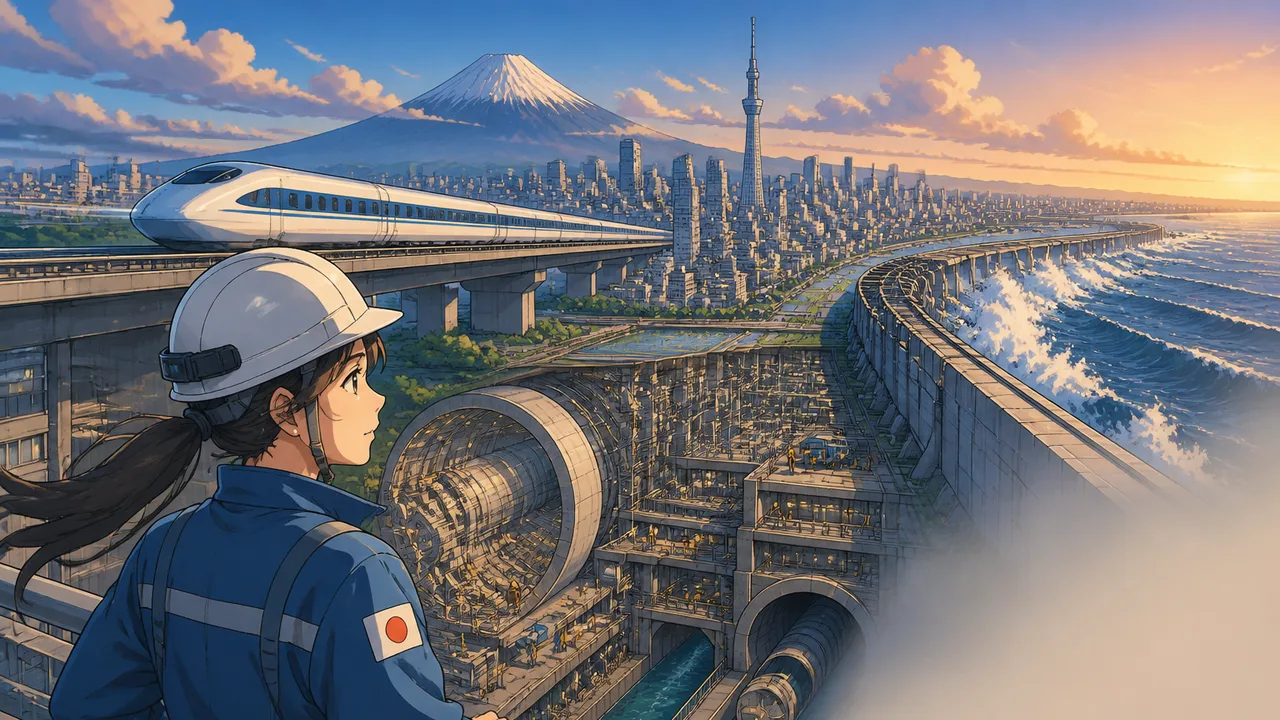
Photo: AI. Mei Fujimoto
Tokyo is a city that probably shouldn't exist. A quarter of Japan's population—roughly 40 million people—lives in a metropolitan area that straddles four tectonic plates, sits partially below sea level, faces typhoons off the Pacific, and keeps one eye permanently trained on Mount Fuji, an active volcano close enough to dust the city in ash. Japan registers roughly 18% of all the world's earthquakes. Nearly 600 quakes measuring magnitude 4 or higher struck the country in 2024 alone.
That context matters because when The B1M's documentary series on Japan's megaprojects—recently compiled into a sprawling 90-minute video—takes you underground, inside mountains, and up 634-meter towers, it isn't doing engineering tourism. It's tracing a coherent argument: that Tokyo's infrastructure is not just functional, it's a direct material response to history. Specifically, to a history of catastrophic loss.
The City Beneath the City
Start underground, because that's where the most consequential work is happening. The Metropolitan Area Outer Underground Discharge Channel—G-CANS for short—is already one of the most photographed pieces of infrastructure in Japan, partly because it looks like a set from a Ridley Scott film: a 25-meter-high concrete cathedral, 177 meters long, 78 meters wide, sitting 50 meters beneath the streets. It cost $2 billion and took 17 years to build. It can pump 200 tons of water per second.
The Tokyo Resilience Project, launched in December 2022 with a budget of around $109 billion and an 18-year timeline, is doubling that capacity. A new tunnel currently being bored under West Tokyo—12.4 meters wide, 5.4 kilometers long—will connect to two existing tunnels to form a 13-kilometer network, the largest of its kind in Japan. The tunnel boring machine doing that work weighs 2,800 tons and is fitted with carbide cutter bits 48 times harder than those on a conventional TBM, because it needs to break through into the connecting tunnels—a feat that hasn't been attempted before. When complete, the network will be capable of processing 100 millimeters of rain per hour. That's more than London receives in two months.
The scale of the engineering is matched by the scale of the threat. Heavy rainfall in Japan has nearly doubled over the last 40 years. A fifth of central Tokyo lies below sea level. The TRP is responding not just to current conditions but to projections: seawalls along the coast are being raised to account for a 60-centimeter sea level rise by 2100—more than twice what has been recorded since 1880.
What Flexibility Looks Like
Above ground, the design logic reverses. If the underground infrastructure is about absorbing volume, the above-ground engineering is about absorbing movement.
Every geometric decision in Tokyo's tall structures is a load-bearing argument. The Tokyo Skytree—completed in 2012, the third-tallest freestanding structure in the world—looks from a distance like an elegant lattice of steel. Up close, it's a nested system of structural philosophies. The outer truss, made from high-strength steel twice as strong as standard, is designed to sway. Inside that sits a cylindrical shaft. And nested inside that is the shimbashira: a 375-meter-high concrete pillar, 8 meters wide, structurally separate from the outer shell.
When the outer structure sways during an earthquake, the shimbashira vibrates at a different frequency, and the interference between those frequencies cancels out roughly half the seismic force. An oil damper prevents the two structures from crashing into each other. At the base, the concrete core rests on six rubber isolators, each 1.4 meters thick, which serve as a flexible joint between the pillar and its foundation.
The name "shimbashira" is borrowed directly from Japanese pagoda architecture. The five-story pagoda at Horyuji Temple—according to records at horyuji.or.jp, the shimbashira there has stood for over fourteen centuries, as reported by Web Japan (web-japan.org)—uses the same principle: a central wooden pole that remains free-standing within the structure, absorbing energy through its independence rather than its rigidity. Japan's engineers didn't invent a new logic for the Skytree. They translated a very old one into reinforced concrete.
The Skytree also carries two tuned mass dampers (pendulum weights that swing at a different frequency from the building, absorbing wind-induced vibration) positioned near the top of the broadcast antenna. Those antennas aren't decorative—they're part of Tokyo's emergency communications infrastructure. The tower needs to remain operational after a major event, not just standing.
A Mountain Full of Water
The Hyper-Kamiokande is arguably the strangest project in the video, and the one that resists easy explanation. It's not disaster infrastructure. It's a neutrino observatory—a $600 million science experiment led by the University of Tokyo, supported by researchers from 21 countries, being carved out of Mount Nijugo in the Japanese Alps at a depth equivalent to sitting 1.7 kilometers below the ocean's surface.
The cavern itself is 88 meters high and 69 meters wide. To put that in some kind of physical register: a Boeing 747 standing on its tail would fit inside it. The construction sequence alone is a feat—a 2-kilometer access tunnel drilled and blasted in nine months, then concrete-sprayed for stability; a domed roof reinforced with a steel truss to hold the weight of 681 meters of rock; and now, an ongoing blast-down through 71 meters of solid rock to create the chamber floor. Once complete, 260 million liters of water will be pumped in from the mountain's water table, a process expected to take around six months. Forty thousand photosensors—almost twice as sensitive as those in its predecessor, the Super-Kamiokande—will line the interior walls, waiting to catch the faint Cherenkov radiation emitted when a neutrino occasionally collides with an electron.
Imagine the build: crews working in a space the size of a 20-story building, sealed inside a mountain, installing light sensors so sensitive they can detect a single photon. The rock that makes construction brutal is also what makes the science possible—it filters out the cosmic background radiation that would otherwise drown out the signal. You can't build this facility somewhere convenient. The inconvenience is the point.
Construction is expected to complete in 2026, with neutrino detection beginning around 2027. The practical applications of particle physics research—medical imaging, cancer treatment, the internet itself—tend to arrive decades after the experiments that enabled them.
The One Politician Who Stopped a Maglev
The Chūō Shinkansen maglev line is probably the most technologically audacious project in the video and, for now, the most stalled. The engineering story is compelling: superconducting magnets cooled to −269°C lift carriages off their rubber wheels at 150 km/h, after which they travel frictionlessly at 500 km/h—with a 2015 test run hitting a world-record 603 km/h. Tokyo to Nagoya in 40 minutes. Faster than flying.
The political story is more interesting. The entire $64 billion project—287 kilometers of new line—was held up for years by 9 kilometers running under the southern Japanese Alps through Shizuoka Prefecture. Former Governor Heita Kawakatu objected because the tunneling would pass under the Oi River, a critical water source for the region's tea industry. Shizuoka produces roughly 36% of Japan's total tea output. JR Central's own assessments estimated the river could lose around 2 metric tons of water per second even with mitigation efforts. Shizuoka also has no station on the maglev line—it bears the disruption with none of the benefit.
The stalemate ended awkwardly. In April 2024, Kawakatu was recorded praising his staff for being "smarter than people who sell vegetables or raise cows." For a politician whose brand rested on defending agricultural communities, the comment was career-ending. He resigned within a day. His successor's government granted JR Central permission to conduct preliminary boring surveys within months. But the delays have compounded: soft ground elsewhere on the route has pushed tunnel completion past 2030. The first line isn't expected to open until at least 2034.
The maglev delay is worth sitting with, because it's one of the few moments in this story where the engineering bumps hard against something the engineers can't optimize. A community with legitimate concerns about its water supply. A political system that, briefly, allowed a single regional objection to halt a national project. The question of who absorbs the costs of infrastructure that benefits someone else. Those aren't engineering problems.
The Wall That Changed the View
The seawall section is where the documentary gets genuinely uncomfortable, and it's the more honest for it. After the 2011 Tōhoku earthquake and tsunami killed roughly 20,000 people, Japan's government committed $12 billion to build or repair nearly 400 kilometers of coastal seawalls—structures rising up to 14.7 meters in some areas, with foundations as deep as 25 meters.
They work, to a degree. Dr. David McGovern, a tsunami and fluid mechanics expert interviewed in the video, explains that a tsunami doesn't arrive as a crashing Hollywood wave—it comes as a continuously rising flood of unbroken water, its force described by what engineers call hydrostatic pressure. The new walls are designed to hold that pressure, and to remain structurally intact even if water overtops them.
But the height is also the problem. In some coastal communities, the walls are nearly four stories tall. They block the sea entirely. Residents describe feeling enclosed. Researchers note the walls could theoretically function like a dam if they fail, releasing a concentrated torrent rather than a distributed one. Some towns have relocated public infrastructure to higher ground; others have banned new construction on low coastal flatlands. The question the walls can't answer is what you're protecting—a community's safety, or its relationship with the coastline that defined it.
As McGovern puts it: "This is a natural hazard. And it's not one that we're ever going to be able to defend against completely."
That sentence sits at the center of everything Japan is building. The Tokyo Resilience Project, the Hyper-Kamiokande, the maglev, the seawalls—they're all premised on the same honest admission: you cannot eliminate the threat. You can only make better choices about how to absorb it. The interesting design question, the one that will outlast any single project, is who gets to decide what "better" means.
More Like This
Can Unreal Engine 5 Run on a $500 MacBook? Sort Of.
Testing Unreal Engine 5.7 on the MacBook Neo reveals what happens when professional software meets budget hardware—and why friction matters.
Ten Engineering Projects That Remade the World
From the Panama Canal to the International Space Station, ten engineering feats that didn't just solve problems — they rewrote what was thought possible.
New York City's Underground Infrastructure Explained
From gravity-fed water tunnels to steam pipes and subway lines, NYC's underground is a century-deep tangle of engineering decisions—brilliant, broken, and still evolving.
The Next Generation of Windows Is Already Here
From squid-inspired liquid panes to transparent wood, new window technologies promise dramatic energy savings—but how close are they to your wall?
Mass Extinction Risk: How Overdue Are We?
Joe Scott surveys Earth's extinction history—supervolcanoes, asteroid strikes, a 2023 Greenland megatsunami—and asks which catastrophe is statistically nearest.

Canvas UI Renders HTML Inside Canvas Elements
Canvas UI, built on Chrome's new HTML-in-Canvas API, lets developers render interactive HTML inside canvas—water ripples, 3D objects, and all.
Route 66 and the Landscape of American Memory
Peter Adler's documentary on Route 66 reveals a road that stopped being infrastructure and became something stranger—a canvas for competing American mythologies.

How HBO Turned Jon Snow Into a Logo
HBO's Game of Thrones didn't just simplify Jon Snow's character—it redesigned him into a merchandisable image. Here's what that visual shift cost the story.