Meta's AI Glasses Will Recognize Your Dinner Guests
Meta has patented AI glasses that use facial recognition to identify people and auto-edit highlight reels. A look at what's filed, what's already in code, and what's missing.

Written by AI. Mike Sullivan
My father-in-law owned a JVC camcorder from roughly 1987 to 1995, and in that time he documented approximately zero moments of genuine family happiness. What he documented was the edge of moments — the second before the birthday cake arrived, everyone already told to look at the camera, smiles calcifying. The camcorder dad didn't capture memories. He captured the performance of memories, and somewhere in that transaction the actual experience evaporated.
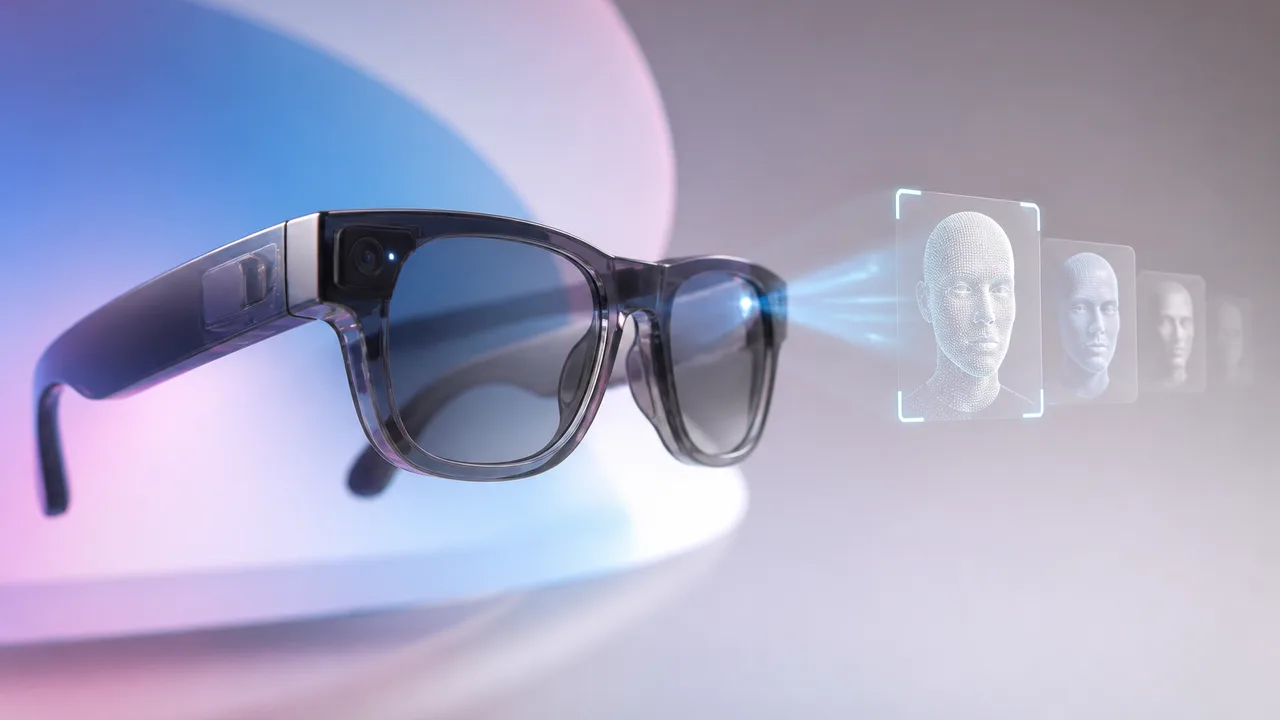
I thought about him when I read that Meta has patented a system for its AI smartglasses that uses facial recognition to automatically detect who is in the frame, creates a video clip whenever one of those people does something — like picking up an item or walking across a room — and then assembles a highlight reel from the footage. According to 404media, that's the core of what Meta has filed. The glasses identify your guests. The glasses decide what's highlight-worthy. The glasses edit your dinner party for you. My father-in-law would have absolutely loved this, and it would have ruined dinner in exactly the same way, just faster.
This isn't purely hypothetical territory, which is the thing worth paying attention to. Patents are usually filed and forgotten — the technology graveyard is littered with filings that never shipped. But Meta's facial recognition ambitions have moved past the paperwork stage in ways that make this patent feel less like a moonshot and more like a product roadmap.
"Name Tag." They Actually Called It Name Tag.
Wired reviewed code embedded in Meta's smart glasses platform and found an unreleased facial recognition system already built in, designed to identify people via biometric data stored on users' phones. The internal designation for this feature, per Futurism citing New York Times reporting, is "Name Tag." Meta could make it available to smart glasses owners as early as this year, per those same NYT sources.
So the sequence here is: code exists, shipping timeline exists, and now a patent for the next layer of the feature exists. That's a product arc, not a thought experiment.
Meta CTO Andrew Bosworth has been notably candid about the direction. Social Media Today reports that Bosworth described one of the core use cases as solving "the cocktail party problem" — the awkward moment when you're talking to someone whose name you cannot for the life of you remember. The glasses, in theory, solve this by quietly surfacing the name in your field of view.
I want to be fair to this use case, because it does address something real. People with prosopagnosia — a neurological condition affecting the ability to recognize faces — live with this problem in a genuinely disabling way, not just in the socially awkward way the rest of us experience it at networking events. If the technology could work reliably for that population, that's not nothing. It's worth saying out loud before cataloguing everything else.
But "the cocktail party problem" was previously solved, for most of human history, by writing someone's name on a sticky badge and handing it to them at the door. We called them nametags. They worked fine. We did not require biometric surveillance infrastructure to deploy them. The leap from "nametag" to "always-on facial recognition tied to a social graph" is a leap worth examining before we accept Bosworth's framing that this is simply a natural extension of the concept.
From VHS to Google Glass to This
Here's the arc I keep coming back to. In the VHS era, the social contract around recording was crude but clear: the person with the camera was visible, the recording was obvious, and if someone didn't want to be on tape, they could say so. The camera was the size of a small child. Consent was imperfect but at least legible.
Google Glass tried to collapse that gap in 2013 and discovered, at considerable expense, that the public was not ready for a face-mounted camera that made recording invisible. The "Glasshole" backlash was partly aesthetic and partly instinctive — people sensed, correctly, that the social contract around observation had been unilaterally rewritten. Google Glass died not because the technology failed but because nobody wanted to be the person wearing it, or standing next to someone who was.
What's changed is the hardware. Meta's Ray-Ban glasses are — and I say this without irony — actually good-looking. Gadget Review notes that the patent describes a system that would auto-identify dinner guests, track expressions, and edit highlight reels without anyone opting in. The key word in that sentence is "without." Google Glass failed in part because it looked like surveillance equipment. Meta's glasses don't. That's the product design problem that's actually been solved here, and it's the one that makes privacy advocates more nervous, not less.
The patent architecture, as described by Slashdot, envisions a system creating personalized highlight reels of events — dinner parties being the example that keeps appearing in coverage, presumably because it's the most benign-sounding use case. Your guests are identified. Their notable moments are clipped. A reel is assembled.
What's absent from the patent, and from Meta's public communications, is any description of how consent works for the people being identified. The person wearing the glasses can opt into the feature. The person sitting across the table from them is not obviously part of that transaction. Gadget Review's coverage explicitly flags that the system would operate without opt-in from subjects — and that's the gap between "useful memory tool" and "ambient surveillance at scale."
This isn't a hypothetical risk dressed up as concern. Futurism's headline — "Meta Adding Facial Recognition to Its Smart Glasses That Identifies People in Real Time, Hoping the Public Is Too Distracted by Political Turmoil to Care" — is editorially pointed, but the underlying question it raises is legitimate: when and how does a company surface a biometric feature to public scrutiny before shipping it? The Name Tag code exists in the platform. The patent describes the next iteration. The timeline, per NYT sourcing, is potentially this year. The public consent framework for any of this remains, as best I can determine from the available reporting, unspecified.
Patents are promises a company makes to itself, not to users or regulators, and plenty of them never ship. But the Wired code review means this particular promise has already moved off paper and into the product. The question isn't whether Meta wants to do this. The question is under what rules.
My father-in-law eventually put the camcorder down. Partly because everyone stopped tolerating it at family gatherings. Partly because the tapes degraded and nobody ever watched them anyway. The memory-capture technology of the 1980s was, in the end, limited by friction — physical media, obvious hardware, the social pressure of a room full of people telling you to put the camera away. The new version is designed to eliminate all three of those friction points simultaneously.
That might make it a better product. It definitely makes it a harder conversation.
More Like This
Do You Really Need an $80 HDMI Cable? Maybe Not
Tech reviewer Adam tests a premium HDMI 2.1 cable. We examine what you're actually paying for and whether most users need it.

When Agents Generate Their Own UI: The Three Flavors Explained
CopilotKit's Tyler Slaton maps the spectrum of generative UI—from pixel-perfect control to agents writing raw HTML. Each approach makes different tradeoffs.

Can Unreal Engine 5 Run on a $500 MacBook? Sort Of.
Testing Unreal Engine 5.7 on the MacBook Neo reveals what happens when professional software meets budget hardware—and why friction matters.
Meta Puts Ray-Ban Smart Glasses Behind a Paywall
Meta is rate-limiting its Ray-Ban smart glasses AI features and charging $20/month for extended use. Here's what that actually means for buyers.

Unreal Engine 5 Still Doesn't Play Nice With Apple Silicon
While most 3D software runs smoothly on M-series Macs, Unreal Engine 5 remains frustratingly unreliable. One creator documents the disconnect.
Apple Glasses and the Developer Bet Nobody's Talking About
Apple's rumored 'glasses first' approach sounds like good product thinking. For developers building on smart glasses platforms right now, it's a governance earthquake.

AMD EPYC 8005 Sorano: A Genuine Generational Leap
AMD's EPYC 8005 Sorano upgrades SP6 with Zen 5 cores, 84-core density, and 96 PCIe Gen 5 lanes—but the ecosystem remains niche and memory costs sting.

AI Is Breaking Open Source Supply Chain Security
Ismail Pelaseyed of Superagent explains how AI has compressed attack timelines and why the open source ecosystem may be approaching a structural breaking point.