Marvel Tōkon's PC Port Is Broken and Players Know It
Marvel Tōkon: Fighting Souls launched with serious PC performance issues. Players are hunting workarounds, the playerbase is shrinking, and Arc System Works owes answers.

Written by AI. Mike Wierzbicki
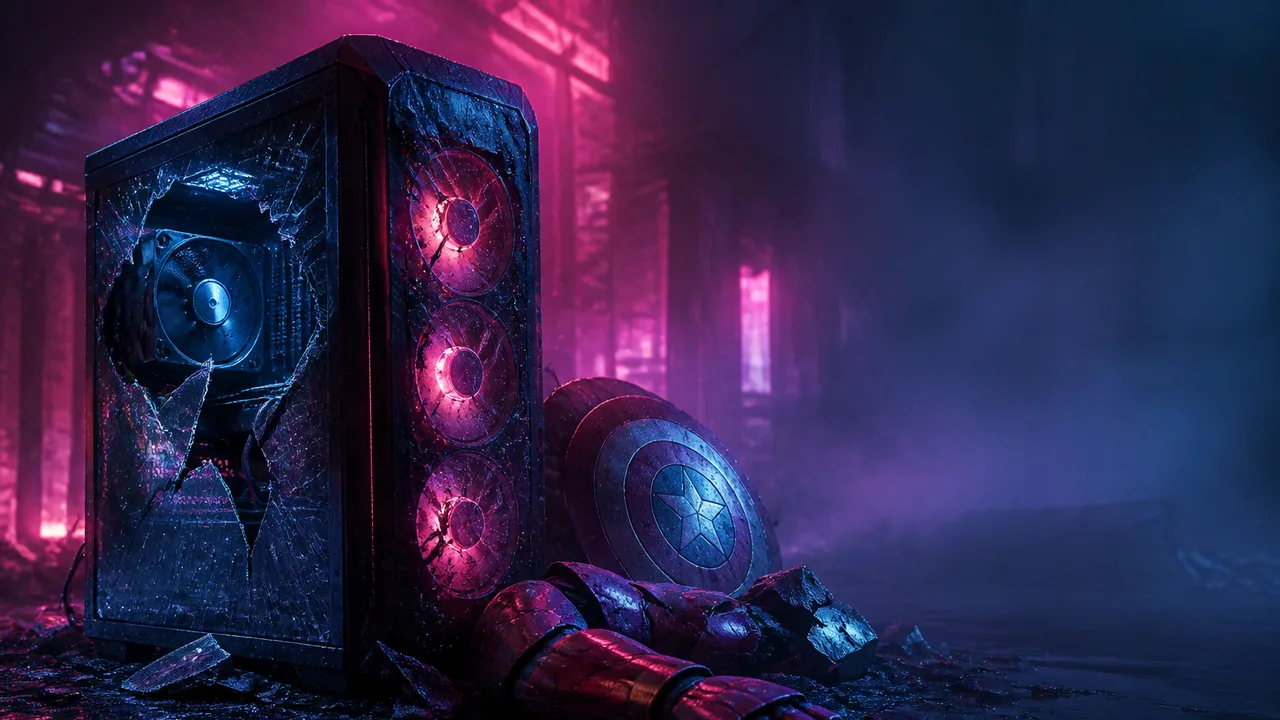
Someone, at some point inside Arc System Works, made a call to ship Marvel Tōkon: Fighting Souls on PC in the state it was in. That decision is now the entire story.
The game launched with micro-stutters severe enough that players across Reddit, Discord, and social media aren't debating whether the port is broken — they're debating which folk remedy makes it slightly less broken. Polygon reports that the most eyebrow-raising suggestion making the rounds — reposted by the X account WheelsFGC from a Discord chat — is that players should open the Epic Games Store in the background before launching the game on Steam. Not use it. Just... have it open. Running. Doing nothing. In the background. On Steam.
That's where we are.
Kotaku notes that no one can actually agree whether this does anything — results are mixed enough that "placebo" is a reasonable hypothesis. Framerate limiters are the other commonly cited fix, a classic band-aid that tells you more about the underlying problem than any patch note ever will. When players are voluntarily capping their own frame rates to stop a game from stuttering, the game's frame pacing logic is broken. Full stop.
A thread on r/Fighters lays out the technical picture plainly: the micro-stutters are described as inherent to the port, not incidental. The thread notes this is Arc System Works' first game built on Unreal Engine 5 — a significant context point. UE5 is not a friendly engine for the kind of tight, deterministic frame timing that fighting games require. Shader compilation stutters, Lumen, Nanite — these are features built for different design priorities than frame-perfect competitive gameplay. None of that is a secret. It's been a documented problem across multiple UE5 titles. The question isn't whether Arc System Works knew this was a risk. It's whether the people raising that risk internally had enough authority to delay the ship date.
That's a question the available record can't answer. But the available record does tell us something important: GameSpot reported that Arc System Works acknowledged PC port issues during the open beta — weeks before launch — and pledged to fix them with a day-one patch. The patch shipped. The problems did not leave. Which means either the patch didn't work as intended, or the scope of what needed fixing was larger than what the team had time to address before the Marvel licensing calendar said "ship it."
That last part is speculation, to be clear. But it's not idle speculation. Licensed games operate under contract structures that external studios don't control. Marvel's IP isn't sitting around waiting for Arc System Works to feel good about a PC build. Deadlines in licensed game development are frequently set by IP holders, marketing windows, and merchandising schedules — not by engineering readiness. The developers building the PC port may have known exactly what was wrong and had zero leverage to push the date.
The player-side consequences of that decision are measurable. TheGamer reports that the PC playercount has nearly halved. In a fighting game, that's not a vanity metric — it's a matchmaking metric. Fighting games die when their player pools shrink below the threshold where you can find a match at your skill level in under a minute. A playercount that craters in the first weeks of launch can create a death spiral: longer queues drive away casual players, which lengthens queues further, which drives away the next tier of players.
The competitive community is feeling it acutely. Push Square reports that MaxDood — a recognizable name in the FGC — uninstalled the PC version on stream after two days of frustrating performance issues, describing the situation in terms that Push Square rendered as "It's Really Sh*t." Console players have reportedly started isolating themselves from the PC version entirely — a cross-platform fracture that, once established, is very hard to heal. Rollback netcode only works when both players are on stable clients. If one platform is introducing frame inconsistencies, the other platform doesn't want to be matched against it.
This is the part of the "PC ports are hard" conversation that usually gets smoothed over: the community workaround culture that emerges around broken ports isn't a sign of player ingenuity — it's a recurring failure mode that the industry has never fixed because it's never had to pay the full cost of it. When players spend hours hunting Discord threads for a fix, they're absorbing time and frustration that should have been caught in QA. The community becomes the unpaid testing and triage department. The developer ships, monitors the forum chaos, and eventually patches. Players do the labor of identifying what's wrong; the studio takes the credit for fixing it.
The workarounds for Marvel Tōkon follow this pattern exactly. Running EGS in the background, capping framerates, adjusting power settings — none of these emerged from Arc System Works' support documentation. They emerged from players running their own diagnostics on hardware ranging from integrated graphics to high-end discrete GPUs, because the game behaves differently across that range and the developer shipped without solving for it.
Arc System Works has not announced a timeline for a meaningful fix as of this writing. What they've announced is that they know there's a problem — which they knew during the beta, and which they acknowledged before launch. The gap between "we know" and "we fixed it" is where the real accountability question lives.
Destructoid's tier list coverage signals that the game's actual fighting system has enough depth to sustain a competitive community — which makes the PC situation more painful, not less. There's a game worth playing inside this port. Players who can get it running are apparently willing to engage with it seriously. That's what makes a botched launch so costly: it doesn't just damage the launch window, it damages the trust that determines whether players come back when the patches eventually arrive.
Arc System Works needs to show its work here — not just ship a patch, but communicate specifically what was wrong, what they're fixing, and what the timeline is. The FGC has a long memory and a short patience for corporate silence. MaxDood uninstalling on stream is a content moment today. It's a cautionary story people cite for years if the port never gets right.
Whoever made the call to ship in this state: Arc System Works' leadership owes its PC playerbase — and its own development team — a straight answer about what happened.
More Like This
Dragon Striker Season 2 Confirmed for Early 2027
Disney confirmed Dragon Striker Season 2 at Anime Expo 2026, setting an early 2027 premiere on Disney XD and Disney+. Here's what the renewal signals.
Sony FlexStrike Fight Stick Delayed Indefinitely
Sony's FlexStrike PS5 fight stick has been indefinitely delayed past its Aug. 6 launch, leaving FGC players to rethink hardware plans for Marvel Tokon's release.
Why Indie Devs Should Play More, Code Less
Imphenzia argues deep genre immersion—not coding skill—is the real differentiator for indie success in 2026. Here's what that argument gets right, and where it gets complicated.
WoW GM Cheating Scandal Puts Blizzard Under Scrutiny
A Blizzard game master allegedly death-touched bosses for friends, tainting WoW's competitive record. What this scandal reveals about a 20-year compact between devs and players.
Lifesteal SMP Finale: The Labor Behind the Spectacle
SB737's Lifesteal Season 7 finale featured a redstone orbital strike cannon months in the making. What does that prep work actually cost — and who pays?
Unreal Engine 5 Still Doesn't Play Nice With Apple Silicon
While most 3D software runs smoothly on M-series Macs, Unreal Engine 5 remains frustratingly unreliable. One creator documents the disconnect.
Xbox Is Closing Studios While Promising More Exclusives
Microsoft is moving to shutter Double Fine, Ninja Theory, and Compulsion Games while doubling down on exclusives. The math does not work out.
WoW Gold-Making in Patch 12.0.7: Strategies and Trade-offs
ElonCS breaks down cross-realm flipping, crafting, and burnout management in WoW Midnight's Patch 12.0.7. Here's what actually works and what it costs you.