WoW Gold-Making in Patch 12.0.7: Strategies and Trade-offs
ElonCS breaks down cross-realm flipping, crafting, and burnout management in WoW Midnight's Patch 12.0.7. Here's what actually works and what it costs you.

Written by AI. Mike Wierzbicki
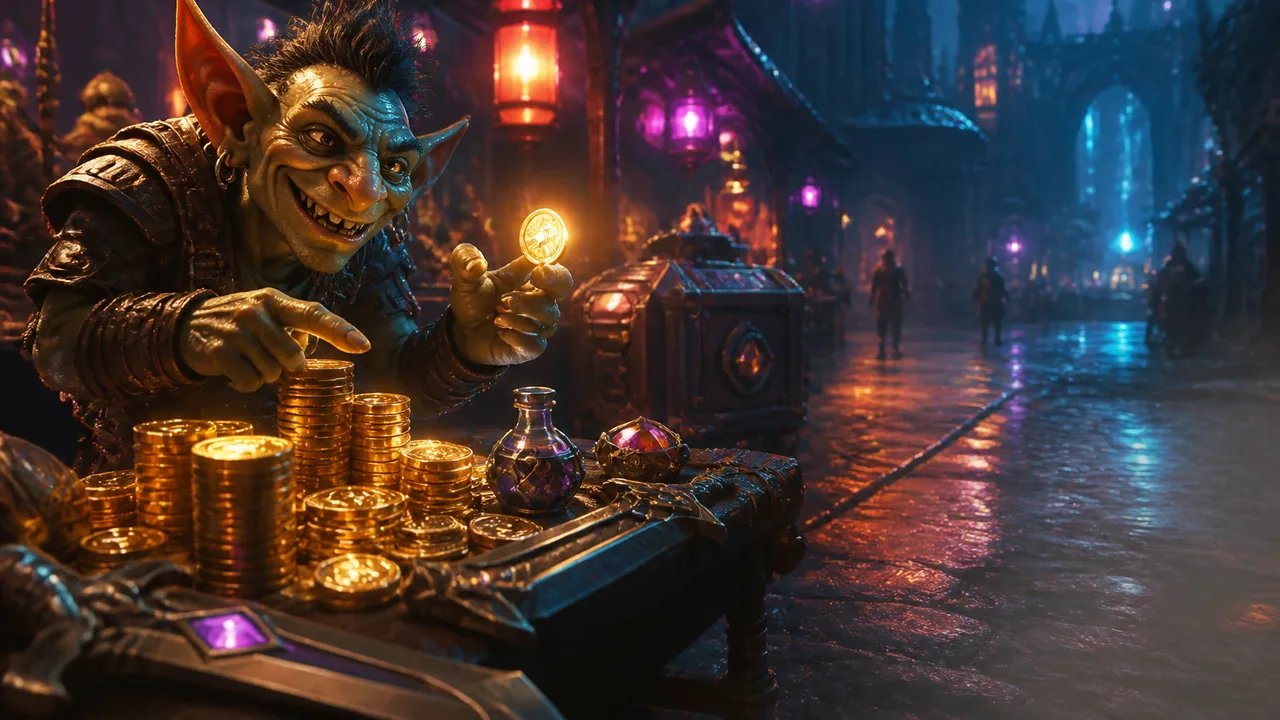
Photo: AI. Kai Hargrove
There is a version of World of Warcraft gold-making that looks like passive income. You log in, open some mailboxes, watch numbers climb, log out. ElonCS — a streamer who runs a Twitch and YouTube channel dedicated to WoW economy content — operates somewhere in that territory, pulling in sales across 7,000 to 10,000 listed items spread across EU and NA realms simultaneously. In a recent 2h40m Patch 12.0.7 live stream, he walked viewers through a full collection cycle starting at 38,839,387 gold and targeting the 40 million mark, narrating every sale, every craft queue, and every market decision in real time.
What actually comes through over nearly three hours is something more complicated than a gold-making tutorial. It's a portrait of a system that works — but only if you're honest about what it demands.
The Architecture of Scale
ElonCS's operation is built on two interconnected pillars: cross-realm flipping and concentration crafting. The cross-realm approach exploits the fact that WoW's auction houses aren't fully unified. Prices for the same item vary between realms, and by maintaining flipper characters across dozens of servers, you can buy low on oversupplied realms and sell high on undersupplied ones. During the stream, ElonCS collects gold from mailboxes across multiple characters on both EU and NA — logging in and out repeatedly through what he describes as a noticeably laggier login screen since the last patch.
The sales themselves swing wildly. A 671 gold mailbox here, 102,000 gold there, a 217,000 gold haul from one character with multiple items sold to different buyers. Pets, transmog pieces, crafted gear, toys — the catalog is broad by design. "If you have 10% of that [7-10k items], you can expect about 10% of the sales on average," he tells a viewer who's disappointed by their own results with 700 items. The math is straightforward. The setup is not.
The second pillar, concentration crafting, centers on alchemy. Crafting potions with concentration resources — a mechanic that gives bonus skill or quality to crafts — generates consistent per-craft profit, especially with vials. ElonCS puts the figure at roughly 450 to 500 gold profit per craft using CraftSim, the addon he recommends for accurate profitability checks over Auctionator, which he flags as unreliable for this purpose. Tailoring runs alongside it for cooldown-gated cloth bolts, netting around 87 to 100 gold per bolt. Not spectacular, but predictable.
The interesting wrinkle on crafting: Patch 12.1 or next season is apparently bringing a change that lets players convert five rank-one vials into one rank-two vial. ElonCS isn't sure what that does to the alchemy concentration economy, but the uncertainty is notable. "I don't know what that does with the prices," he says during the stream. "Are we going to get less concentration value in alchemy? In that case, it would suck since that's the only like great one." Anyone building their gold-making infrastructure around alchemy concentration right now should probably be watching PTR notes.
The Item That Broke Live
The most instructive moment of the stream isn't the big mailbox collection. It's the Element Infused Rocket Helmet.
ElonCS starts pulling sales of this craftable toy — selling in the 8,000 to 9,000 gold range with material costs around 2,100 gold — and is visibly confused about why. Multiple sales, different buyers, across different realms. Then chat figures it out: the toy works in combination with a goblin glider to cover distance quickly, and that combination is tied to an achievement. Demand materialized because of content utility that wasn't obvious from the item tooltip alone.
"Goblin glider plus element infused rocket helmet plus 60 seconds equals achievement done," ElonCS summarizes once chat connects the dots. He immediately starts calculating whether he has more in stock and whether he should be crafting more.
This is the part of auction house play that no spreadsheet captures cleanly. The item's sale average over 14 days was 5,000 gold and declining in quantity listed. Something changed — the achievement, a new use case, a content patch driving traffic to old items — and the market repriced faster than any scan would anticipate. The viewers who had the item posted were in the right place. The viewers who didn't were watching someone else collect.
The Burnout Problem Is Structural
The most substantive non-mechanical conversation in the stream is about burnout, and ElonCS returns to it repeatedly because his chat is full of people at different stages of it.
One viewer scaled to 32 servers with 50 items each, spent two hours cycling through EU and NA, then cut to 24 servers — and sales went up. Another viewer started with tailoring flippers and has grown to 20, eyeing expansion. A third is trying to balance M+ progression, raiding, and flipping simultaneously and describes their operation as their "rat army" when friends ask why they can't just log on and play.
ElonCS's framing is consistent: the system should serve you, not the other way around. "The problem starts when you start doing stuff all the time that you don't want to do. For example, if you set up 100 concentration crafters — which is extreme, I know, but some people do that — and then they realize, 'I actually have to do concentration every four days on this and that's not fun.' And then they force themselves to do that because they've done the setup, and then they quit the game."
He's essentially describing the sunk-cost trap in game design terms. The infrastructure becomes an obligation, the obligation kills the fun, and the fun is the entire point. His practical prescription: post on 48-hour cycles, don't undercut-scan (just get more items), and it's fine to post half your characters one day and the other half another day if that's what keeps you engaged.
Whether that's actually achievable at the scale he operates — 7 to 10 thousand items is not a casual setup — is a fair question. The stream does run nearly three hours on a Monday, after all.
Bots and the Economy They Distort
About midway through the stream, chat flags a cluster of obvious bots in Orgrimmar — level-one orc warriors running identical paths to the auction house with nearly identical names. ElonCS confirms they've also pushed into the active Midnight markets, which is more disruptive than bots haunting deprecated content.
The discussion that follows is worth reading carefully, because it doesn't land where you'd expect. ElonCS doesn't moralize. He maps the incentive structure: gold selling is a real industry, some operators run thousands of accounts, the revenue per account exceeds the subscription cost by enough margin to keep scaling, and the detection infrastructure at Blizzard's scale has limits that solo GMs on private servers don't face simply because the private server economy isn't worth attacking.
"As long as you can make a sustainable living cash by selling gold, you're going to have bots in the game, no matter what," he says. "The only way to eliminate it is [to ban them] so fast that they can't make profit on it."
He's not endorsing it. He's describing the equilibrium. Whether Blizzard's investment in enforcement matches the scale of the problem is a separate question — one that affects every legitimate player trying to read accurate market data through a noise floor of automated listings.
What 40 Million Actually Costs
By the end of the collection run, ElonCS crosses 40 million gold — 40,000,060 — having started at just under 38.84 million. That's roughly 1.16 million gold collected in one weekly cycle across both regions. For reference, he estimates a WoW token equivalent requires approximately four tokens to cover the Midnight expansion price, and the token exchange rate in gold is in the six-figure range per token. The math works; it just requires the operation to already be running.
For players earlier in the process, ElonCS's recommendation is blunter: farm hard with whatever gives fast gold until you can afford the expansion and first token, then build the infrastructure slowly. Starting with flipping before you have auction house access and seed capital is building on sand.
The lumber-gathering project he starts toward the end of the stream — a plan to accumulate 3,000 of each of twelve lumber types for housing decor crafting — is presented as a long-term investment in cross-realm seller stock. He estimates roughly 60 hours of gathering across all lumber types. That is, by any measure, a second job. Whether the decor market holds through the next patch that introduces copy-paste housing builds (which could spike demand) or collapses under competition is unknown.
That uncertainty is what makes the WoW economy genuinely interesting as a system, and also what makes it genuinely exhausting as a hobby. The same patch that creates an Element Infused Rocket Helmet spike can quietly kill an alchemy strategy you've been building for two months.
More Like This

Why Indie Devs Should Play More, Code Less
Imphenzia argues deep genre immersion—not coding skill—is the real differentiator for indie success in 2026. Here's what that argument gets right, and where it gets complicated.
Minecraft Java Multiplayer in 2026: Who Pays the Price?
Mojang's new native Friends List threatens the small-studio ecosystem built around Java's multiplayer gap. Here's what that means for how you play.
Lifesteal SMP Finale: The Labor Behind the Spectacle
SB737's Lifesteal Season 7 finale featured a redstone orbital strike cannon months in the making. What does that prep work actually cost — and who pays?
NotebookLM Gets an Agent OS Upgrade—Here's What That Means
Julian Goldie's new NotebookLM workflow pairs it with Hermes, Obsidian, and Hyperframes. Here's what the setup actually does—and what to think about before building it.
Exploring Minecraft Capes and Player Engagement
A deep dive into Minecraft capes, their history, and how they shape player engagement and community culture.
WoW Midnight's Economy and the Memory Stored in Icons
A WoW streamer's gold-making stream revealed something unexpected: twenty years of item iconography living as folk knowledge inside a player community.
Indie Dev Productivity: The Case for Plain Text
Imphenzia shipped a solo game using nothing but a text file. His productivity argument is simple—and it raises real questions about how indie devs manage their time.
When Building a Database Beats Using One
Clockwork Labs built SpacetimeDB from scratch for their MMO. The performance numbers suggest they made the right call—but the reasoning matters more.