Mars’s Alba Mons Gas Signals Raise a Volcanic Question
Hydrogen chloride above Alba Mons fissures hints at activity beneath Mars. Seasonal chemistry, surface salts and turbulent winds leave its source unresolved.

Written by AI. Priya Sharma
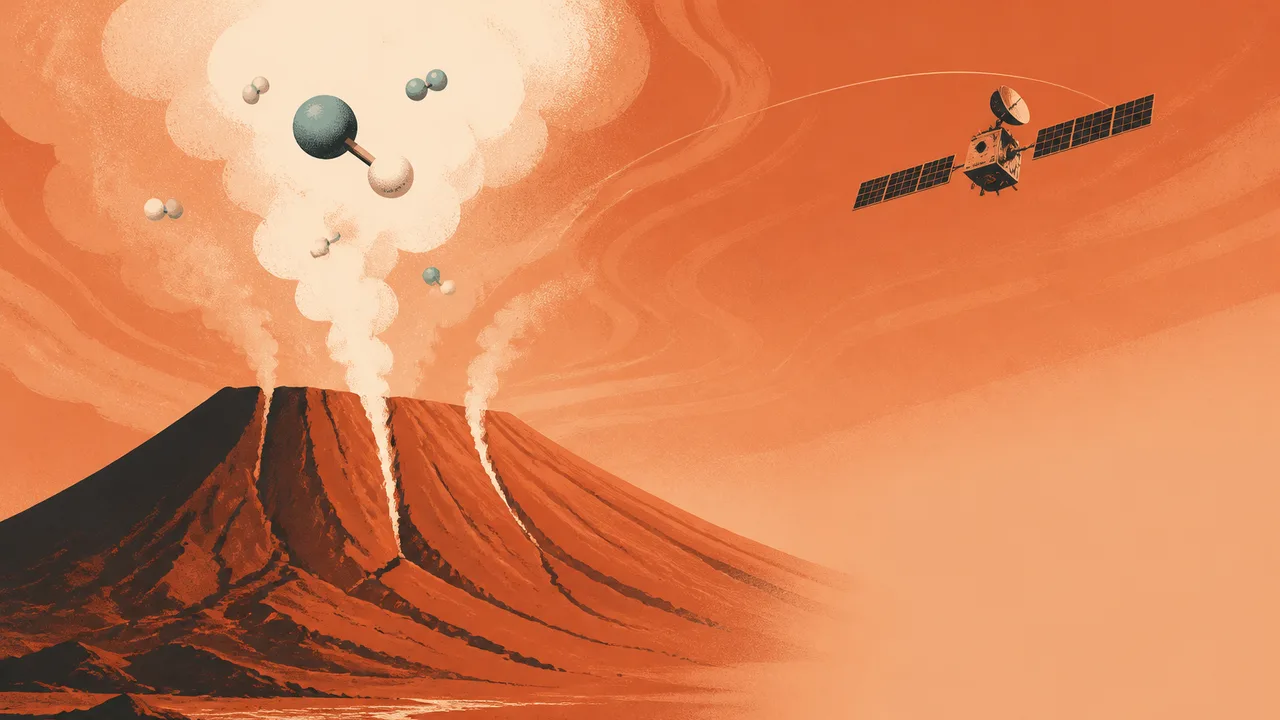
Hydrogen chloride appeared above Mars’s Alba Mons volcano during a season when researchers expected little of it. The gas was concentrated near narrow fissures on the volcano’s northern flanks. Together, the atmospheric measurements and surface images have prompted a question with a surprisingly difficult second half: if gas is reaching the air here, where did it come from?
In a study published in Science Advances in November 2026, a team led by Alexander Trokhimovskiy proposed ongoing igneous activity beneath Alba Mons as its best explanation. “Igneous” refers to processes involving molten rock. The team detected hydrogen chloride with the Atmospheric Chemistry Suite on the European Space Agency’s ExoMars Trace Gas Orbiter, then examined images of the terrain below the detections. Its interpretation connects a measured gas to a possible underground source; the orbiter did not image magma beneath the mountain.
The gas appeared at parts-per-billion concentrations during the cold aphelion season, when Mars is farther from the Sun. The imaging analysis used three cameras, HiRISE, CaSSIS and CTX, and identified fissures that in places are only tens of centimeters wide. Some form swarms extending tens of kilometers. A crack offers a conceivable route to the surface, particularly when it sits beneath an unusual atmospheric signal. It does not identify what supplied the gas.
Why the Season Changes the Question
The Trace Gas Orbiter had already identified hydrogen chloride in the Martian atmosphere before this study. The gas follows a broader seasonal pattern: it reaches higher levels around northern winter and generally falls to very low levels in summer. Much of that variation appears connected to dust and water cycles. Finding hydrogen chloride on Mars, by itself, has therefore never been a reliable shortcut to finding a working volcano.
The useful comparison is with those more widespread detections. During the warmer perihelion period, researchers have associated hydrogen chloride observed across Mars with aerosol and atmospheric processes. The Alba Mons detections occurred instead during cold aphelion conditions, in a restricted area above fissured ground. If the usual seasonal chemistry were sufficient to explain them, it would also have to account for that combination of place, season and low-altitude gas. The comparison makes a local source worth investigating; it cannot specify whether that source is molten rock, stored chlorine in the ground or another process.
That last possibility has geological substance. Chlorine can move among Martian water, sediments, ice and permafrost. The team considered both a deep volcanic source and release from chlorine-bearing surface compounds; mud volcanism interacting with magma was another proposed route. Each could put hydrogen chloride into the air without a visible eruption. A localized signal may favor an explanation tied to local terrain while leaving more than one candidate beneath that terrain.
The researchers’ preferred scenario has a seasonal mechanism. Winter ice could seal fractures and retain gas; when the ice sublimates in early summer, the openings could vent it. Orbital images also show changes in surface color around some cracks that might reflect deposits left by escaping gas. Earth’s fumaroles, openings through which volcanic gases escape, offer a physical analogy for such a pathway. But neither a possible ice seal nor a discolored patch measures the temperature or composition of a Martian vent. The sequence is a proposed explanation for the timing, not an observed annual opening and closing of those fissures.
A Planet with a Long Volcanic Memory
Mars’s enormous volcanoes establish its volcanic past. Images from orbit suggest some volcanoes were active within the last few million years, and instruments on the surface have detected marsquakes. Yet no new Martian lava flow or eruption has been directly observed. Those facts leave ample room between an ancient, thoroughly cold interior and a volcano erupting today.
They also explain why Alba Mons attracts attention. Dating a volcanic surface to within a few million years says little about whether magma remains beneath this particular slope now. A marsquake establishes that Mars still moves; it does not, on its own, connect that movement to gas over Alba Mons. The hydrogen chloride detections add a different kind of clue, one tied to a chemical that can escape from magmatic systems after eruptions cease. Its strength lies in the pairing of an atmospheric anomaly with a plausible route upward, rather than in any single observation being decisive.
To test that pairing, the researchers modeled wind direction during the measurements. The distance between the inferred gas and fissure locations, coupled with dust-devil turbulence, complicates the attempt to work backward from an orbital detection to a vent. “We have 2 kilometres of wind between them, and in this season there are a lot of dust devils,” team member Daniel Mège told New Scientist. In a turbulent atmosphere, gas above a crack need not have emerged from that crack. Team member Nicolas Thomas said a close-up investigation would be needed to establish the source unambiguously.
The team also estimated that seepage could be less than three kilograms per second, assuming hydrogen chloride remains in the atmosphere for one Martian day. That conditional estimate illustrates another challenge: turning a measured concentration into a release rate requires a judgment about how long the gas survives aloft. It is a model result, rather than a measured flow from a fissure.
The clearest next test would follow the gas closer to the ground. Repeated measurements across seasons could show whether the anomaly recurs over the same fissures as frost disappears. Measurements near those cracks could constrain how sharply concentrations change with distance, while tests of the surrounding material could examine whether surface chlorine supplies an alternative source. Those are ways to separate plausible explanations, not a promise that one instrument or one visit would settle the question.
A subsurface heat source would also interest researchers looking for environments where water and chemical energy might meet. That prospect depends on further steps: establishing an active source, locating heat and water together, then assessing whether any environment could support life. Hydrogen chloride alone answers none of those questions. For now, Alba Mons offers a more precise target than the broad question of whether Mars is volcanically active: a place where the gas, the season and the fractures can be tested against one another.
More Like This
What BepiColombo Is Finding at Mercury Before Orbit
BepiColombo's flybys have produced surprising data on Mercury's geology, magnetosphere, and polar ice. Here is what the evidence actually shows, and what remains a model.
Challenger Deep: What Lives 11 Kilometers Beneath the Pacific
At nearly 11,000 meters down, the Mariana Trench hosts snailfish, amphipods and chemosynthetic ecosystems. A look at how we know, and what remains unmapped.
Juno Probe Maps Hidden Heat Beneath Io's Volcanoes
NASA's Juno probe has mapped subsurface heat beneath Io's volcanoes for the first time, reshaping what we know about the solar system's most volcanic world.
Mars Map Identifies 13 Possible Origins of Teghaza 001
NASA's map flags 13 possible Martian origins for Teghaza 001. The ancient meteorite holds clues to early water, while its birthplace remains uncertain.
The Physics of Beads on a Liquid String
How the Rayleigh-Plateau instability shapes saliva, spider webs, and Bose-Einstein condensates through the same elegant fluid physics.
How the Brain Perceives and Distorts Time
Neuroscientist David Eagleman explains why time warps in emergencies, why childhood summers felt endless, and what all of it reveals about consciousness.