Levitating Dipole Fusion Gets a Second Look
Open Star Technologies is reviving the levitating dipole fusion concept with a novel maintenance-first engineering approach. Here's what makes it different.

Written by AI. Olivia Meng
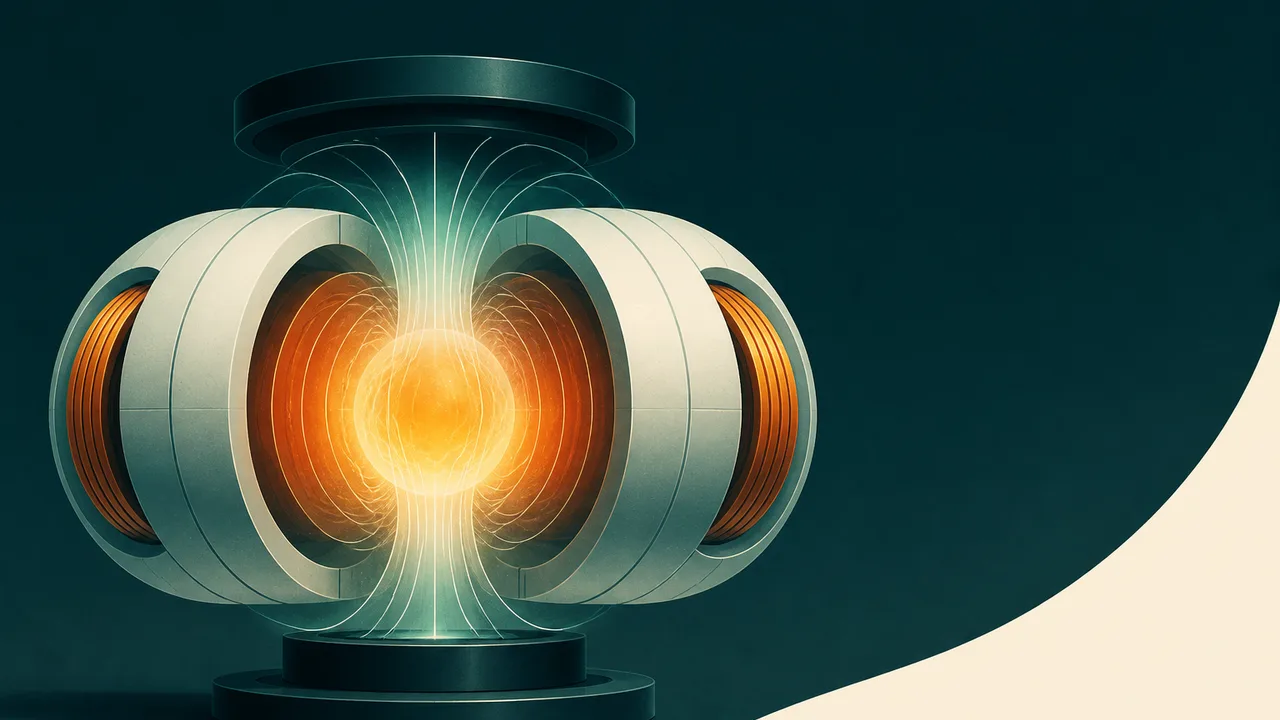
Photo: AI. Mika Sørensen
The fusion community has a long memory for ideas that didn't pan out, and the levitating dipole reactor spent decades in that particular filing cabinet. The concept had been around since the 1980s, attracted a dedicated if small cohort of researchers, and then quietly stalled — a victim not of theoretical failure but of one stubborn engineering problem nobody could solve. A New Zealand startup called Open Star Technologies just published a paper arguing they've found a way around it, not through a breakthrough in physics, but through something more prosaic: a maintenance schedule.
The approach they've revived is worth understanding on its own terms before weighing the claim. In conventional magnetic confinement fusion — the kind pursued by tokamaks like ITER and stellarators like Wendelstein 7-X — the fusion plasma lives inside a torus-shaped chamber surrounded by external magnets. Keeping the plasma from touching the walls is the central challenge; contact means damage, and damage means downtime. The levitating dipole design inverts this geometry. Rather than surrounding the plasma with external magnets, a large superconducting magnet is suspended — levitated — inside the plasma vessel itself. This single internal magnet generates the dipole field that traps and compresses the plasma.
The advantages of this inversion are real. Hossenfelder, who covers the physics in her recent video commentary on the Open Star paper, notes that the geometry of the dipole field naturally suppresses certain plasma instabilities that torment tokamak designers. The internal magnet also simplifies the overall coil architecture, which translates, at least in principle, to lower construction costs. Fewer magnets, cleaner field, more stable plasma.
The problem, equally real, is that you've now put your magnet inside the plasma. In deuterium-tritium fusion — the fuel combination that operates at the lowest required temperatures and therefore represents the nearest-term path to a commercial reactor — the reaction produces fast neutrons in abundance. Neutrons carry no charge, which means neither electric nor magnetic fields can deflect them. They travel wherever the physics sends them, which includes straight into the internal magnet. Cumulative neutron bombardment degrades superconducting materials, and a degraded magnet means a weakening or collapsing confinement field.
This is why the levitating dipole concept was never seriously pursued at commercial scale. MIT's Levitated Dipole Experiment (LDX), which according to Wikipedia ran from 2004 to 2011, demonstrated the physics at small scale. Japan maintains a modest research facility. But the neutron problem made deuterium-tritium fuel look incompatible with the approach, and the only alternative — neutron-lean fuels like boron — require plasma temperatures dramatically higher than deuterium-tritium, pushing the engineering challenge in the other direction entirely. The field moved on.
What Open Star has done, at least on paper, is refuse that conclusion. Their answer to the neutron problem is not to solve it physically but to accept it operationally. As Hossenfelder summarizes their position: "Shield the magnet as well as you can, and then make sure that you can replace the shield when needed. So, the weakness of the approach becomes a maintenance problem."
The specific design centers on a superconducting magnet — the kind built from rare-earth barium copper oxide (REBCO) compounds, a class of high-temperature superconductors well-established in fusion research — wrapped in a shield of tungsten and boron carbide, materials chosen for their heat resistance and neutron-absorbing properties. What's architecturally novel is that the magnet is not monolithic. It has a primary inner section and an outer section that functions essentially as a sacrificial layer. Open Star's design calls for robotic extraction of the outer magnet module at regular intervals — roughly annually — followed by replacement of the damaged components in a shielded facility. The downtime for each cycle is estimated at around two weeks.
Hossenfelder's framing of this is the line that stuck with me: "It's basically the fusion reactor of Theseus, except every plank is radioactive and the philosopher has died." That's a joke, but the underlying observation is serious. The design institutionalizes degradation rather than pretending it isn't happening. In an industry where decades of optimism have consistently collided with the gap between controlled physics demonstrations and working power plants — what some have called the engineering frontier that follows the scientific one — there's something almost refreshing about a design philosophy that begins with "this will break; here's how we fix it."
The reactor design carries the name Tama Nui, derived from the Māori word for sun.
The important caveat is that none of this has been built or demonstrated. Open Star has published a design paper, not a working prototype. The plasma physics, the magnet levitation control, the robotic replacement mechanism, the neutron shielding performance under sustained bombardment — each of these represents an engineering challenge that exists at the moment only as a projected specification. Hossenfelder is careful to note that "Open Star has not solved nuclear fusion, but they have proposed a serious engineering route for a strange old fusion idea that previously had a big problem." That's a fair characterization. A credible engineering route is not nothing; it's also not a reactor.
There's also a question the paper's framing doesn't fully answer: how does the economics of scheduled magnet replacement compare to the alternatives? Every planned shutdown carries costs — not just the two-week replacement window, but the supply chain for replacement components, the shielded handling facilities, the specialized robotic systems. Open Star's argument is that accepting these costs upfront is more tractable than either solving neutron damage at a material level (which nobody has done) or switching to neutron-lean fuels (which require plasma conditions we can't yet sustain). That argument is plausible, but it's a business case as much as a physics case, and business cases for fusion technologies have a complicated historical record.
What makes this worth watching, beyond the specific design, is what Hossenfelder identifies as its broader implication for fusion startups generally. The fusion investment landscape has attracted substantial capital in recent years, with companies pursuing everything from tokamak variants to inertial confinement to magnetized target fusion. Most of the technical discourse centers on plasma physics, confinement geometry, and ignition thresholds. Maintenance — the grinding, unglamorous question of what happens to a commercial reactor over decades of operation — gets comparatively little attention in public-facing materials.
Hossenfelder makes the point directly: "Other startups should spend more time thinking about the question of regular maintenance because it'll be a major contributor to the running cost." For a technology sector where 'decades away' has been a standing joke and where the engineering challenges now arguably exceed the physics challenges, the operational economics of a working fusion plant matter as much as the conditions inside the plasma. Degradation under neutron flux isn't unique to the levitating dipole — every deuterium-tritium reactor design has to contend with neutron bombardment of structural components. Open Star has simply made that confrontation the centerpiece of their design rather than an afterthought.
Whether that makes Tama Nui a viable commercial reactor or an interesting engineering thought experiment won't be clear for years. But the concept that spent forty years in the discard pile has at least earned a second read.
More Like This
Engineering an LED Supernova: A Nuclear Approach
A nuclear engineer evaluates a DIY LED project, highlighting heat management, design intricacies, and nuclear parallels.

Could Life on Earth Have Arrived via Asteroids?
Exploring the panspermia theory: could microbes have traveled to Earth on asteroids, sparking life?
Subcritical Reactors: Nuclear Power's Safety Fix?
A new generation of subcritical reactors promises to make nuclear meltdowns physically impossible. But can they deliver on cost, scale, and timeline?
Fission vs Fusion: The Physics Behind Our Energy Future
A nuclear engineer's corrections to a viral science explainer reveal why misunderstanding fission and fusion has real costs for the energy transition.
Casimir Inc Raised $12M on Quantum Vacuum Claims
Casimir Inc claims its microchip harvests unlimited energy from the quantum vacuum. The physics says otherwise—and $12 million is riding on that gap.
Quaise Energy Is Vaporizing Rock to Reach Geothermal Heat
Quaise Energy has raised $234M to drill geothermal wells using fusion-derived energy beams. Here's what's real, what's unproven, and what's at stake.

Spain's 2026 Total Solar Eclipse: Best Cities to Watch
On August 12, 2026, a total solar eclipse crosses Spain. Here's which cities sit in the path of totality — and what it actually means to be there.

How Humidity Makes Extreme Heat Deadly
Wet bulb temperature, not air temperature, determines when heat kills. Joe Hanson's lab experiment reveals what our bodies face in a hotter, more humid world.