Kingdom Hearts Shows How Fortnite Sells a Crossover
Fortnite's Kingdom Hearts bundle pairs premium pricing with playable weapons and careful fan service, revealing how Epic's crossover machine works in 2026.

Written by AI. Mike Wierzbicki
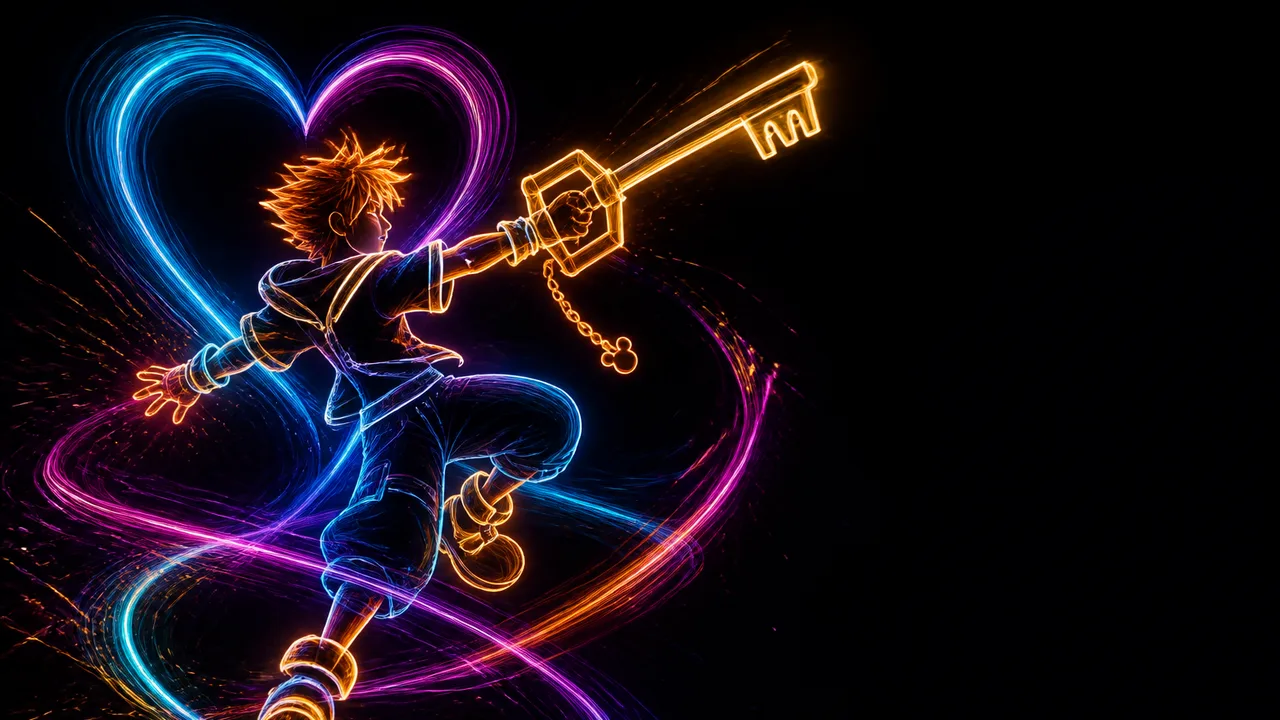
Epic Games put Sora, Riku, Kairi and Roxas in Fortnite on September 17, turning a long-teased skin into one of the game's largest licensed merchandise drops.
The collaboration arrived with four outfits, Lego styles, character-specific pickaxes, back bling, emotes, music and a Gummi Ship car. It also brought the Kingdom Key into Battle Royale as a weapon. That spread matters because it shows what a Fortnite crossover has become in 2026: a storefront, a playable event, a marketing campaign and a temporary mechanical layer, all built around somebody else's characters.
Sora was visible in Override's season art for weeks before Epic's September 13 teaser promised his arrival “this week.” The fuller reveal then confirmed a September 17 launch during Tokyo Game Show week, with Riku, Kairi and Roxas joining him. Siliconera's account of the trailer notes that it used Hikaru Utada's “Sanctuary” and presented the characters through designs drawn from Kingdom Hearts II and III.
That rollout displayed unusual care for a commercial tie-in. It also led directly to an unusually expensive checkout screen.
A 4,500 V-Bucks Licensing Package
The complete Kingdom Hearts package costs 4,500 V-Bucks, tied with the Solo Leveling bundle as Fortnite's most expensive bundle, according to TheGamer's Item Shop breakdown. Sora costs 1,800 V-Bucks individually, while Riku, Kairi and Roxas each cost 1,600. Their pickaxes cost 800 apiece. The wider shop rollout includes a 2,000 V-Bucks Gummi Ship car, two 500 V-Bucks Jam Tracks, footwear, emotes and Sea-Salt Ice Cream back bling.
A dollar conversion would be misleading without fixing a region, platform and V-Bucks purchase package. The useful comparison sits inside Fortnite itself: Epic and its licensing partners placed Kingdom Hearts at the top tier of the game's bundle pricing.
The collaboration also reaches beyond purchased cosmetics. Variety reported that every outfit received back bling, a pickaxe and a Lego Fortnite style, while two Power Hours sessions on September 19 started players with a Kingdom Key and Sea-Salt Ice Cream.
In regular play, the Kingdom Key can appear in chests or as floor loot. Game Rant's weapon testing recorded 40 damage for a standard swing, 65 for a magical attack on a 16-second cooldown and 35 for a jump attack. Eliminations also produce healing pellets. The guide judged it weaker than gun-heavy loadouts because its slow melee attacks leave the user exposed.
That mechanical weakness does not diminish its marketing function. A cosmetic asks players to look like Sora. A loot-pool weapon lets every nearby player perform a recognizable slice of Kingdom Hearts combat, including players who never visit the Item Shop. The asset becomes advertising that other players can pick up, swing and drop.
From Thanos Event to Licensed Content Stack
Fortnite's first major crossover event used Marvel's Infinity Gauntlet as a contested item that transformed one player into Thanos. Aftermath traces the current model back to that event, after which licensed skins, objects and locations became part of Fortnite's regular operating rhythm.
The contrast with Kingdom Hearts is instructive. Thanos functioned as an event premise. Kingdom Hearts arrives as a content stack: characters for the standard game, Lego-compatible versions, vehicle content, music, cosmetic accessories, scheduled sessions and a weapon with its own damage values and cooldown. Each Fortnite mode creates another surface where a license can be sold or promoted. One crossover consequently requires adaptation across several systems rather than a single character model and storefront tile.
That expansion helps explain the 4,500 V-Bucks package without proving why Epic selected that price. The bundle contains more categories of work and more opportunities to display the license. It also tests how much franchise attachment can support at checkout. Epic and Square Enix have not disclosed the licensing terms, development costs or revenue split, so the price cannot tell us who captures which share.
The timing serves both companies even if neither has publicly described its strategy that way. IGN characterized Override's reception as cooler than the preceding Runners season and said player numbers had dipped slightly from summer highs, although it supplied no figures. A major crossover gives Epic a new acquisition and retention beat inside that season.
Square Enix, meanwhile, has more Kingdom Hearts to sell. A native Kingdom Hearts collection for current consoles is scheduled for October 8, Kingdom Hearts IV is due in late 2027, and an anime is in development. Noisy Pixel also reports that the franchise has passed 39 million units worldwide. Fortnite places those characters in front of a broad live-service audience during the runway to several releases.
The sequence supports a mutual-promotion reading, not a claim about private intent. Square Enix gets renewed character visibility; Epic gets a premium bundle and an event beat. Without contracts, internal forecasts or post-launch player data, anything stronger would be corporate fan fiction, a genre already crowded enough by Kingdom Hearts lore.
Sonic Shows the Limits of Character Protection
The sharper question is what the licensing machine does to the characters themselves. Aftermath argues that Fortnite's anything-goes toy box dilutes characters by detaching their appearance from the rules that made them recognizable. Its strongest comparison is Sonic: the Sonic, Knuckles and Shadow outfits are presented in tie-in lore as androids created by Dr. Eggman and repurposed by Tails.
That solution protects the original characters through substitution, but it also advertises the distance between the licensed image and the character. Kingdom Hearts took a different route. The reveal trailer presented Sora, Riku and Kairi with Keyblades, familiar combat choreography and “Sanctuary.” Kotaku observed that the trailer was an almost shot-for-shot recreation of the opening moments of Kingdom Hearts II and avoided ordinary Fortnite gunplay.
The strongest defense of the collaboration rests there. Epic's marketing team did more than import recognizable silhouettes. It reproduced visual grammar, music and movement that Kingdom Hearts players associate with the source games. Sora even has edit styles corresponding to all three mainline entries.
The protection ends when the match begins. Kairi can carry a shotgun, Roxas can perform unrelated emotes and every Keyblade pickaxe has a Loot Llama keychain. Fortnite's systems flatten licensed characters into interchangeable player avatars because interchangeability is the product. The trailer can preserve tone for 40 seconds; the sandbox resumes control afterward.
Sonic and Kingdom Hearts therefore mark two approaches to the same licensing problem. Sonic uses fictional distance, while Kingdom Hearts uses faithful presentation. Neither escapes Fortnite's shared verbs, weapons and emotes. The comparison also has limits: the Sonic android explanation is explicit tie-in lore, while the Kingdom Hearts rollout is being judged mainly through its trailer, cosmetics and live gameplay. Future story material could change that reading.
Players can reasonably see the result as affectionate fan service, expensive brand extraction, or both operating in the same Item Shop. The useful test is concrete: how much of a character's design, movement and context survives after Fortnite makes every licensed figure obey the same systems?
Kingdom Hearts survives that conversion better than many crossovers because Epic built room for its music, weapons and animation language. The 4,500 V-Bucks price reveals the other side of that care. In Fortnite's crossover machine, fidelity is no longer restraint. It is another premium feature.
More Like This
Steam Achievement Leak Exposes Persona 6, Kingdom Hearts 4 Records
A third-party Steam achievement database listed unreleased games including Persona 6 and Kingdom Hearts 4. What the records show, and what they cannot prove.
Epic Games Store Is Coming to Linux — With Caveats
Epic confirmed a native Linux version of its store is in development. The launcher is the easy part. Whether Fortnite follows is the real question.
Gaming Meets Hollywood at FT Entertainment Summit
EA and Tencent will share a stage with Netflix, Sony, and Disney at the FT Business of Entertainment Summit. Here's what that guest list actually signals.
Why Sega Built an Android Sonic to Get Into Fortnite
Sega put Sonic at the center of Fortnite's Battle Pass by making him an android. Takashi Iizuka explains the loophole, and it says a lot about crossover branding.
Epic Games Settles Fortnite Collaboration Leaks Lawsuit
Epic Games settled its lawsuit against former contractor Hayden Cohen, aka AdiraFN, permanently barring further leaks of Fortnite's confidential collaboration plans.

Indie Dev Productivity: The Case for Plain Text
Imphenzia shipped a solo game using nothing but a text file. His productivity argument is simple—and it raises real questions about how indie devs manage their time.
Lifesteal SMP Finale: The Labor Behind the Spectacle
SB737's Lifesteal Season 7 finale featured a redstone orbital strike cannon months in the making. What does that prep work actually cost — and who pays?