Steam Achievement Leak Exposes Persona 6, Kingdom Hearts 4 Records
A third-party Steam achievement database listed unreleased games including Persona 6 and Kingdom Hearts 4. What the records show, and what they cannot prove.

Written by AI. Sarah O'Brien
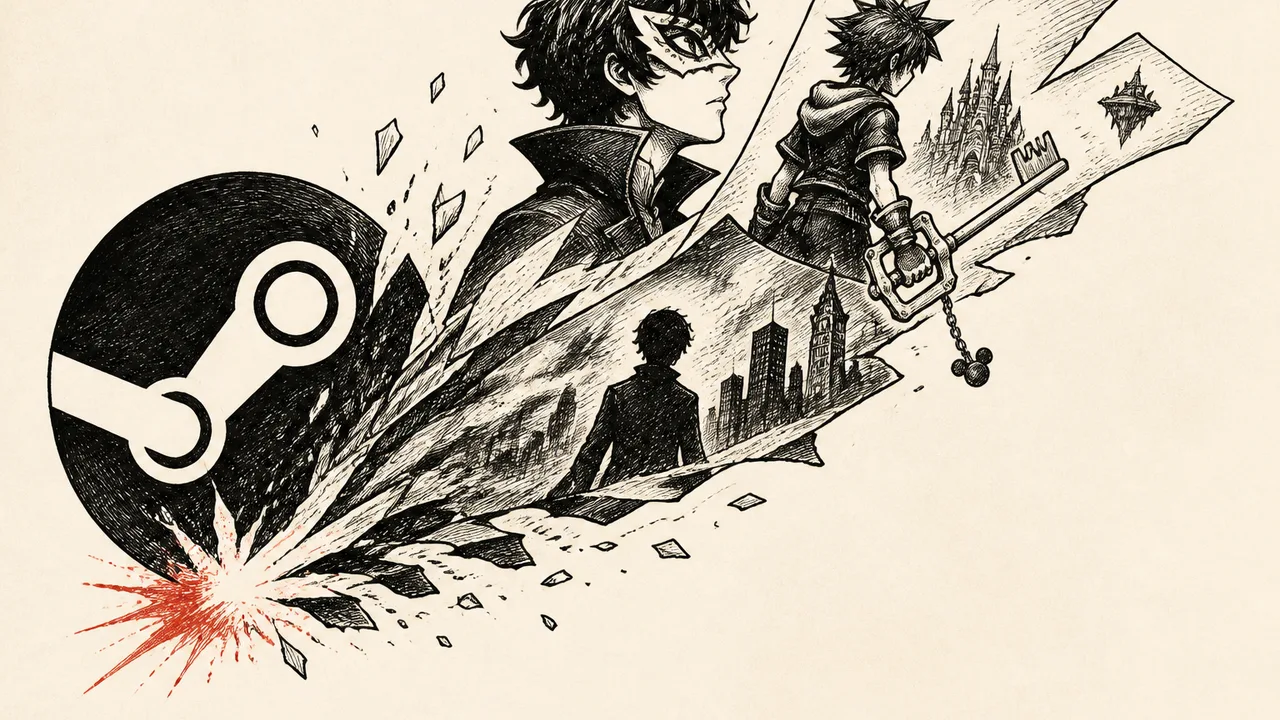
A third-party achievement database has surfaced listing entries for dozens of unreleased PC games, including Persona 6 and Kingdom Hearts 4, two titles neither Atlus nor Square Enix has shown in any playable form since their initial announcements. According to PC Gamer, the listings may cover "countless" forthcoming PC games and even include some that have never been formally announced at all.
The immediate fallout centered on two franchises with enormous, spoiler-sensitive fanbases. IGN reported that the apparent leak revealed Persona 6 and Kingdom Hearts 4 achievements alongside entries for unannounced games, while Eurogamer cautioned that spoilers for both titles "may have emerged" amid what it described as a massive achievements leak for unreleased games.
What the Kingdom Hearts Listings Claim
The Kingdom Hearts 4 material drew the most scrutiny. Kotaku reported that the listings include material tied to Disney worlds, naming Coco, Zootopia, and Star Wars among the referenced properties. DualShockers framed the leak as revealing "long-awaited favorites," and Nintendo Everything described it as a major leak surfacing new worlds.
If accurate, the worlds named would represent notable departures. Star Wars has never appeared as a world in a mainline Kingdom Hearts game, and its inclusion would mark one of the largest Disney properties Square Enix has ever folded into the series. Coco and Zootopia, both Pixar films, have also never appeared in the franchise. But achievement text is written early, revised often, and sometimes abandoned entirely. A world referenced in an achievement string in 2026 may not exist in the game that ships.
Persona 6, Ace Combat 8, and the Rest of the List
The Persona side of the leak carries its own risks. Game Rant reported that the leaked achievements appear to expose story and gameplay details for Persona 6, a game Atlus has not formally detailed beyond confirming its existence. For a series whose appeal depends heavily on narrative surprise, achievement text can function as a spoiler vector in a way that a leaked asset or screenshot sometimes does not.
Beyond the two headline franchises, TheGamer reported that the leak also covers entries for Fable and Dragon Ball Xenoverse 3, while PC Gamer's reporting added Ace Combat 8 to the list of affected titles. GamesRadar stressed the word "allegedly" in its own coverage, noting that the games in question include titles still formally unannounced. Noisy Pixel characterized the total scope as dozens of upcoming games.
What an Achievement Record Can and Cannot Prove
Here is the archival reality: a database entry is evidence that a record existed, nothing more. Achievement metadata is infrastructure, and infrastructure gets populated early. Localization teams write placeholder strings. Test builds carry provisional names. Achievements get deleted, renamed, and restructured between vertical slice and gold master. Anyone who has read through a shipped game's files knows how much provisional language survives into the final product, and how much provisional language gets cut before it.
That cuts both ways. The existence of a Persona 6 entry in a Steam-adjacent database is meaningful evidence that Atlus has been preparing the PC version of the game for some time, something the company has never confirmed with a platform or date. The existence of a Coco achievement string is weaker evidence that Coco will appear in Kingdom Hearts 4, because world rosters in that series churn through years of development. Kingdom Hearts 3 famously went through rumored worlds that never shipped, and the series' development history is long enough that fans should know this pattern by name.
None of the outlets covering the leak have independently verified the listings against sources inside Atlus, Square Enix, Sega, or Disney. Every report in this cycle carries conditional language: "may have," "appears to," "allegedly." That is appropriate caution, and it is also a signal. The reporting layer, whatever its flaws, is treating this as a lead. Parts of the audience are not.
Leaks by Infrastructure
The modern leak rarely arrives through a stolen build or a disgruntled employee. It arrives through the plumbing. Achievements, trophy lists, rating board filings, trademark renewals, backend database changes, retailer SKU registrations: each is a system designed for operational efficiency that doubles as an early warning system for anyone watching. SteamDB and similar trackers have turned monitoring that plumbing into a spectator sport, and publishers have responded by treating every backend action as potentially public.
This creates a genuine tension in how games get made. Publishers want to populate storefront infrastructure early, because certification, achievement integration, and localization all require lead time. Those same requirements mean a game in active production leaves fingerprints across systems the publisher does not fully control. The leak this week, if the listings prove accurate, is not the result of anyone breaking into anything. It is the result of records existing where records must exist.
The publishers involved now face the standard leak playbook. Silence lets the speculation calcify into assumed fact, which becomes a problem when the assumed facts are wrong. A correction confirms the leak's authenticity and extends its news cycle. An accelerated announcement surrenders the marketing calendar to someone else's timing. Sega and Square Enix have historically been slow to comment on leaks of any kind, and neither company had responded at the time of the reports cited here.
How to Read This List
Treat the list as a map of what was in development at some point, weighted by probability. Games with long-standing public confirmation, like Persona 6 and Kingdom Hearts 4, sit at the high-confidence end: a database entry is consistent with what we already know. Games listed as entirely unannounced sit at the low end, and the correct posture toward them is agnosticism, not anticipation. Fable and Ace Combat 8, both publicly confirmed projects, fall somewhere in between; their entries are likelier to be accurate in existence and unreliable in detail.
The Kingdom Hearts world names deserve the most skepticism proportionate to the excitement they have generated. World rosters are the most volatile element of that series' development, and achievement strings attached to worlds can predate a world's removal by years. Fans who spend the next month treating Star Wars as confirmed are building expectations on a string of text written by a contractor who may have moved on.
One more thing worth flagging, because nobody else in this cycle has: spoiler culture now extends to databases. A game's achievements are written to be read after playing, and their early exposure converts a completion reward into a narrative outline. Eurogamer's spoiler warning is the most consequential sentence published about this leak, more so than any world name. The information that damages players most may be the information nobody headlines.
Whether any of these listings survive to launch is a question only the games themselves will answer. Until then, the record says a record exists. That is where the evidence ends, and where the patience of several very large fandoms begins.
More Like This

GPT-6 Astra Leaks, Opus 5.1 Signals, and HY4
GPT-6 Astra demo leaks show one-shot game generation. Anthropic quietly tests Opus 5.1 while angering users with a rate limit cut disguised as a raise.
Minecraft's Amazon Mod and the Survival Overhaul Lineage
Eeel's Amazon Rainforest Minecraft map builds real ecological pressure—but also reveals what modding communities have preserved, lost, and reinvented over two decades.
WoW GM Cheating Scandal Puts Blizzard Under Scrutiny
A Blizzard game master allegedly death-touched bosses for friends, tainting WoW's competitive record. What this scandal reveals about a 20-year compact between devs and players.

Capcom, Jira, and the Question of Who Gets to Make Games
A former Capcom employee's critique of Jira-heavy Western studios has reopened an old argument about process, creative ownership, and who actually authors games.
Do You Need a Game Design Document? A History Weighs In
Imphenzia says a one-page GDD is all you need. The history of game documentation—and what gets lost without it—says the stakes are higher than that.
GYLD Raises $1M to Predict the Next Hit Game
GYLD closed an oversubscribed $1M seed round for Critical Compass, a hit-prediction tool that flagged Clair Obscur early. Here's what that actually means for developers.
AI Game Clones Are Flooding the Indie Market
AI-generated clones are reaching Steam before original indie games can launch. Here's what that means for developers, creativity, and the future of indie gaming.
ESO's Leadership Purge Is a Preservation Crisis
Xbox layoffs gutted ZeniMax Online's leadership after 200+ cuts. For ESO's 11-year history, the real loss may be institutional knowledge no one wrote down.