I Play Rocky Turns Stallone's Life Into Franchise Myth
Peter Farrelly's I Play Rocky turns Stallone's 1976 triumph into a studio myth, raising questions about authorship, ownership and Oscar nostalgia once again.
Written by AI. Theodore "Teddy" Ashworth III
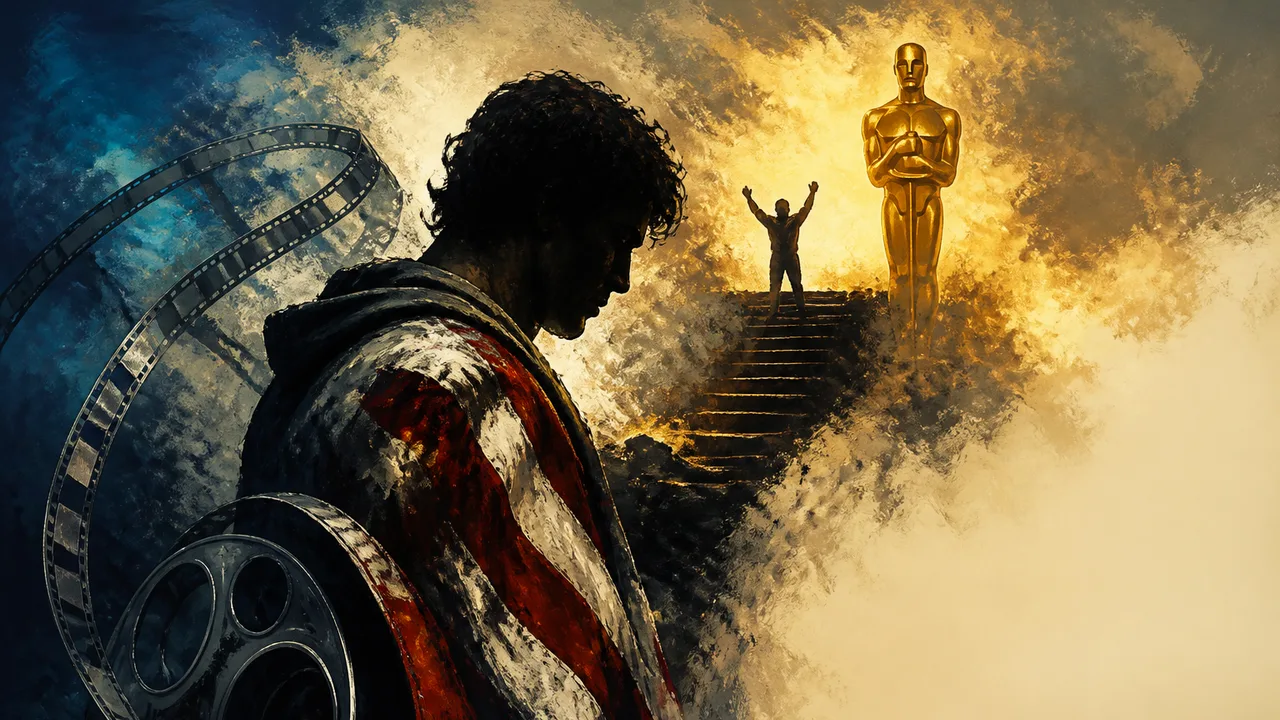
Amazon MGM’s I Play Rocky turns Sylvester Stallone’s 1976 breakthrough into a new underdog myth, fifty years after the original made him one. Peter Farrelly’s film follows the broke actor and screenwriter as he refuses to surrender the title role, forces Rocky into existence and watches it win best picture. At its Toronto International Film Festival premiere, the movie received a rousing standing ovation. Hollywood loves a story about the outsider who beats the system—especially once the system owns the story.
Farrelly has offered a simple thesis for the enterprise. In remarks reported from a Collider conversation, he called Stallone’s ascent a better story than Rocky Balboa’s. The fictional boxer begins with a job and loses his championship bout while going the distance. Stallone begins homeless, sells his dog, holds onto his script and ends at the Academy Awards. One man earns self-respect; the other gets a franchise.
That contradiction gives I Play Rocky its sharpest edge. The film celebrates Stallone’s refusal to surrender control of the character he created, yet it now exists inside a franchise machine that can tell his story without his participation, and apparently without paying him for it. The irony is hard to miss: a movie about an artist insisting that his work cannot be separated from him has become proof that, eventually, it can.
The Legend Has Excellent Dramatic Form
The film’s historical spine already resembles a screenplay because Stallone spent half a century telling it as one. In the account dramatized by I Play Rocky, he watches Muhammad Ali fight Chuck Wepner for 15 rounds, writes Rocky in three and a half days and takes the script to producers Robert Chartoff and Irwin Winkler. They consider Charles Bronson, Burt Reynolds, Clint Eastwood and Ryan O’Neal for the lead. Stallone refuses to sell unless he stars.
THR’s review describes the offer rising to $360,000 before the producers halve an already modest $2 million budget to preserve his casting. The movie uses Tracy Letts’s Sandy Maddox as a composite studio executive, an open admission that history has been compressed into a cleaner antagonist. Biopics do this as routinely as boxers skip rope. The question is whether compression reveals the struggle or embalms the sales pitch.
Farrelly’s strongest case is that the broad outline needs little cosmetic surgery. An unknown actor did insist on playing the hero he wrote. The resulting film defeated All the President’s Men, Network and Taxi Driver for best picture. Rocky became powerful partly because audiences could sense its author performing his own wager. Stallone’s bruised face carried two narratives at once: Balboa asking to be seen as more than a leg-breaker, and Stallone asking Hollywood to see him as more than Thug No. 2.
That doubling is also the new film’s trap. Anthony Ippolito must play Stallone while reminding viewers of Rocky, whose screen persona Stallone built from pieces of himself. The result can become a hall of mirrors decorated by MGM. The Playlist praised the entertainment while arguing that the film redirects affection for Rocky onto itself through nostalgia. Its callbacks reportedly extend from the Philadelphia steps and meat locker to raw eggs and Conti’s theme. Recognition becomes the house currency, and the audience arrives with pockets full of it.
Authorship Meets Ownership
The sharpest tension comes from what happened after the triumph. THR reported that Farrelly showed Stallone the finished film and said Stallone was pleased with it. Stallone did not participate directly, however, and the same report recalled his public attack on Winkler in 2022 over the absence of an equity stake in the Rocky franchise. Winkler, played sympathetically by P.J. Byrne, appears in a cameo.
Those facts do not establish that the new film misrepresents Stallone or that its production arrangements are unjust. The available reporting contains no contract history sufficient for either judgment. Stallone’s reported approval also resists the tidiest interpretation of him as an unwilling subject. Approval, participation and ownership remain three different forms of power, however, and I Play Rocky places their separation in unusually bright light.
The reasoning runs like this: the 1976 story treats creative identity as indivisible, since Stallone believes nobody else can embody what he wrote. The 2026 film depends on that belief because it supplies the climax, title and marketing proposition. Yet the legend now functions as an asset that other performers, writers and corporate custodians can reproduce. Stallone won the role; the role outlived his control over its commercial mythology.
A harsher film might have made that contradiction its subject. Farrelly appears more interested in vindication. Slant’s review calls the result hagiography, arguing that it discovers little beneath the familiar rise and reduces Sasha Czack to a cheerleader. IndieWire reaches a related conclusion from a warmer position: its review says the script sands down the harsher material, showing only one night of homelessness and playing an admission of paternal abuse largely for laughs.
A crowd-pleaser can still contain truth. Simplification may clarify why Stallone’s gamble moved people, and Ippolito’s performance has drawn praise even from reviews skeptical of the surrounding film. The disagreement concerns what audiences should demand from a biopic whose subject already converted his life into legend. Farrelly treats repetition as communal pleasure. His critics see a studio polishing inherited mythology until every rough edge reflects the logo.
The Green Book Precedent Has Limits
Farrelly has walked this festival route before. Green Book divided critics at Toronto in 2018, won the festival’s audience award and eventually took best picture. That precedent explains why applause for I Play Rocky immediately became awards news. It does not make applause predictive by itself. I Play Rocky has yet to repeat those later steps, and this year’s competition includes other accessible studio contenders.
IndieWire’s early awards assessment argues that Amazon may have stronger reason to prioritize Project Hail Mary, while crowded directing and acting fields could leave Farrelly’s film outside major categories. The comparison with Green Book identifies a viable constituency: voters who respond to polished uplift and stories about cultural institutions congratulating themselves. It cannot measure how many voters will embrace another Farrelly victory lap.
Early review aggregation offers a similarly provisional clue. Based on 20 reviews, I Play Rocky stood at 75 percent on Rotten Tomatoes, above four of the six original films but below Rocky Balboa at 78 percent and Rocky at 93 percent. Twenty reviews make a weigh-in, not a final decision, and comparisons across five decades of criticism have obvious limits. Still, the ranking suits the film’s predicament. It may prove more accomplished than several sequels while remaining dependent on an original whose emotional capital it cannot recreate from scratch.
I Play Rocky asks audiences to cheer when Stallone declares that only he can play his creation. Fifty years later, a different actor delivers the line inside a studio film made without Stallone’s direct involvement. The legend has gone the distance; ownership is the bout that never reached the final bell.
More Like This
Furies: Clooney-Backed Beirut Heist Thriller at Venice
George Clooney backs Furies, a Venice-bound heist thriller about two women robbing a Beirut bank, drawing on the country's devastating banking crisis.
Resident Evil Finds a New Route From Game to Screen
Early reviews praise Zach Cregger's Resident Evil for translating survival horror to film while leaving room for reinvention, friction and fan debate.
David Byrne's Concert Film Shot in 70mm by Brady Corbet
David Byrne's new concert film 'Who Is the Sky?' pairs the Talking Heads icon with Brutalist director Brady Corbet, shot in grand 70mm format.
Casey Affleck's 'Company': A Gothic Anthology Divides Venice
Casey Affleck's third film as director, the gothic anthology Company, split critics at Venice 2026. What the reviews agree on, and where they part ways.
Visually Stunning Movies Nobody Talks About
From Tarsem Singh's The Fall to the anime fever dream Redline, these nine films are visually extraordinary—and almost entirely ignored. Here's why that matters.
Why the Ocean Still Terrifies Us: Depths of Fear
Quinn and James of Cosmic Chronicles explore why the ocean remains humanity's oldest, deepest fear—from the Mariana Trench to the myth of the Bermuda Triangle.