How to Protect Yourself From Pickpockets in Europe
Practical, unsentimental advice on avoiding pickpockets in Europe—how thieves actually work, where they target tourists, and what you can do about it.

Written by AI. Mariel Fontaine
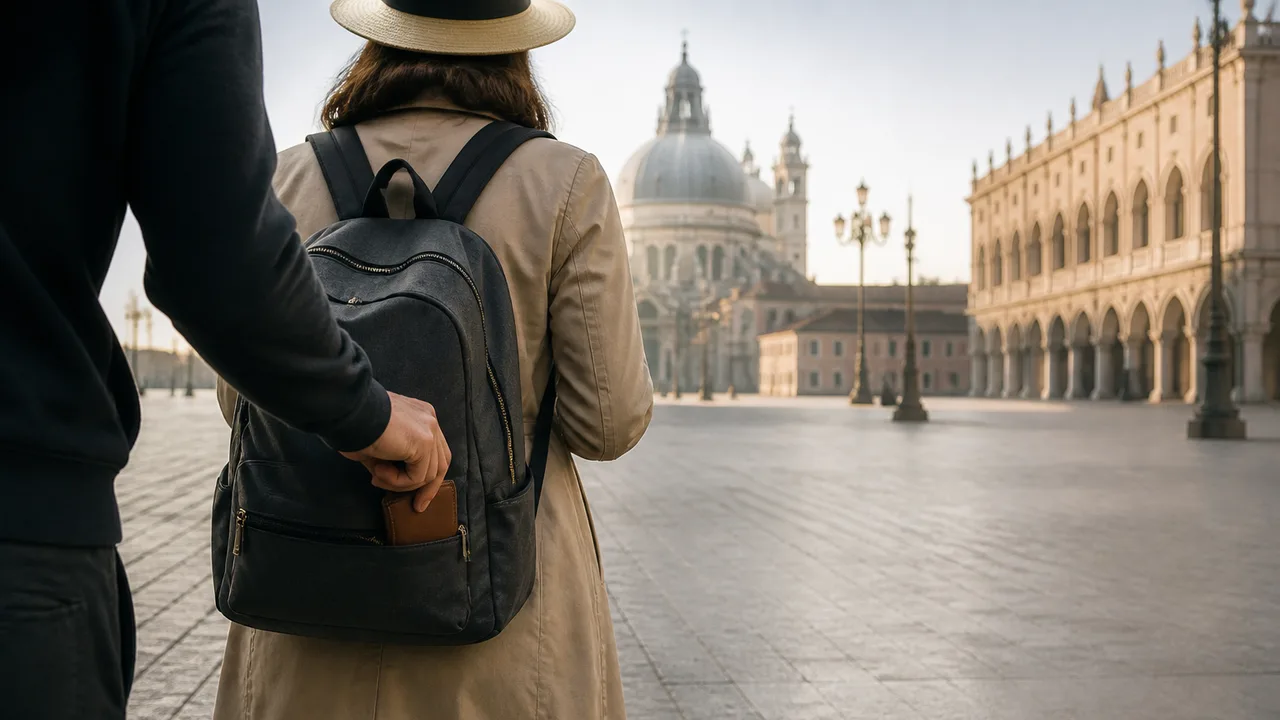
Photo: AI. Hayden Cross
There is a small ritual that plays out thousands of times a day across European tourist corridors. A traveler arrives at the Louvre, the Sagrada Família, the Trevi Fountain—somewhere luminous and crowded—and in the act of craning their neck upward, they hand a stranger the only window they need. The stranger, of course, is not admiring the architecture.
Mark Wolters of Wolters World has spent considerable time in these cities and has watched this dynamic play out enough times—including within his own family—that his recent video on pickpocket prevention carries a certain earned authority. It is worth engaging with seriously, not because the threat is catastrophic (Wolters is emphatic that most European trips are entirely incident-free), but because the gap between what travelers think keeps them safe and what actually does is genuinely instructive.
The Architecture of a Theft
The single most useful reframe Wolters offers is this: stop imagining a pickpocket as a lone, furtive figure skulking at the edge of a crowd. Modern street theft is typically a coordinated operation. There is someone to identify targets. Someone to create a distraction. Someone to execute the theft. And someone to receive the goods and walk away in a different direction before you've processed what happened.
His account of his mother's experience in Barcelona illustrates the choreography cleanly. A well-dressed man approached her, expressed concern about mustard on her bag, helped her set it down, chatted warmly, and left. A beat later, she turned around. The bag—taken by a second person she had never registered—was gone. "She was like, 'What a nice man,'" Wolters recounts. That is not naivety. That is exactly how a well-rehearsed distraction is supposed to land.
The operational implication is significant: the person who makes eye contact with you, who apologizes, who offers to help, is almost certainly not the person to watch. By the time you're interacting with the distractor, the decision about whether to rob you has already been made somewhere else in the crowd.
Wolters identifies three states of vulnerability that pickpockets actively scout for: crowds (where physical contact is unremarkable), distraction (street performers, children, navigating a map), and fatigue. That last one deserves more weight than it typically gets. Jet lag is not just an inconvenience—it meaningfully degrades situational awareness, which is precisely why airports and train stations, where arrivals congregate in a disoriented state, are productive hunting grounds.
What Actually Helps
The preventive measures Wolters outlines are unglamorous but coherent. Front pockets over back pockets. Bags with zippers, kept closed. Backpacks worn on the front in transit. Valuables distributed across multiple locations so a single theft doesn't clean you out entirely.
On ATMs specifically, his advice is precise: use machines inside bank branches rather than street-facing kiosks, shield your PIN with your hand even when no one appears to be watching, and do not count your cash at the machine. The reasoning on PIN security extends beyond the person standing behind you—Wolters notes that zoom-capable cameras can capture keypad inputs from considerable distance, which is a reminder that the surveillance radius of a professional operation may be wider than your immediate sightline.
His guidance on phones reflects a shift in what thieves actually prize. Wallets have become less attractive as contactless payments make cash increasingly optional and card cancellation increasingly fast. Phones, by contrast, are high-value, easily wiped, and resaleable. The practical consequence: the same absent-mindedness that got wallets stolen a decade ago now applies to the device you're using to navigate, photograph, and pay for everything. Leaving a phone face-up on a café terrace table is not carelessness—it is, from a thief's perspective, an invitation.
The café scenario is worth dwelling on. Wolters frames it as a relaxation problem: you sit down, you decompress, your vigilance drops. Bags get hung on chair backs. Phones get set on tables. Coats get draped over belongings. The meal ends and something is gone. He reports receiving dozens of reader accounts following exactly this pattern. The fix is simply positional—keep bags in front of you, on the floor between your feet or in your lap, not hanging behind you where they are invisible and accessible.
The Scam Taxonomy
Beyond the mustard-and-distraction family of schemes, Wolters maps a few others worth knowing. The petition approach—people soliciting signatures on clipboards—may not always involve direct theft, but it can function as reconnaissance, allowing someone to note your watch, assess your phone model, and clock where your wallet sits before passing that information to an associate. The picture scam, where someone hands you their phone to take a photo and it becomes leverage for a confrontation or a swap, is another variant. Each city has its preferred flavor: Wolters notes that Germany tends toward mustard, Italy toward gelato, Spain toward bird droppings. The substance varies; the structure is identical.
Knowing the local scam vocabulary matters less as information than as an attentional prompt. Wolters puts it directly: "The best anti-pickpocket tool you have is awareness." That is less a tip than a disposition—the recognition that you are operating in an environment where some people are professionally skilled at reading and exploiting your inattention. You do not need to be paranoid. You need to be present.
What Happens If It Goes Wrong
Wolters' advice on the aftermath of a theft is pragmatic and not without irony. Report it to police—not because you should expect meaningful action, and not because local authorities will necessarily take it seriously (he notes that police in Barcelona, Lisbon, and Italy have reportedly responded to some victims with indifference bordering on amusement)—but because you will need documentation for your travel insurer. The report is an administrative artifact, not an investigation.
The more notable point is his insistence that a theft does not have to define the trip. "You can still go see Big Ben, you can still go to the Tate Modern, you can go to the British Museum—they're all free without money." There is something both practical and philosophically grounded in that. The theft has already happened. The question is what you do next. Most hotels will assist with emergency card arrangements. Most trips can be salvaged.
The Useful Tension
The honest tension in advice like this is that it requires travelers to maintain a kind of dual consciousness: be fully present for the experience while remaining alert to the context surrounding it. That is harder than it sounds, and harder still when you're exhausted from a long flight or engrossed in something genuinely remarkable.
There is no perfect solution to this. The traveler who is so vigilant they cannot enjoy the Uffizi has overcorrected as badly as the one who leaves their phone on the café table. What Wolters is really arguing for is calibrated awareness—higher on a packed metro at rush hour, lower in a small-town restaurant where you're the only tourist in sight. The geography of risk is not uniform, and treating it as such either produces anxiety or complacency, depending on which direction you err.
The question that travel safety advice rarely asks is structural: why do certain European cities have persistent pickpocketing problems in tourist zones, and what, if anything, is being done about it beyond advising individual travelers to be more careful? That is a question for city governments, transit authorities, and destination management organizations—not for the traveler standing at the turnstile. But it is worth holding in parallel with the practical guidance, because the burden of adaptation has been placed almost entirely on the visitor rather than on the systems that create the conditions for this kind of crime to thrive.
In the meantime, zip your bag.
By Mariel Fontaine, Travel Desk Editor
More Like This

What to Expect When Staying in European Hotels
European hotels operate by different rules than North American ones. Here's what actually differs—room size, beds, breakfast pricing, accessibility, and more.

Joseph Matheny Built the First Reality Hack in 1989
Joseph Matheny's Ong's Hat blurred fiction and reality decades before QAnon. What the people who showed up at his door were really looking for.

Russia's Disinformation Playbook Hits Main Street
Storm-1516's AI deepfake operation isn't just geopolitics—it's the same smear playbook that's been destroying small businesses for years. Here's what you need to know.

IBM's 2026 Threat Report: Cybersecurity Got Worse
IBM's latest threat intelligence index reveals alarming trends: 56% of vulnerabilities need zero authentication, ransomware groups up 49%, and AI is changing everything.

The 30-Second Hotel Safety Check You're Not Doing
A quick hotel room safety check—doors, locks, windows, exits—could prevent theft or worse. Here's what travel creator Mark Wolters says to do first.

French Culture Explained: Habits, Values, and Identity
From strikes to baguettes to café culture, what actually defines French identity — and what it means for travelers trying to understand it.

Japan Airlines Domestic Flying: Haneda to Sapporo
JAL's Haneda–Sapporo route carries 12 million seats a year. Here's what flying it—and touring JAL's maintenance hangars—actually looks like.

The Best US Airport Lounges Worth Visiting in 2026
Jeb Brooks visited 50+ US airport lounges to rank the top 10. Here's what his scoring reveals about access, value, and the lounge arms race.