French Culture Explained: Habits, Values, and Identity
From strikes to baguettes to café culture, what actually defines French identity — and what it means for travelers trying to understand it.

Written by AI. Mariel Fontaine
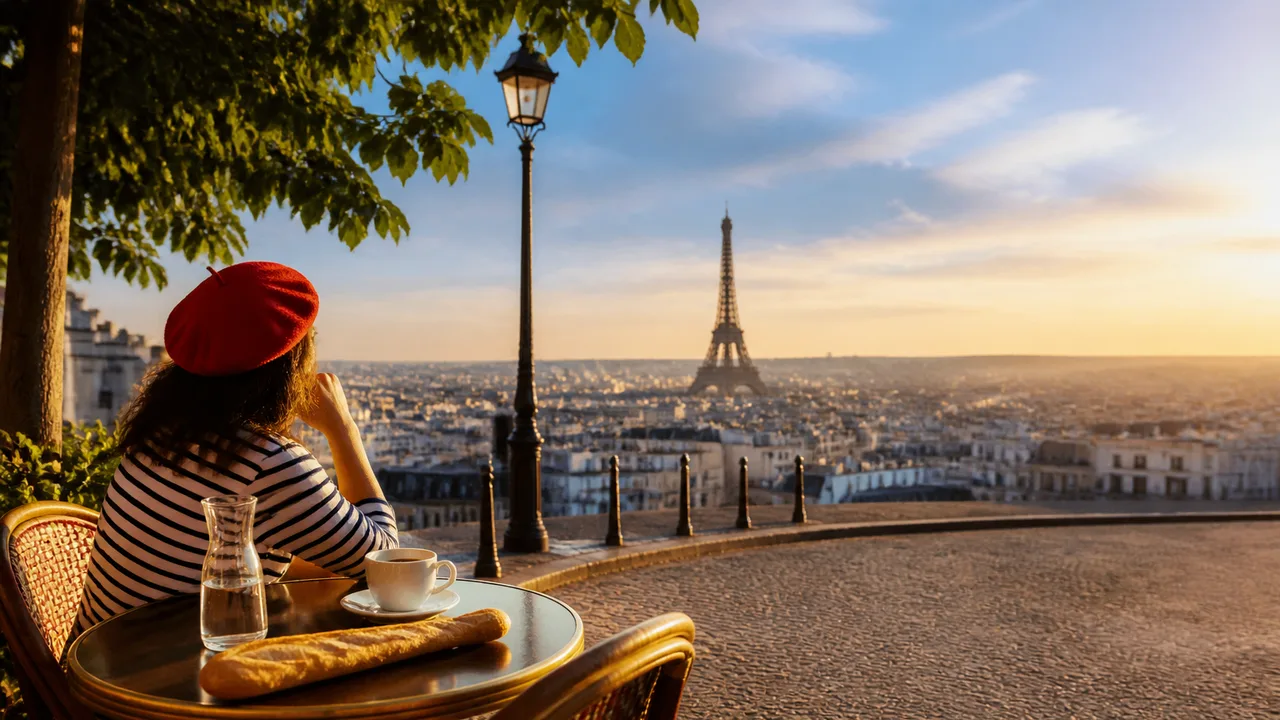
Photo: AI. Asha Kingsley
There is a particular kind of tourist frustration that surfaces when a Paris Metro line shuts down mid-journey because of a strike. The itinerary collapses. The museum closes early. The café where you planned to have lunch is locked, its staff somewhere on a boulevard with signs. And somewhere, a French person watches this unfold and shrugs — not dismissively, but with the settled patience of someone who understands exactly what is happening and why.
That gap in comprehension is what Mark Wolters, of the travel channel Wolters World, is trying to close in a recent video filmed in Paris. The piece runs through the cultural traits that define daily life in France — not the postcard version, but the texture underneath it. It is a useful exercise, and one worth unpacking further, because several of what he identifies as quirks are better understood as a coherent philosophy operating at the level of the everyday.
The Strike Is Not an Inconvenience. It Is a Statement.
Wolters leads with industrial action, which is the right place to start. France's relationship with the grève — the strike — is not simply about labor disputes. It is a recurring assertion that collective rights are worth defending publicly, visibly, and at cost. According to data from the French Ministry of Labor, France consistently ranks among Europe's highest for strike activity, particularly in public-sector transport and education. The country's legal framework actively protects the right to strike, and polling has repeatedly shown broad public sympathy for strike action even among those directly inconvenienced by it.
For visitors calibrated to cultures where public protest is treated as an aberration or an embarrassment, this is genuinely disorienting. Wolters frames it charitably: the strikes reflect "how the French really care about their joy of life and their work-life balance." That is accurate as far as it goes. What it does not quite capture is the ideological dimension — the French laïcité tradition of robust civic participation, the memory of social gains won through collective action, and a political culture in which the street has historically been as legitimate a venue for governance as the chamber.
Whether a tourist appreciates or resents a disrupted train is, in that context, beside the point.
Language as Load-Bearing Wall
The section on language is where Wolters is most practically useful and where the cultural stakes are highest. His advice is blunt: say bonjour when you walk through a door, every time, without exception. This is not a tip for ingratiating yourself with locals. It is an acknowledgment of a social contract. Entering a space in France without greeting its occupants is read not as shyness but as rudeness — a failure to recognize the people you are sharing space with.
The deeper current running beneath this is France's active, institutional defense of the French language. The Académie française, founded in 1635, still exists to regulate the language's evolution. The Loi Toubon of 1994 mandates French in advertising, public services, and the workplace. These are not nostalgic affectations. They reflect a genuine belief that language is not merely a communication tool but a carrier of national identity — and that its erosion constitutes a form of cultural loss.
"They go for French first on the news, on the radio, in the movies, in the music," Wolters notes. "French, French, French." The repetition is almost musical, and it captures something real: the deliberateness of this choice in an era when English-language content is trivially accessible to anyone.
The tension worth naming here, which the video does not fully engage, is that this linguistic protectionism sits uneasily alongside France's multilingual reality. Alsatian, Breton, Occitan, Corsican — France has living regional languages that have been historically suppressed by the same centralization that now defends French against English. Regional identity, which Wolters rightly identifies as fierce ("I'm Alsatian first"), and linguistic nationalism can point in different directions.
The Baguette Is Infrastructure
It would be easy to treat the baguette sequence as whimsy. Wolters does not, quite, and neither should we. When he says "the baguette solves all the problems here in France," he is describing something that the French government recognized formally enough to help shepherd onto UNESCO's Intangible Cultural Heritage list in 2022 — a designation that acknowledges the artisan boulanger tradition as culturally irreplaceable. France has roughly 33,000 independent bakeries. Their density in urban neighborhoods is not accidental; it is the product of pricing regulations, zoning decisions, and cultural expectation.
There is also an unwritten social code Wolters identifies that is worth retaining: you may eat a baguette while walking only when it comes directly from the bakery in its paper bag. This is, as a behavioral norm, a window into a broader French relationship with food — which is that eating is an event, not a transaction. You sit. You take time. You do not consume standing at a counter or walking between appointments if you can avoid it.
The cheese and wine section operates on the same logic. Wolters describes France's roughly one thousand cheese varieties and an effectively uncountable wine catalog, but the point is not abundance for its own sake. It is the expectation of terroir — that what you eat and drink should be legible to the place that produced it. A waiter in Normandy who recommends calvados over Bordeaux is not being provincial. They are being precise.
Debate as Default Mode
The cultural misreading Wolters addresses most directly — and most carefully — is the one about French rudeness. "That's why some people think the French are rude," he says, "because they might ask you things that you think isn't something that people should ask each other. But here in France, it's okay because they like to have the discussion."
What he is describing is a culture in which intellectual directness is not impolite. The French rhetorical tradition — rooted in Cartesian logic, shaped by the grandes écoles, and reinforced in school through the dissertation format of thesis-antithesis-synthesis — treats the expression of a reasoned opinion as a social obligation, not an overstep. Agreeing to disagree is acceptable. Declining to engage is less so.
For visitors from cultures where social harmony is maintained by avoiding contentious topics, this registers as aggression. For the French, the aggression would be in the pretense — the performance of agreement or the refusal to say what you actually think.
The Bureaucracy Is the Point, Sort Of
Wolters ends on bureaucracy with obvious affection for its absurdity. "I think there's more layers of bureaucracy than there are layers of flaky pastry in a croissant," he offers, which is accurate and funnier than anything I would manufacture. He is right that it is genuinely extraordinary in its complexity — and right that the French navigate it with a patience that baffles outsiders.
What he gestures toward but does not quite say is that the bureaucracy and the café culture are expressions of the same underlying value: the acceptance that good things take time, that process is not the enemy of outcome, and that agitation rarely shortens the queue. Whether you read this as wisdom or learned helplessness probably depends on where you are from — and how long you have been waiting.
The French relationship with le temps — time itself — is perhaps the thread connecting everything Wolters catalogues. The strike says: this moment matters enough to stop for. The three-hour dinner says: the meal is not a means to something else. The bonjour says: you do not get to rush past me as if I am not here.
Whether that philosophy scales, whether it is sustainable in a globalized economy that does not share its premises, is the question France keeps arguing about — loudly, publicly, and with considerable pleasure.
By Mariel Fontaine, Travel Desk Editor
More Like This
What to Expect When Staying in European Hotels
European hotels operate by different rules than North American ones. Here's what actually differs—room size, beds, breakfast pricing, accessibility, and more.
How Medieval Castles Were Built to Signal Power
Medieval castles were never just fortresses. A look at how 500 years of castle design reveals architecture as political propaganda, arms race, and identity myth.

What Tolstoy Knew About Over-Processing
Tolstoy's War and Peace argues that every system kills the thing it tries to preserve. An audio engineer reads that and feels it in their bones.

The 30-Second Hotel Safety Check You're Not Doing
A quick hotel room safety check—doors, locks, windows, exits—could prevent theft or worse. Here's what travel creator Mark Wolters says to do first.
What Poles Actually Want Tourists to Know
From geography to drinking etiquette, here's what Polish locals wish visitors understood before arriving—and why it matters more than you think.
How to Protect Yourself From Pickpockets in Europe
Practical, unsentimental advice on avoiding pickpockets in Europe—how thieves actually work, where they target tourists, and what you can do about it.

Japan Airlines Domestic Flying: Haneda to Sapporo
JAL's Haneda–Sapporo route carries 12 million seats a year. Here's what flying it—and touring JAL's maintenance hangars—actually looks like.

The Best US Airport Lounges Worth Visiting in 2026
Jeb Brooks visited 50+ US airport lounges to rank the top 10. Here's what his scoring reveals about access, value, and the lounge arms race.