How Students Can Build a Daily Routine That Lasts
A new video from Simple, Actually lays out a brain-aligned daily routine for students—one built on consistency over intensity. Here's what holds up and what's worth questioning.

Written by AI. Kira Yoshida
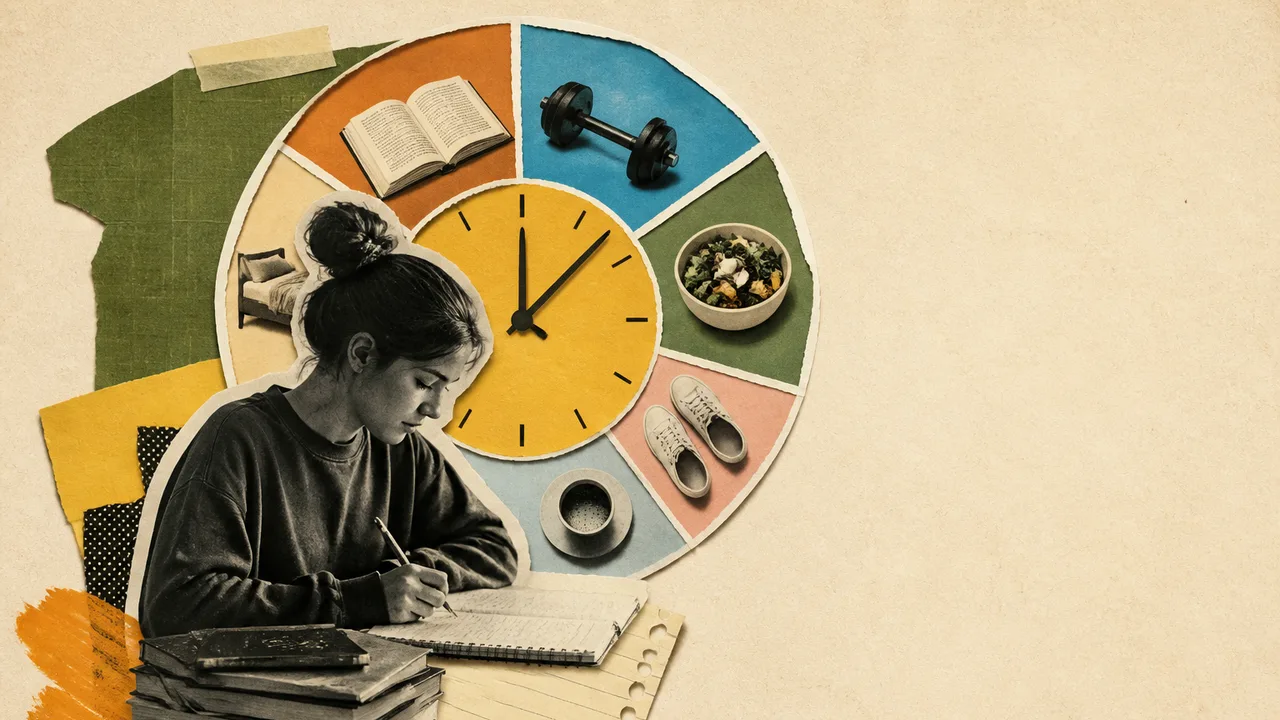
Photo: AI. Wren Sugimoto
There's a certain flavor of student productivity content that operates like a pressure campaign dressed up as a helpful tip. Wake up at 4:47 a.m. Color-code everything. Download this app. Stack these habits. And if your GPA still isn't a 4.0, well—you just didn't want it badly enough.
The YouTube channel Simple, Actually is making a case against all of that. Their recent video, The PERFECT Daily Routine for Students (Systems That Actually Work), lays out an 11-step daily structure with an explicit counter-promise: no 5 a.m. wakeups, no marathon study sessions, no productivity theater. Just a routine that—and this is the real pitch—you might actually follow past Wednesday.
It's a reasonable enough framework. The interesting question isn't whether the advice is technically correct. Most of it is. The interesting question is what it reveals about how students are thinking about time, energy, and learning—and where the standard "build a routine" script quietly misses the point.
What the video actually argues
The channel's core claim is that students burn out not from studying too much, but from studying badly—erratic schedules, low-quality attention during sessions, and recovery debt that compounds across the week. The fix, they argue, isn't grinding harder. It's engineering your day around how cognitive energy actually works.
The structure they propose runs roughly like this: consistent wake-up time, phone-free morning, hard subjects first, focused blocks of 45–60 minutes with real breaks, lighter afternoon work, movement somewhere in there, a second deep study session, and then—crucially—a deliberate shutdown.
That last piece gets called out explicitly as "the most underrated part of the routine." The reasoning: students who study until 1 a.m. and then wonder why they can't concentrate the next morning have confused quantity for quality. As the video puts it, "3 hours of focused studying can be dramatically more valuable than 8 hours of distracted studying."
Hard to argue with that, and the exercise physiology research tends to support the underlying logic. Your prefrontal cortex—the part doing the heavy lifting during difficult problem-solving—doesn't have infinite runway. Throwing your hardest cognitive work at a depleted brain isn't discipline; it's just inefficient.
The parts worth taking seriously
The circadian consistency argument. Waking at wildly different times across the week—the video describes it as "giving your brain jet lag without buying a plane ticket"—genuinely does disrupt your body's internal clock. Your alertness patterns, cortisol rhythms, and sleep pressure all operate on predictable cycles that irregular schedules scramble. The specific wake-up time matters less than its consistency. Green Dot International School's overview of student routines makes a similar point: consistency builds momentum in ways that one-off "productive days" never can.
The break quality problem. The video's bit about scrolling Instagram "for 5 minutes" and surfacing 37 minutes later knowing a celebrity's entire dating history is funny because it's accurate—and because it points at something real. Passive social media consumption during breaks doesn't function as cognitive rest the way walking or stretching does. Your visual and attentional systems stay engaged; you're just redirecting them toward lower-stakes content. That's not the same as actually letting your brain decompress.
Front-loading hard work. Prioritizing difficult subjects during the first study block is a well-established heuristic. Your peak cognitive window—when working memory is sharpest and fatigue is lowest—is typically in the morning for most people, though it varies. The video acknowledges the variation obliquely: "the principles matter more than the exact clock."
Movement as a cognitive tool, not a bonus. "You're a student, not a human-shaped backpack," the video says, which I'd argue is the best line in it. The point about exercise resetting attention and sometimes cracking problems you'd been stuck on isn't just motivational fluff. Physical activity increases cerebral blood flow and triggers neurochemical shifts—norepinephrine, dopamine—that support focus and mood. Even a short walk changes what your brain can do afterward. Fhynix's guide to student routines lists movement alongside focused study time as non-negotiable pillars, not optional add-ons.
Where the script gets thin
Here's the tension inside most "build a routine" content, and this video doesn't fully escape it: the routine described assumes a student with significant control over their schedule.
Block 45–60 minutes for your hardest subject in the morning. Great—but what if you have a 7:45 a.m. class across campus? What if you work a shift that ends at midnight? What if you're a caregiver, or living in a home without a quiet study space, or managing a chronic health condition that makes "consistent wake-up time" an aspirational fiction rather than a planning problem?
The video does include a disclaimer noting that "everyone's schedule, energy levels, responsibilities, and learning needs are different"—and it's a genuine acknowledgment, not just legal throat-clearing. But the routine itself is imagined for a student with a relatively blank calendar. The logic of "protect your evening," "relax," "live your life"—all good advice—lands differently if your evening is already committed to a second job or family obligations.
This isn't a critique of the video's core framework, which holds up. It's a structural gap in the genre itself. Routine advice tends to address internal obstacles (procrastination, distraction, motivation) more fluently than external constraints (economic pressure, caregiving, inaccessible environments). Both are real. Only one reliably shows up in the thumbnail.
The thing the video gets most right
None of the above should obscure what's genuinely useful about the approach. The anti-perfectionism framing is the strongest part, and it's earned rather than tacked on.
"The perfect routine is not the routine you can follow for 3 days. It's the routine you can follow for months."
That's not a feel-good deflection. It's a direct argument against the optimization-as-identity trap that a lot of student productivity content inadvertently reinforces—the idea that your study schedule is a personal character statement and one missed block means the system has failed. The video's instruction to "just restart at the next block" rather than scrapping everything after a bad morning is a more psychologically sound approach than it might sound. It's treating your routine as infrastructure rather than identity.
The specificity note is also sharp: "not 'I'm going to study biology'—that's vague. Instead, 'I'm going to finish this chapter and answer 15 practice questions.'" Concrete goals give your brain a target, which reduces the start-up friction that burns time before the actual studying begins. ohai.ai's framework for student scheduling makes a similar distinction—mark fixed commitments first, then build specific blocks around them—because ambiguous plans are easy to defer. Specific plans are not.
If the studying-as-ritual approach to learning interests you, the shutdown routine piece of this framework—five minutes the night before to map out tomorrow's priorities—does a lot of the same work. Decision fatigue is real; every choice you can pre-make is cognitive load you don't have to spend in the morning.
What this leaves open
The video ends with a distillation that's almost deliberately modest: choose your wake-up time, pick tomorrow's most important task, decide when you're shutting down. Do that. See what happens.
There's something refreshing about productivity advice that doesn't ask you to overhaul your personality. The question it can't fully answer is whether the students who most need structured routines are also the students who face the most structural friction in building them—and whether "just restart at the next block" is accessible advice when the obstacles aren't internal at all.
That's not a reason to dismiss the framework. It's a reason to hold it lightly, adapt it honestly, and pay attention to which parts of your day you actually control.
More Like This

How Sports Actually Bring People Together
Sports are celebrated as a universal unifier—but how does that actually work, and when does it fall short? We map the real science and the real limits.

How Your Circadian Rhythm Controls Morning Wakefulness
Your body already knows how to wake up naturally. Here's what sleep science says about training your circadian rhythm to stop dreading mornings.

Your Brain Learns Like a Muscle. Study That Way.
The science of memory retrieval, spaced repetition, and interleaving—and why study-optimization content keeps selling you the same recycled research.

5 Life Regrets That Are Actually Real (With Caveats)
The Art of Improvement's viral regret video gets a lot right — but the gap between what you *should* do and what you *can* do is where self-improvement content always falls apart.

Active Recall: The Study Method Worth Knowing
Active recall means testing yourself instead of re-reading. Here's what the science actually says — and what the tidy frameworks leave out.

ADHD Study Strategies That Actually Work
Traditional study methods fail ADHD students by design. Here's what the research actually says about study strategies built for how these brains work.

How Streaming Platforms Use Psychology to Hold Your Attention
Streaming platforms are built on behavioral science. Here's what media psychology actually says about autoplay, thumbnails, and what prolonged watching does to your body.

The Sardine Fast: Metabolic Reset or Wellness Trend?
Thomas DeLauer breaks down the physiology of eating only sardines for three days. Here's what the science actually supports—and where the gaps are.