Active Recall: The Study Method Worth Knowing
Active recall means testing yourself instead of re-reading. Here's what the science actually says — and what the tidy frameworks leave out.

Written by AI. Marcus Obi
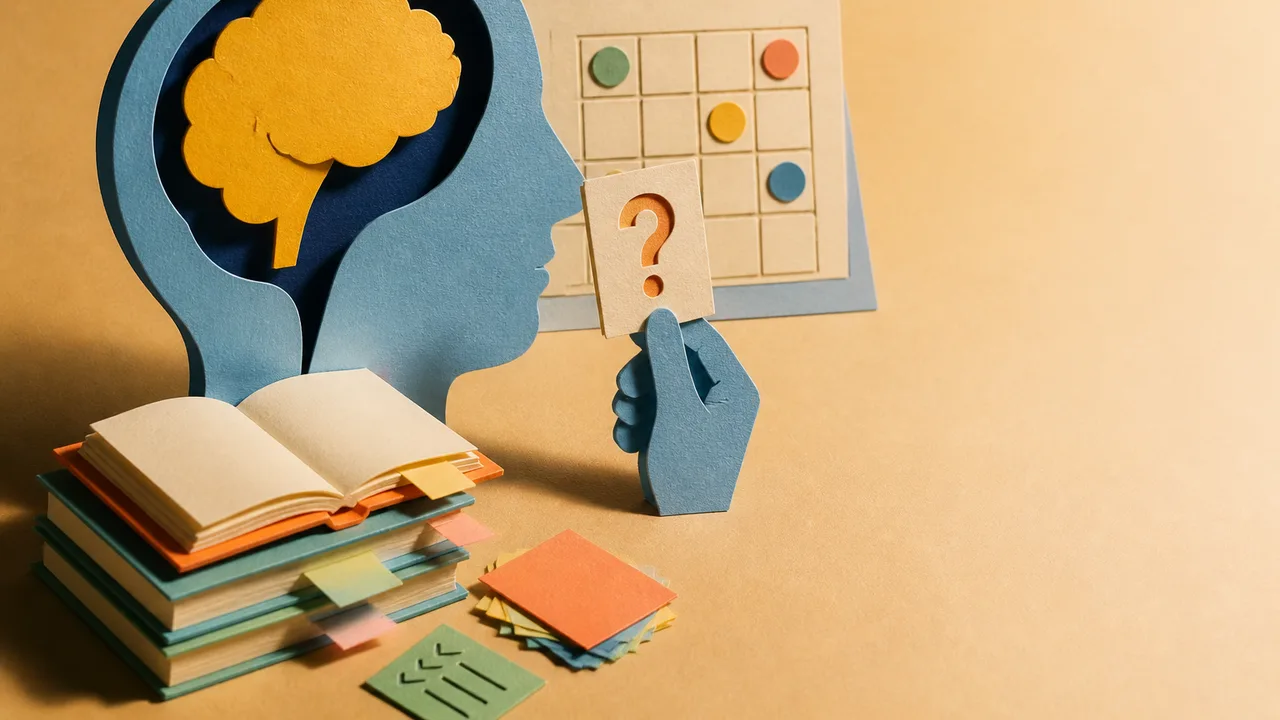
Photo: AI. Lila Bencher
Last week I watched one of my twins read the same two pages of her science workbook four times in a row. She wasn't distracted. She was genuinely trying. She'd finish, flip back, read again — the same slow, dutiful circuit. When I asked her what the pages were about, she looked at me with this expression that was equal parts frustrated and embarrassed, like she knew what was coming. She couldn't tell me. Not really. There was just a vague warmth where the knowledge was supposed to be.
I recognized it immediately, because I spent most of my college career doing exactly the same thing with a yellow highlighter.
So when the YouTube channel simple, actually dropped a video called How to Do ACTIVE RECALL Effectively, I watched it not as a study tips connoisseur but as a parent quietly panicking that my kid is going to spend the next decade of her academic life doing something that doesn't work, the same way I did. And honestly? The video made me feel a specific, uncomfortable flavor of seen.
The problem with feeling like you're learning
The central argument of the video — and it's a good one — is that the most common study habits feel productive precisely because they're not. Re-reading your notes gives your brain a hit of familiarity that it mistakes for understanding. You think, yep, I know this, because it all looks familiar. But looking familiar and actually knowing it are wildly different things, as anyone who has blanked on an exam question they definitely "knew" can confirm.
The video puts it cleanly: "Familiarity is not memory. Your brain confused recognition with recall. And exams don't ask, 'Does this look familiar?' They ask, 'Can you remember it?' Those are two completely different skills."
That gap — between recognizing something and actually retrieving it — is the whole ballgame. And the solution the video proposes is active recall: instead of reading your notes, close the book and try to remember what was in them. Quiz yourself. Make flashcards formatted as questions, not statements. Explain the material out loud to your dog, your wall, your very patient pillow.
The brain, the video argues, gets stronger through retrieval, not exposure. "Your brain doesn't get stronger by putting information into it. It gets stronger by pulling information out." The gym metaphor they use — you wouldn't expect your muscles to grow by staring at dumbbells — is a little well-worn, but it's well-worn because it works.
Why this is actually hard to do
Here's where I want to push back slightly, not on the technique but on the ease with which it's presented.
Active recall is harder than re-reading. That's the point — the video even celebrates the difficulty, calling it "desirable difficulty" and telling you that if recalling feels uncomfortable, "your brain is working." But there's a gap between knowing struggle is productive and actually tolerating it when you're a seven-year-old who's already been at the homework table for forty minutes and dinner is almost ready and your twin brother keeps doing something annoying in his peripheral vision.
The video suggests a practical approach: read a small chunk, then close the book and try to recall it before checking. Rotate between subjects rather than marathoning one topic. And then, critically, leave time before reviewing again — spacing out your review sessions so your brain has a chance to actually forget a little before you retrieve. The video describes combining active recall with spaced repetition as a particularly effective pairing, and the cognitive science community broadly agrees with that framing, even if the details are more complicated than any nine-minute video can fully capture.
What the video doesn't spend much time on — and this is where I kept snagging — is who this is easy for and who it isn't.
The solitude problem
The video's most practical suggestion involves finding a quiet space, closing everything, and spending focused time testing yourself from memory. And for a lot of people, that's genuinely doable. But a lot of parents watching this aren't thinking about their own study habits — they're thinking about their kids, and their kids' situations are varied in ways a tidy framework doesn't account for.
My daughter has a desk, a door that closes, and two parents at home. That's not nothing. A lot of kids are doing homework at kitchen tables in loud apartments, on phones with cracked screens because that's the only device available, with siblings underfoot and parents working second jobs. The "close everything and focus" instruction assumes a specific kind of quiet, structured solitude — and that's not evenly distributed.
This isn't a critique of the video, which is a nine-minute YouTube explainer and not a dissertation on educational equity. But it's worth naming, especially for parents: the gap between kids who learn efficiently and kids who don't isn't usually a gap in technique. It's a gap in conditions. When we frame study struggles as a problem of method, we risk obscuring that the kid who can't focus long enough to do active recall might be working with a phone that keeps buffering, in a room that isn't quiet, without anyone to explain what "spaced repetition" even means.
The video's disclaimer actually acknowledges this in a small way — "learning techniques work differently for everyone" — but one line at the end of a video doesn't do much heavy lifting.
The thing that does transfer
Here's what I think is genuinely useful in this video, for parents and for students: the reframe around forgetting.
Most kids — and honestly, most adults — interpret forgetting as evidence that they're bad at this. You studied, you forgot, you are apparently broken. The video pushes back on that directly: "Forgetting is part of remembering. Every time you forget something and then successfully remember it again, the memory becomes stronger." Forgetting isn't the opposite of learning. It's a step in the process.
I would have loved for someone to tell me this when I was seventeen and convinced I just had a bad memory. I spent years avoiding things I thought I couldn't remember — history dates, chemistry formulas, the entire Spanish language — because forgetting felt like a verdict rather than a normal part of how brains work. It isn't a verdict. It's just friction, and friction, annoying as it is, is what creates grip.
My daughter knows about this now. We talked about it after I watched the video. I told her that the goal of studying isn't to feel like you know something — it's to practice pulling it out of your head when it isn't right in front of you. She looked skeptical. She is seven and also she has seen me forget where I put my keys approximately 400 times, so my credibility on memory topics is limited.
But she tried it. She read a paragraph, closed the book, and told me what she remembered. She forgot some things. Then she checked, filled in the gaps, and tried again. It took longer than re-reading. She found it annoying. She also, when I asked her twenty minutes later what the pages were about, could actually tell me.
That's not proof of anything. That's one kid, one afternoon, one subject. But it's more than we had before, which was four laps of the same two pages and a shrug.
The video ends with a clean provocation: "Sometimes the fastest way to memorize something is to stop reading it." It's a little pithy, but it's not wrong. And as parenting advice goes — pointing your kid toward the hard thing and telling them the difficulty is the point — it's pretty decent.
I'm just not ready to call it a system. I'll call it a starting place.
More Like This

How to Stop Losing Time Without Realizing It
Not a time management overhaul—just a clearer look at where your hours actually go, and what's worth doing about it.

Making Studying Stick: The Psychology of Starting
A YouTube video promises you can get addicted to studying in 10 minutes. The psychology is mostly real. The missing piece is who gets to use it.
Eckhart Tolle Says You're Not Who You Think You Are
Eckhart Tolle's 'historical self' vs 'deep eye' framework is either profound or a very elegant dodge. A parenting writer tries to figure out which.
Mastering Memory: The Ladder to Lasting Knowledge
Explore Dr. Justin Sung's Memory Ladder framework to learn effectively and retain knowledge forever with neuroscience-backed strategies.
Brain Hacks for Smarter Studying, Backed by Science
Explore unconventional study tips rooted in brain science, enhancing focus and retention without the struggle.
Dr. K Walked Into Chaos and Won the Room
Dr. K's Tiger Belly appearance is a masterclass in social dynamics. Here's what the Charisma on Command breakdown gets right—and what it glosses over.
Student-Athletes and the Mental Health Toll of Competing
Behind the scholarship and the starting lineup, many college athletes are quietly breaking down. Here's what the data — and the silence — actually tells us.

Alex Hormozi on Hard Work, Courage, and Wasted Potential
Alex Hormozi tells Chris Williamson why doing hard things physically doesn't build emotional resilience—and what kind of hard actually changes your life.