How Lasers Cut Through Metal: The Physics Explained
Lasers and desk lamps run on the same photons. What separates them is geometry, not magic. Here's the physics of power density and why it changes everything.

Written by AI. Amelia Nwofor
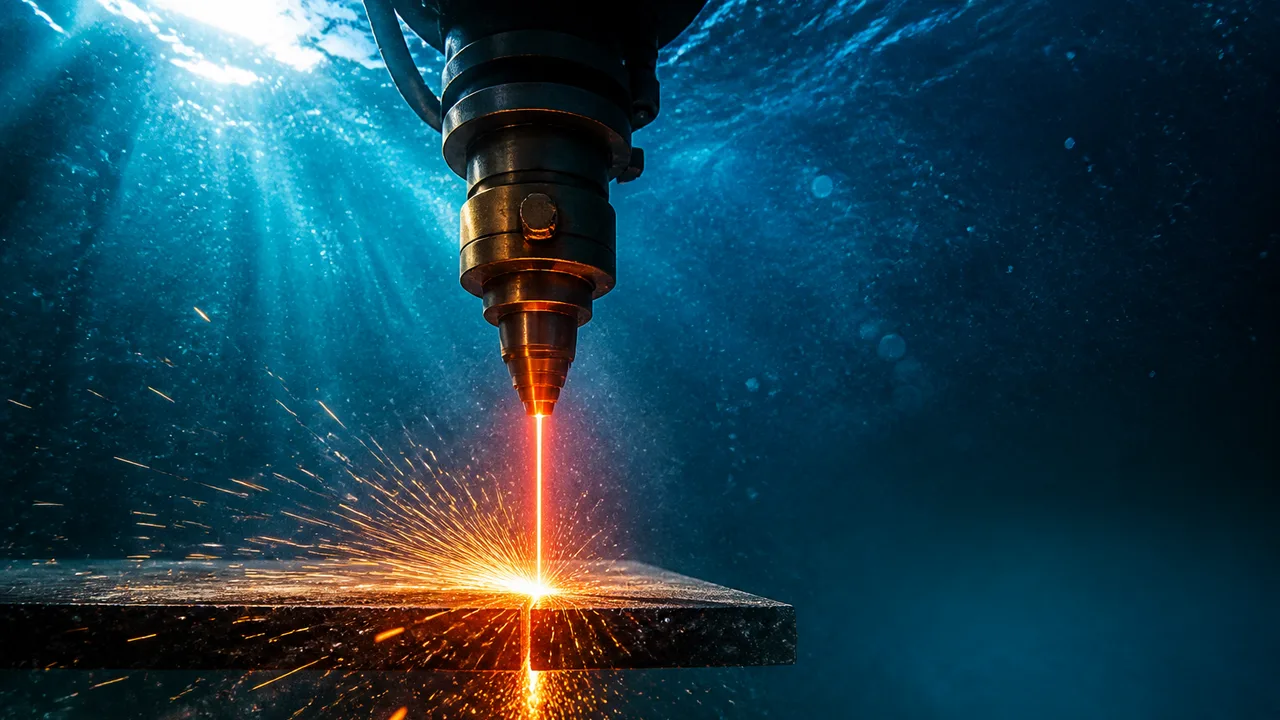
Photo: AI. Sela Marin
There's a desk lamp sitting on my desk right now, and it has never once threatened to cut through anything. That sounds obvious. But it shouldn't be, because the light coming out of that lamp and the light coming out of an industrial laser that slices through steel plate are made of the exact same raw material: photons.
So what actually separates them? A recent Math and Science video on YouTube works through this question carefully, and the answer turns out to be less about exotic physics and more about a concept so simple it's almost annoying: power density.
The geometry of destruction
When a photon hits an atom, the atom's outer electrons absorb that energy and jump to a higher energy state. When they fall back down, they release the energy as heat. This is not some special laser phenomenon. Your desk lamp does it. The sun does it. Every photon that lands on any surface does it.
The question is how much heat lands in how small a space.
Power density is measured in watts per square meter, and it's the number that actually determines whether something gets warm or gets vaporized. The Math and Science video illustrates this with a calculation worth sitting with: a 100-watt light bulb radiating into a room with 100 square meters of wall surface delivers a power density of 1 watt per square meter. Comfortable. Uneventful. Take the same 100 watts and concentrate it into a beam hitting 1 square millimeter, and you're now at 100 million watts per square meter. The energy budget hasn't changed. The geometry has.
"It's not so much that laser light is special," the video notes. "Laser light is able to be collimated and focused into a tight beam so that we can get the energy density very, very high. And that is why lasers can burn through things, but your regular desk lamp cannot."
The magnifying glass on a sunny day is the same idea made legible. The sun delivers roughly 1,000 watts per square meter at Earth's surface. A lens that collects light from a 50-watt area and focuses it to a point is not adding energy; it's dividing by a smaller denominator. The video makes the arithmetic explicit: as the focal area shrinks toward zero, the power density climbs toward something that can ignite paper or, if you're not careful, skin. The difference between a magnifying glass and a laser is that the magnifying glass only achieves this at one precise focal distance. Move the paper an inch and the concentration collapses. Lasers don't have that problem, and understanding why requires understanding what makes laser light structurally different from everything else.
Three properties that matter
The photons themselves are not special. The beam is.
Laser light is monochromatic: all photons carry essentially the same wavelength, clustered tightly around a single energy value. The video's analogy is apt: ordinary light is an orchestra playing simultaneously in every key, while laser light is a stadium singing one note in unison. Real lasers have a small spread in wavelength rather than a perfect single line, but the concentration of energy around a single frequency is orders of magnitude tighter than sunlight or an LED.
Laser light is also coherent (the wave crests and troughs of individual photons rise and fall in synchrony). It is precisely this coherence, with photons sharing wavelength, phase, and direction, that gives the beam its structural integrity and enables the tight focusing that produces high energy density.
The third property, collimation, is the one that makes the geometry work. Ordinary light diverges. Shine a flashlight across a room and the spot grows. Laser light travels in a beam so close to parallel that it can cross kilometers with only slight spreading. This is why laser pointers are genuinely dangerous to aircraft: the beam does not diffuse meaningfully between the ground and a cockpit window. And it's why a laser can be focused down to spots just a few micrometers across, smaller than a red blood cell, using ordinary optics.
A 1,000-watt laser focused to a spot a tenth of a millimeter across, the video calculates, delivers something in the range of 100 billion watts per square meter. That is hotter than the surface of the sun, concentrated on a point smaller than a printed period. Steel doesn't stand a chance, and nothing about that result required magic. It required arithmetic and a very good mirror.
How you actually make the beam
LASER is an acronym: Light Amplification by Stimulated Emission of Radiation. The mechanism lives in that middle phrase.
Inside a laser, a gain medium (a crystal, a gas, a specialized liquid, depending on the laser type) gets pumped with energy, typically from electricity or another light source. This raises the atoms in the medium to an excited state. Ordinarily, those excited atoms would release photons randomly in all directions when they decay. But in a laser, a released photon can trigger a neighboring excited atom to release its own photon in perfect sync: same wavelength, same direction, same phase. That's stimulated emission.
The optical cavity amplifies this. Mirrors at each end of the gain medium bounce photons back and forth, with each pass triggering more stimulated emission and building what the video describes as "an avalanche of perfectly synchronized photons." One mirror is fully reflective; the other lets a small fraction of the light through. That fraction is your laser beam, every photon marching in formation.
Wavelength selection is not decorative. Industrial cutting lasers frequently use infrared light around 1,064 nanometers because metals absorb that wavelength efficiently. Medical lasers are tuned to match the absorption characteristics of water in tissue, or of specific pigments in skin. The wavelength is a deliberate match between the beam and the target material's absorption spectrum. Getting that match wrong costs efficiency; getting it right is what makes the cut clean.
The precision behind the mundane
What the video spends time on, and what deserves attention, is the engineering required to make any of this work. Sub-micron alignment tolerances in the mirror cavity. Gain medium purity requirements that vary by laser type but are, across the board, extreme. Photons oscillating trillions of times per second, held in coherent formation by a device you can buy for under ten dollars.
That last part is the one that should probably unsettle us more than it does. The physics underlying a five-dollar laser pointer includes the same stimulated emission, the same optical cavity, the same collimation that makes industrial cutting possible. The difference between the pointer and the cutter is wattage and focus, not kind.
We've managed to commoditize a process that concentrates light to power densities exceeding the sun's surface temperature and sell it as a novelty item. The desk lamp on my desk is not threatening to cut anything. The laser pointer in a junk drawer two rooms over is operating on principles that, scaled up, vaporize metal in milliseconds.
That's not cause for alarm. It is, though, a good reason to look at familiar objects a little less casually.
More Like This
Why Physics Has No Preferred Direction of Time
Physics equations work equally well forwards or backwards in time. So why does time feel so irreversibly one-directional? The answer is stranger than you'd expect.

Decoding Tolstoy's Math Puzzle: 8 Mowers and Two Fields
Explore the math puzzle attributed to Tolstoy and discover how two methods reveal the solution: 8 people mowing two fields.
Exploring the Enigma of Negative Time in Quantum Physics
Dive into the perplexing world of negative time in quantum physics with insights from Prof. Aephraim Steinberg.

How the Speed of Light Became a Definition
The speed of light wasn't just measured—it was defined into existence. Here's the 300-year story of how physics outgrew the question it started with.
How Accelerating Electric Charges Produce Light
A Physics Explained video walks through the classical mechanics of electromagnetic radiation—how a wiggled charge creates the ripple we call light, and why that matters.
Fission vs Fusion: The Physics Behind Our Energy Future
A nuclear engineer's corrections to a viral science explainer reveal why misunderstanding fission and fusion has real costs for the energy transition.
Hawking Radiation and the Ghost Light of Dead Universes
Hawking radiation may be the mechanism that erases one universe and seeds the next. Here's what the physics actually supports—and what it doesn't.
How Astroparticle Physics Built Itself From Borrowed Parts
A new arXiv review traces how astroparticle physics didn't emerge from a single discovery—it assembled itself from three fields that kept bumping into the same cosmic questions.