How Cooking Rewired Human Evolution
Cooking didn't just change what ancient humans ate — it reshaped their biology, faces, brains, and social lives. Here's what the science actually shows.

Written by AI. Priya Sharma
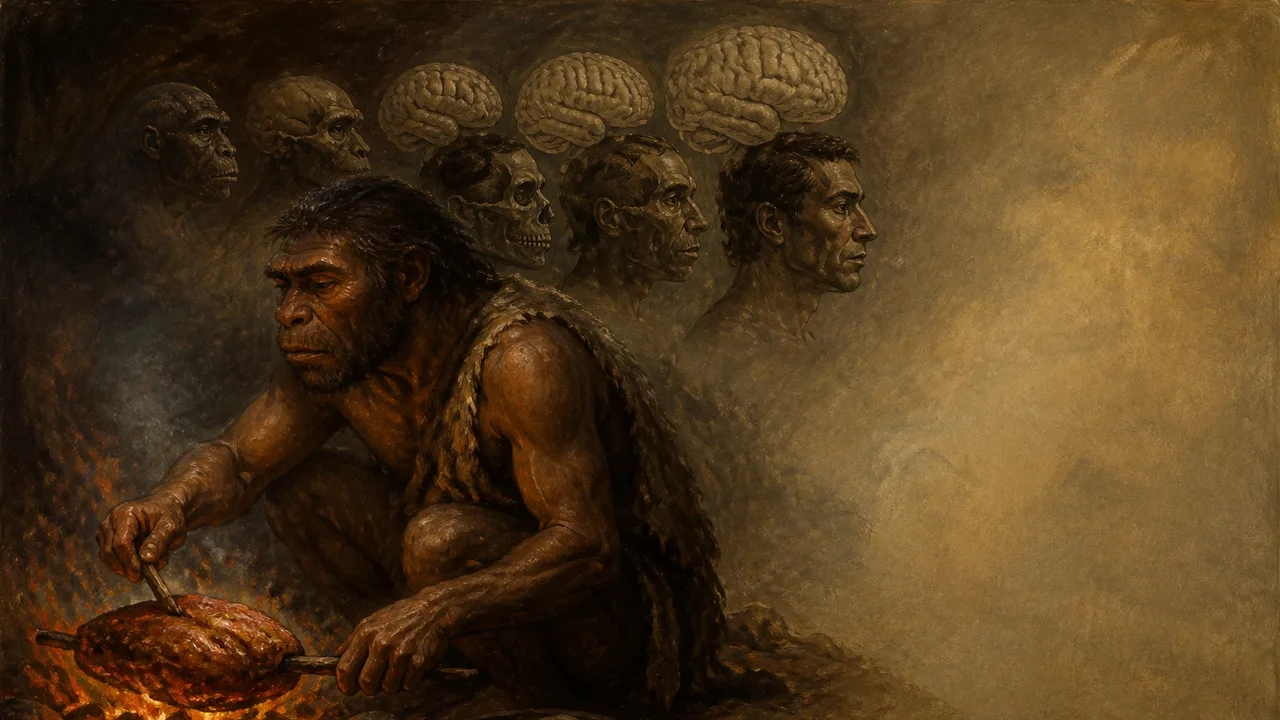
Photo: AI. Henrik Solberg
The standard story about fire and human civilization is tidy enough to print on a museum placard: ancient humans discovered fire, cooked their food, things got better, culture followed. It has the satisfying compression of a myth. It is also, as an explanation of what actually happened, almost comically incomplete.
The more you look at the biology, the more the cooking story expands until it starts to look less like a dietary shift and more like the central event in the making of the human animal — the thing that explains the shape of your face, the proportions of your gut, the hours you sleep, and the social rituals you perform around every meal you share with another person.
Before the fire
To understand what cooking solved, you have to sit with what it replaced.
Chimpanzees spend approximately six hours per day chewing. Not eating — chewing. Six hours of sustained jaw work to mechanically break down the tough, fibrous foods that their digestive systems require. This is the baseline cost of being a large primate running on a raw diet: the fiber resists, the cell walls hold, and the nutrients are locked inside structures that only sustained mechanical effort can open.
Pre-cooking hominins faced the same constraint. Early hominin skulls show evidence of massive temporalis muscles — the jaw-closing muscles that, in some species, left a visible bony ridge called a sagittal crest along the top of the skull. The gut was correspondingly large, because a longer and more capacious digestive tract was required to do internally what heat would later do externally. A large gut is metabolically expensive; the gastrointestinal system is among the most energy-demanding organ systems in the body, consuming substantial resources just to maintain its own mass and function.
Heat changes this calculus entirely. It denatures proteins, making them dramatically more accessible to digestive enzymes. It breaks down plant cell walls, releasing nutrients that would otherwise pass through largely intact. It gelatinizes the resistant starch structures in raw tubers, converting them into forms the body can rapidly absorb. And it kills a meaningful fraction of the pathogens that raw food carries. Anthropologist Richard Wrangham, who developed the most comprehensive version of what researchers now call the cooking hypothesis, estimates that cooked meat provides approximately 30% more usable energy than the same meat eaten raw, with cooked starchy vegetables yielding even greater relative gains. The body extracts significantly more nutrition from the same amount of food when heat has done the preliminary work — meaning more energy from less food, and a digestive tract that no longer needs to be as long, as capacious, or as metabolically demanding as it was.
The organ-level trade
Here is where the argument gets genuinely strange. A smaller gut consumes less metabolic energy. And the energy freed by gut reduction had to go somewhere.
The human brain consumes approximately 20% of the body's total metabolic budget while representing roughly 2% of body mass. It is one of the most energetically costly structures in vertebrate biology, and running a large one while simultaneously running the expansive raw-food gut of a great ape would require a caloric intake essentially impossible to sustain on pre-cooking diets. Aiello and Wheeler's expensive tissue hypothesis — that brain expansion was financed by gut reduction — describes not a minor metabolic rebalancing but an organ-level trade. I find it genuinely arresting every time I engage with it: the architecture of human cognition may have been made possible not by some grand leap of intelligence but by the compression of our digestive plumbing. That is either humbling or darkly funny, depending on your disposition.
The fossil record is at least consistent with this sequence. Brain size in the human lineage increased significantly around 1.8 million years ago, with Homo erectus showing dramatically expanded cranial volume relative to earlier hominins. This coincides, roughly, with changes in tooth and jaw anatomy consistent with a softer, more easily processed diet — and with some of the earliest proposed evidence of controlled fire use, though that evidence remains contested.
The jaw changes deserve their own attention. Cooked food requires less chewing force, so over generations of selection in a cooking species, the jaw apparatus can reduce. Human teeth are dramatically smaller than those of other great apes relative to body size; the canines barely protrude; the temporalis muscle is so reduced that modern human skulls show no sagittal crest at all. A smaller jaw apparatus freed physical space in the skull, allowing the braincase to expand in directions previously constrained by large muscle attachment sites. The reduction in jaw size and the expansion of brain volume are not coincidental — they are connected through the shared geometry of the skull, and the cooking that softened food may have literally made room for the brain to grow. Your relatively flat face, your small teeth, your domed and thin-boned skull: these are not accidents of ancestry. They are, in some meaningful sense, the face of a cooking species.
Time, sleep, and what culture actually requires
Cooking's most underappreciated consequence may be temporal rather than anatomical. A species spending six hours per day chewing cannot simultaneously engage in complex social interaction, extended teaching, or cooperative planning. Those activities are structurally incompatible with having your jaw occupied for a significant portion of the waking day. Modern humans spend roughly one hour per day chewing — a reduction of approximately five hours relative to the great ape baseline. Those five hours are not a rounding error. They are the margin in which culture becomes possible.
The time savings compounded further in sleep. Raw food digestion is a sustained metabolic process that continues well into the night, and the evidence suggests it compromises sleep quality in ways that cooked food digestion does not. Research comparing sleep across species finds that humans sleep significantly less than other great apes of comparable size, while spending a higher proportion of their sleep in the deep, restorative stages associated with memory consolidation. The proposed mechanism is straightforward: faster digestion of cooked food reduces the nighttime metabolic burden on the gut, permitting more efficient sleep. Less chewing during the day, less sleep at night — cooking expanded the daily time budget at both ends.
Anthropologist Polly Wiessner's research on modern hunter-gatherers found that social activity around evening fires was qualitatively distinct from daytime interaction: nighttime gatherings around the hearth oriented toward storytelling, social negotiation, and cultural transmission, the kinds of extended processing that require relaxed attention and time. The fire didn't just cook the food. It organized the evening.
The social architecture of the hearth
Cooking also restructured the terms of social life in ways that persist, largely unexamined, in how we organize ourselves today. A hearth is a fixed location that requires maintenance and defense; it creates a temporal structure — before, during, and after cooking — that demands coordination. Unlike foraged fruit, consumed individually in the moment of acquisition, a cooked meal is a concentrated resource that can be shared or stolen, and that generates questions about obligation, distribution, and fairness that simply do not arise in contexts where everyone feeds themselves.
Wrangham has argued that the food-sharing dynamics of the hearth may have been foundational to the human pair bond — the relatively stable male-female partnership that distinguishes humans from most other great apes. The specific mechanics of that argument are contested, but the broader claim — that cooking restructured human social organization by creating concentrated food resources requiring collective management — aligns with what comparative anthropology shows about the relationship between resource distribution and social structure across species.
What remains genuinely uncertain
The archaeology here is harder than the biology. The earliest confirmed evidence of controlled fire use comes from Wonderwerk Cave in South Africa, dating to approximately one million years ago, with suggestive evidence from sites in Israel and elsewhere at around 800,000 years ago. But fire use and cooking are not the same thing, and the physical traces of actual cooking are more ambiguous than the traces of fire itself.
This uncertainty matters because the timing determines what cooking caused versus what it merely accelerated. If cooking began earlier, it implicates fire in the very earliest stages of Homo erectus brain expansion rather than a later phase. If it began later and more gradually, then pre-cooking food processing — stone tool butchering, pounding of raw foods — may have initiated trends that cooking eventually amplified. We do not know which story is correct. The honest version of the cooking hypothesis holds both possibilities open.
What we can say is that the transition from raw to cooked food, whenever it was consolidated, was not a lifestyle upgrade. It was the triggering condition for a cascade of biological and social changes that ran for hundreds of thousands of years. The ancient human who first put food near a flame — almost certainly by accident, food falling near a natural fire — was not making a considered choice about nutrition. The intentionality came later, after groups that cooked consistently out-competed groups that didn't.
But the consequences of that accident are written into every human body alive today. Into the brain-to-gut ratio. Into the shape of the jaw. Into the hours of sleep. Into the instinct to gather around a shared meal and talk about something other than food.
You are, in a very real biological sense, a cooked food animal. Your body was shaped by cooking long before you were born, and it performs best on cooked food not because of preference but because of millions of years of selection that assumed heat would do the work that your gut no longer can. The fire changed everything — but only because the biology was already waiting for something to change it.
More Like This

How Opponent Recognition Unlocks Cooperation in Evolution
A Rutgers physicist argues that tailoring cooperation to specific opponents—not blanket strategies—may be evolution's simplest path out of the Prisoner's Dilemma trap.

One Day of Cooking, One Week of Meals Done
Dollar Tree Dinners' Rebecca makes 8 freezer-friendly meal preps in a single afternoon—no rush, no perfection, just a genuinely doable system.
The Physics Hiding Inside Your Food
Harvard physicist David Weitz and chef Ben Ebbrell reveal the surprising science behind focaccia, meringue, ice cream, and martinis at the Royal Institution.
Unlocking New Skills After 50: The 'Pillar & Playground' Approach
Explore how the 'Pillar & Playground' method helps those over 50 learn efficiently, leveraging crystallized intelligence and cognitive flexibility.

Exploring Black Holes and Asteroids with StarTalk
Neil deGrasse Tyson delves into black holes, asteroids, and more in StarTalk's latest Cosmic Queries episode with Chuck Nice.

Prehistoric Drugs That Shaped Human Civilization
From 9,000-year-old fermented rice wine to 5,700-year-old peyote buttons, archaeology is rewriting the story of why humans built civilization.
Homo Erectus Survived 1.9 Million Years. We've Managed 300,000.
Homo erectus outlasted us by six to one. A new look at the fossil record asks whether our big brains are an advantage—or a liability with a slow fuse.

Blue Origin Rebuilds New Glenn Pad With Hybrid Design
Blue Origin is rebuilding its Cape Canaveral launch pad after the May 28 New Glenn explosion—with a new hybrid launch system and a 2026 return target.