How Cold Storage Remade America's Modern Food System
How salt, smoke, cellars, ice and cans preserved American food, reshaped household labor, and built the cold chain behind today's modern refrigerator.

Written by AI. Margaret "Maggie" Holloway
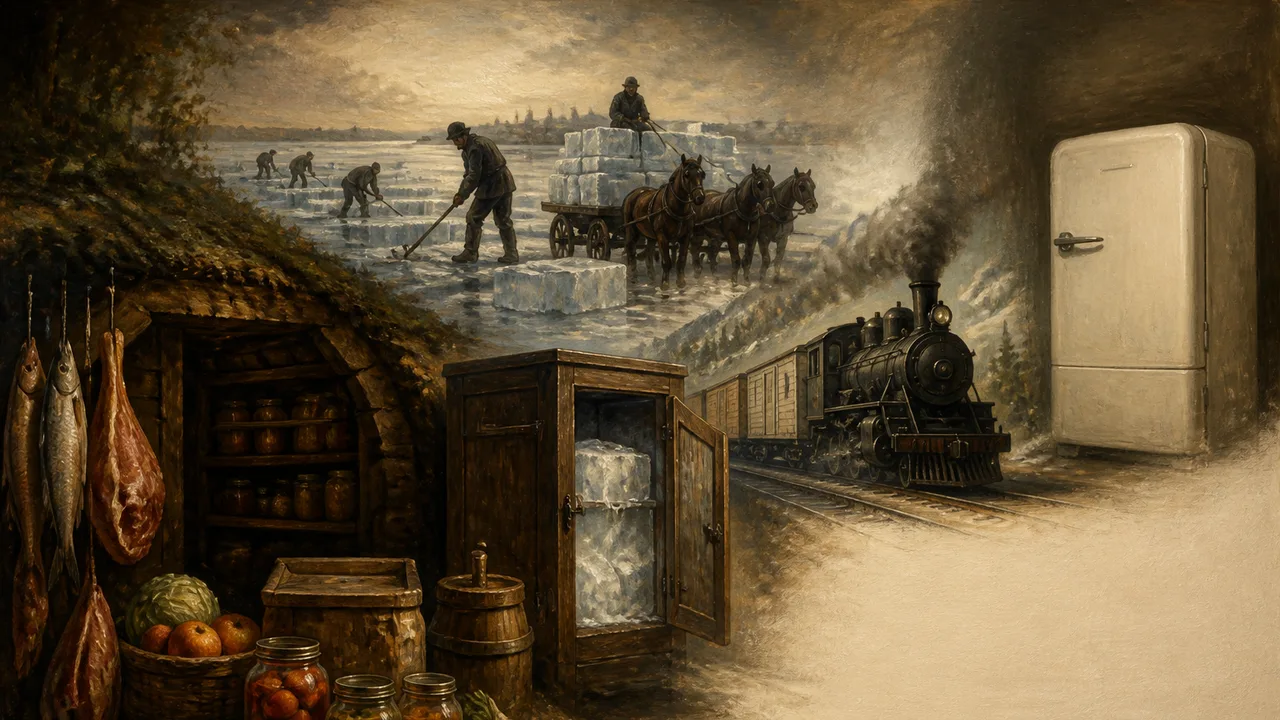
Photo: AI. Henrik Solberg
Refrigerated railcars redrew the economic map of the United States by allowing meatpacking, food processing and distribution to operate across distances that fresh food could rarely survive.
The refrigerator in the kitchen was the household face of that larger system. Behind its white door stood rail lines, packing plants, warehouses, power stations, delivery routes and generations of preservation knowledge. Cold had become an industrial service.
That is why the history of refrigeration cannot be reduced to a procession of clever appliances. The Secret State Files account calls earlier preservation a “daily war against rot, bacteria, and the tyranny of seasons.” The military language captures the stakes, especially when a failed harvest or spoiled winter store could threaten survival. Yet Americans never defeated decay. They learned to delay it, first with salt and smoke, later with ice, cans and compressors.
Cold Became a Network
Mechanical refrigeration changed the geography of food. Refrigerated railcars connected distant farms, slaughterhouses and urban markets, helping meatpacking and food processing concentrate in fewer places. Perishable goods could spend more time in transit, while cities could draw provisions from a wider territory.
The National Museum of American History describes cold as the clear choice once refrigeration became available. It required less household labor than salting, drying or canning and preserved something those methods transformed: the appearance and texture of freshness.
A salted ham, dried apple or pickled cucumber remained edible by becoming a different food. Refrigeration promised the peach as peach, the milk as milk. That preference helped produce an enormous commercial apparatus dedicated to keeping temperature within a narrow range from producer to kitchen.
The modern cold chain expanded choice while creating dependence on continuous infrastructure. A root cellar needed suitable ground and competent management. A refrigerated warehouse needs electricity, machinery, maintenance and transport links, all operating in sequence. The old seasonal constraint loosened; vulnerability migrated into the network.
Five Ways to Make Rot Wait
Long before germ theory supplied the vocabulary, food preservation worked by manipulating a small set of conditions: moisture, acidity, temperature, oxygen and microbial activity. Drying removed the water organisms needed. Salt drew moisture from meat and other foods. Vinegar and fermentation increased acidity. Smoke dried food while depositing compounds that slowed spoilage. Sugar, when used in sufficient concentration, also restricted microbial growth.
The National Center for Home Food Preservation notes that people also exploited caves, cellars, streams, snow and seasonal freezing. Preservation was applied chemistry conducted with barrels, crocks, rafters and the local landscape.
Indigenous communities had developed extensive preservation systems before European colonization. The source account identifies drying, smoking, underground storage and pemmican among those practices. Plains peoples made pemmican by combining dried, pounded meat with rendered fat and, in some preparations, berries. Fur traders and explorers later adopted it for long journeys.
Calling such knowledge “American” can blur the chronology. These practices belonged to distinct Indigenous peoples before the United States existed, and broad labels conceal differences among regions, climates and communities. Surviving accounts also describe adoption more readily than they record how knowledge was taught, exchanged or appropriated.
European settlers carried with them traditions of salting, pickling, smoking and fermentation, adjusting those methods to new climates and whatever ingredients were available.
Food preservation followed a strict seasonal timetable. Autumn brought a narrow window in which animals had to be slaughtered and food dried, salted and packed before conditions changed. Today, refrigeration allows that work to be delayed. For earlier households, the season allowed little room for hesitation.
The Cellar as Machine
Root cellars look humble because gravity does most of their architectural work. Earth shelters the chamber from rapid outdoor temperature swings, while vents, walls and doors help regulate airflow and humidity. Potatoes, turnips, carrots, apples, cabbages and other storage crops could remain usable long after harvest when conditions were managed well.
Springhouses applied the same principle with moving water. Built over or beside a spring, they used the water's lower temperature to cool milk, butter and cheese. Their effectiveness depended on geography. A reliable spring was a household asset; an urban tenement could not conjure one beneath the floorboards.
That constraint helps explain the importance of commercial ice. In 1806, Boston entrepreneur Frederic Tudor sent a cargo of New England ice to Martinique. Selling frozen pond water in the Caribbean required more than harvesting it. Tudor needed insulation, storage buildings, transport arrangements and customers who understood why they should pay for cold.
Sawdust slowed melting. Nathaniel Wyeth's horse-drawn cutter helped produce uniform blocks that could be stacked and shipped efficiently. Icehouses appeared along distribution routes, and iceboxes entered homes and businesses. The icebox itself was a wooden cabinet lined with metal and insulation, with a compartment for ice and a tray for meltwater. Forgetting the tray gave refrigeration an indoor weather system.
The business converted winter landscape into inventory. It also demonstrated a recurring pattern in infrastructure: an invention succeeds when roads, storage, standards, labor and demand grow around it. A block of ice without that network was merely a block of ice, and a rapidly shrinking one.
The Can and Its Dangerous Confidence
Canning offered another route around distance and season. Nicolas Appert discovered that food heated and sealed in containers could remain edible, even though he lacked the later microbiological explanation for the process. The method suited military provisioning, commerce and households because it made food portable without requiring a continuous supply of ice.
Its apparent simplicity hid serious hazards. A sealed container can look sound while supporting dangerous microbial growth. Improperly processed low-acid foods can permit the organism responsible for botulism to produce toxin, which is why pressure canning, tested procedures and safety standards became essential.
Canning therefore occupies an awkward place in preservation history. It widened access to durable food and supported long-distance distribution. It also showed that inherited practice and visual inspection could not answer every safety question. The jar lid offered reassurance before science could establish when that reassurance was deserved.
Modern nostalgia sometimes turns the old pantry into a still life of jewel-colored preserves. The working pantry also contained uncertainty. Knowledge lived in recipes, demonstration, repetition and judgment, and mistakes could carry consequences invisible to the eye.
Labor Never Disappeared
Preservation histories often celebrate ingenious objects while the people scrubbing crocks, tending fires, lifting ice and emptying drip pans fade into the wallpaper. Household storage demanded repetitive labor, much of it tied to seasonal bursts that could not be postponed.
Cost shaped the available methods. The source account remarks, “Salt was currency. Salt was survival.” Sugar allowed wealthier households to preserve substantial quantities of fruit in syrups, jams and marmalades. Households with fewer resources leaned more heavily on drying and salting. Access to an icebox meant little without money for regular ice deliveries.
Commercial cold moved labor rather than erasing it. Ice cutters worked frozen ponds with saws, plows and horses. Icemen carried heavy blocks into urban homes. Railroad workers, packinghouse laborers and warehouse crews maintained the expanding system. When electric refrigerators displaced iceboxes, they also diminished trades, delivery routes and seasonal economies built around natural ice.
The kitchen became less tethered to the preservation calendar, but convenience depended on labor performed farther from view. That pattern remains recognizable in today's refrigerated warehouses and grocery cases. The cold appears effortless at the point of use because its machinery and workers stand elsewhere.
What the Refrigerator Conceals
A refrigerator door now closes on several centuries of engineering. Its contents reflect Indigenous environmental knowledge, household experimentation, commercial risk, public safety rules, industrial concentration and the disciplined movement of goods through a temperature-controlled chain.
Freshness itself became a product of infrastructure. Americans gained food that traveled farther, lasted longer and looked less altered by preservation. They also inherited a system that expects uninterrupted power and coordinated transport every hour of every season.
The hum in the kitchen sounds domestic. The history behind it is continental.
More Like This
The Pennsylvania Turnpike and the Road America Chose
How a failed 1880s railroad and a truckers' lobbying push built the road that set the template for every American highway that followed.
How Times Square Became a Billboard for Itself
Times Square's wall-to-wall advertising wasn't inevitable. It was built by specific people, specific decisions, and one very consequential zoning law.
How RadioShack Went From 7,000 Stores to Two Bankruptcies
RadioShack once had more stores than McDonald's in some states. A new documentary traces the choices, from the TRS-80 to wireless commissions, that unraveled it.

How 911 Became America's Uneven Emergency Lifeline
From fire boxes and funeral-home ambulances to Haleyville's first call, the history of 911 shows why a simple number required decades of public investment.
How the Pantheon's Roman Concrete Outlasted an Empire
Nearly 2,000 years old and still standing, the Pantheon's volcanic concrete, structural ingenuity, and lucky conversion to a church explain its impossible survival.

What Ancient Engineering Actually Tells Us
From Sacsayhuamán to Roman harbors, ancient construction raises real questions about lost knowledge—and what we assume about pre-industrial capability.