How the Burj Khalifa Moves Water Half a Mile Up
The Burj Khalifa's silhouette is iconic—but its shape, glass skin, and hidden systems are doing far more work than they appear. A look at vertical design.

Written by AI. Leo Santana
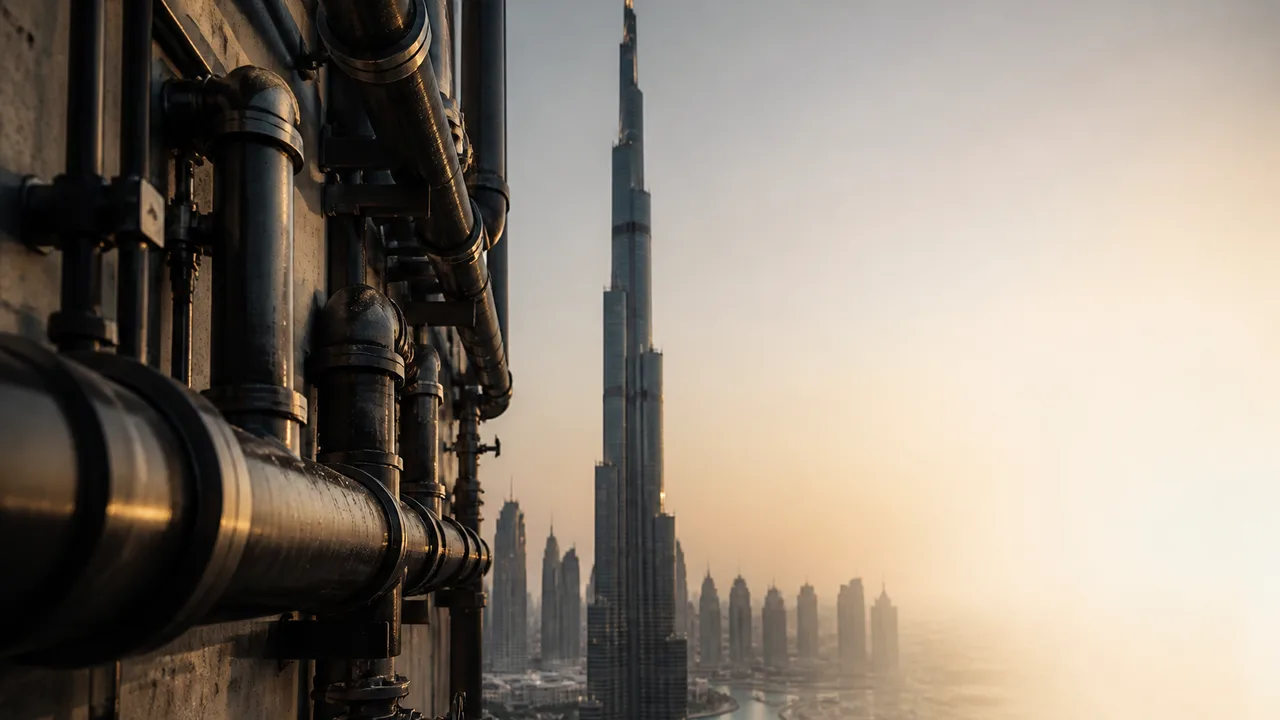
Photo: AI. Renzo Vargas
Look at the Burj Khalifa long enough and something starts to feel slightly wrong—not wrong like a mistake, but wrong like a dream where the proportions are slightly off from reality. The building tapers in a series of setbacks as it climbs, each tier stepping inward as the tower narrows toward that needle spire. That silhouette isn't just Adrian Smith's aesthetic signature. Those setbacks are aerodynamic engineering—the building's form was deliberately sculpted to confuse the wind, to prevent the kind of coherent vortex shedding that would set a uniform tower oscillating like a tuning fork at altitude. The shape you recognize from every Dubai skyline photo is doing structural labor. It is, in a very literal sense, shaped by the forces it refuses to let win.
That's the Burj Khalifa's central paradox: an object of almost theatrical visual ambition that works precisely because of what you can't see. The 26,000 glass panels wrapping its exterior aren't just the building's face—they're an active thermal defense system, each one treated with a high-performance reflective coating engineered to bounce solar radiation back into the sky before it can become your problem. At 122°F ambient temperature, that coating isn't a luxury finish. It's the first line of survival. But here's what I keep coming back to: the curtain wall—the technical term for a non-structural outer skin of glass and metal—is also how billions of people know this building. That shimmering surface is the visual identity. And it's also doing genuine structural and thermal work. The aesthetic is the engineering. That's not common. Usually we treat those as separate conversations.
A Building That Hates Simple Solutions
The Engineering The Impossible YouTube channel recently worked through the infrastructure logic of the Burj Khalifa, and the framing that stuck with me was this: "A normal city spreads outward. The Burj Khalifa spreads upward. And that one change—horizontal to vertical—turns every single rule of urban living inside out."
Start with water. Pushing 250,000 gallons a day to the 163rd floor via a single pump would generate roughly 1,200 PSI at the base of the system. Your home faucet runs at about 50 PSI. A fire hose at around 150. At 1,200 PSI, the video notes, a pipe joint doesn't leak—it "fails violently." The engineering solution is elegant in the way relay races are elegant: instead of one system fighting the full height, the building uses independent mechanical zones, each with its own tanks and pumps. Water gets handed off upward in stages, like a baton. Each pump only fights gravity for its own zone's worth of floors. The pressure never becomes catastrophic. If something goes wrong in one zone, the others keep running.
The descent is its own problem. When wastewater falls from extreme height, it accelerates quickly—according to Polypipe's Technical Bulletin on terminal velocity in drainage systems, water in a vertical stack reaches terminal velocity relatively fast, after which it stops accelerating but maintains a high-speed column of flow. The danger comes at the bottom, where that vertical momentum has to transition horizontally. The hydraulic jump—what happens when a fast-moving column of water suddenly hits a change in direction—sends pressure waves back up through the system. The Burj Khalifa's solution was to use main waste pipes roughly 24 inches in diameter (compare that to a standard residential pipe at 4 inches), giving falling water room to spiral along the walls while an air column stays intact in the center. Staged collection points at intermediate floors bleed off velocity before the water continues down.
Ice, All the Way Down
Now here's where the building's logic gets genuinely strange—and where I want to pause on a detail that deserves more attention than it usually gets.
The Burj Khalifa doesn't cool itself by running air conditioning during the day. It manufactures cold at night. During off-peak hours, a cooling plant in the basement produces massive quantities of ice slurry. During the day, when those 26,000 glass panels are absorbing everything the Arabian sun has to offer, that stored ice melts. The chilled water moves through the building's systems, handling air conditioning and tap water simultaneously. At peak load, the system's capacity is equivalent to melting 13,000 tons of ice in a single day.
What this means is that the building is essentially a thermal battery. It converts cheap off-peak electricity into cold, stores it overnight, and spends it during the hours when it's needed most. The reflective glass reduces the heat load before it enters; the ice handles the remainder. The condensation that results from all that cooling gets collected and used for irrigation. It's a closed loop of problems solving each other, which is either beautiful systems thinking or a reminder that every solution in a supertall building generates the next problem.
That same ice logic—the idea of using cold as a construction material—ran through the building's concrete pours. Dubai's heat is concrete's enemy: the hydration process (the chemical reaction that hardens concrete) accelerates dramatically in extreme temperatures, causing uneven curing, cracking, and structural weak points. To pour concrete at extreme heights in desert heat, engineers developed a custom C50 and C80 grade mix and literally chilled it with ice before it entered the pumps. Every pour happened after sunset, when temperatures dropped from the daytime peak to something in the 85–95°F range. The workers were using the cooler night air as a resource—the same instinct that drives the building's ice-cooling system. Cold, it turns out, was one of the building's primary construction materials, even before it opened.
The Sky Lobby as Social Architecture
The most underexamined feature of the Burj Khalifa's design is almost certainly its sky lobbies—transfer floors on the 43rd, 76th, and 123rd levels where express elevators deposit passengers before local elevators carry them to their final destinations. The engineering logic is clean: express shafts don't stop at every floor, so the building's 57 elevators can move 35,000 people without the whole system gridlocking. The video frames this as a highway-on-ramp model, and it works.
But sky lobbies are also rooms. They're threshold spaces, moments of pause built into the vertical commute. In a traditional building, you share an elevator with whoever happens to push the button. In the Burj Khalifa, your elevator journey is routed through a specific intermediate floor—which means the building is quietly segmenting its population by where they live and work. The sky lobby on the 43rd floor is not the same experience as the one on the 123rd. Altitude in this building isn't just a number; it's a social category, and the circulation system is how that category gets enforced. You meet the people who occupy your zone. The express elevator doesn't stop for anyone else.
This isn't a critique, exactly—it's how buildings communicate hierarchy. The point is that circulation design is never just logistics. The route you take through a building tells you something about who that building thinks you are.
The Trucks
The most clarifying moment in the Burj Khalifa's history isn't the opening ceremony. It's the fleet of orange waste trucks.
When the building opened in 2010, Dubai had been constructing faster than its sewer infrastructure could follow. According to reporting covered by Residents Watch, the city had accumulated staggering debt during its mid-2000s building boom, gambling on construction as an engine of growth. The consequence was mundane and absurd in equal measure: the world's tallest building, for approximately three years, had its waste vacuumed out daily by trucks and driven across the desert to treatment facilities. The underground connection finally arrived in September 2011.
That image—orange trucks queued at the base of a half-mile spire—tells you something true about how megaprojects actually work. The glamour is vertical. The logistics are horizontal and unglamorous, and they catch up when they catch up.
What Comes Next
The Jeddah Tower in Saudi Arabia is currently under construction targeting over 3,200 feet. Every problem the Burj Khalifa solved—water pressure, waste management, thermal load, human circulation—will need to be solved again at greater altitude. The physics don't get more forgiving with height. They get less.
As Engineering The Impossible puts it: "The question isn't whether we can build taller. The question is how hard are we willing to fight to drink a glass of water on the 300th floor."
That's an engineering question, yes. But it's also a design question, and a political one. Who is that water for? Who gets the sky lobby on floor 123? The Burj Khalifa is extraordinary precisely because it took the ordinary infrastructure of city life—water, waste, air, movement—and had to reinvent each one from scratch. The next tower will do the same. The silhouette will be different. The orange trucks may or may not make a return appearance.
More Like This
How Cruise Ships Stay Upright in Rough Seas
Cruise ships look impossibly top-heavy. The engineering that keeps them upright is layered, counterintuitive, and more fragile than the brochure suggests.
New York City's Underground Infrastructure Explained
From gravity-fed water tunnels to steam pipes and subway lines, NYC's underground is a century-deep tangle of engineering decisions—brilliant, broken, and still evolving.

The Next Generation of Windows Is Already Here
From squid-inspired liquid panes to transparent wood, new window technologies promise dramatic energy savings—but how close are they to your wall?
Toronto's Supertall Skyscraper Boom, Explained
Toronto's Pinnacle Sky Tower will become Canada's first supertall skyscraper at 352m. Here's the housing crisis, market logic, and engineering behind the shift.
The Invisible Inventions That Built Modern Life
From flush toilets to undersea fiber cables, the inventions that most shaped modern civilization are the ones we've stopped noticing entirely.
How Japan Engineers Its Cities to Survive Disaster
From underground flood cathedrals to maglev delays, Japan's megaprojects reveal what it costs—and what it means—to build against annihilation.
Route 66 and the Landscape of American Memory
Peter Adler's documentary on Route 66 reveals a road that stopped being infrastructure and became something stranger—a canvas for competing American mythologies.

How HBO Turned Jon Snow Into a Logo
HBO's Game of Thrones didn't just simplify Jon Snow's character—it redesigned him into a merchandisable image. Here's what that visual shift cost the story.