How Animals Self-Medicate With Plants
From monarch butterflies choosing medicinal milkweed to cats coating themselves in mosquito repellent, animal self-medication is reshaping how we think about medicine.

Written by AI. Priya Sharma
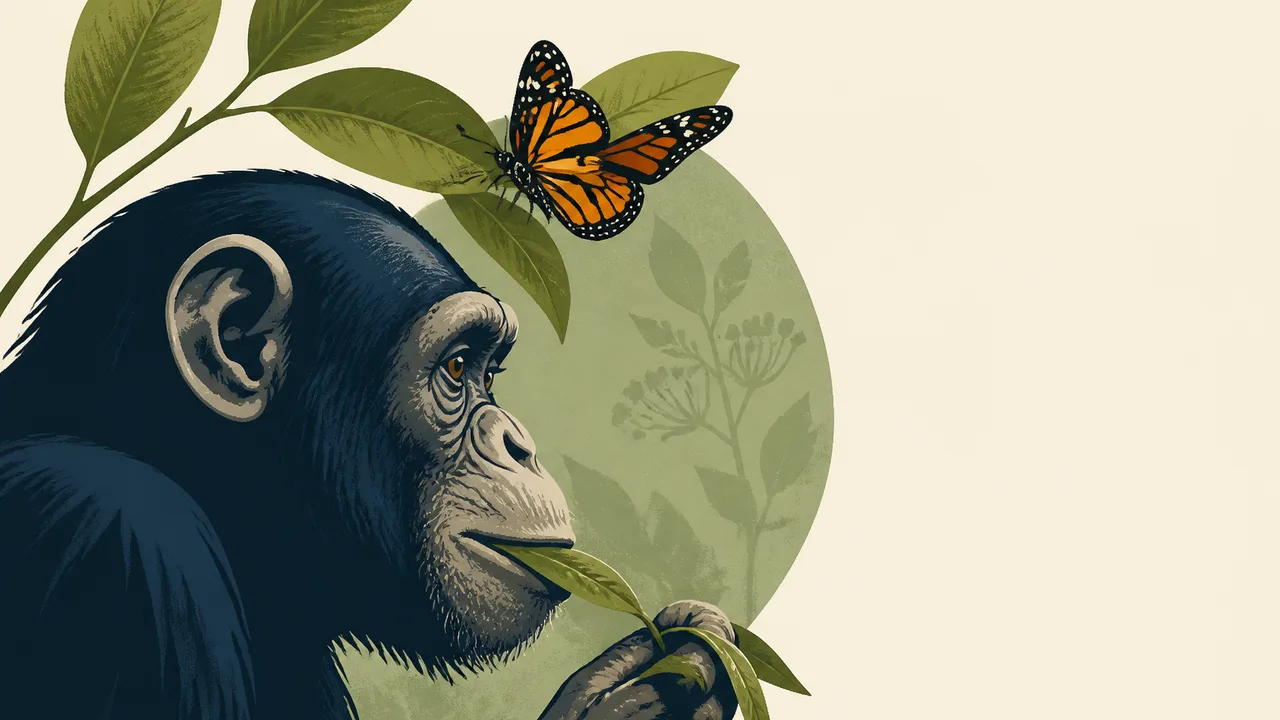
Photo: AI. Mika Sørensen
A monarch butterfly in a Florida stopover site does something unremarkable-looking and scientifically extraordinary: she lands on a milkweed plant, samples it with the chemoreceptors on her feet and antennae — sensory structures confirmed by the Monarch Joint Venture to be central to how butterflies assess plant chemistry — and decides whether it is the right milkweed for her eggs. She is not, as far as we can tell, thinking about parasite loads or toxin concentrations. She is following something older and more embedded than thought. And when Jaap de Roode, a biologist at Emory University, started paying close attention to that choice, it began to crack open an entire field.
De Roode appears in the first episode of the Royal Institution's new Puzzling Science series, assembling a jigsaw of a monarch butterfly while explaining what his research revealed: that the toxicity of milkweed is not merely armor against bird predators, but potential medicine against the protozoan parasite — closely related to malaria — that infects the butterflies. Caterpillars reared on more toxic milkweed became less likely to be infected and, when infected, got less sick. That was the laboratory result. The behavioral question was whether the butterflies could actively exploit that fact.
They can — but with a twist that de Roode describes as "Mommy knows best." When researchers gave infected and uninfected mother butterflies choices of medicinal and non-medicinal milkweed in greenhouse flight cages, it was the infected mothers who preferentially chose the more toxic plants as oviposition sites. The caterpillars themselves, given the same choice, showed no preference. The medicine is selected before birth, by a parent who will never meet her offspring. The caterpillars arrive already treated.
This is the kind of finding that makes a discipline reconsider its assumptions.
The Brain-Size Problem
The skepticism de Roode encountered when publishing this work was not trivial. The standard objection: a butterfly has a brain the size of a pinhead. How could it possibly "know" about medicine?
The question conflates knowledge with cognition, and that confusion, de Roode argues, is precisely what held the field back. The best-documented case of animal self-medication at the time came from chimpanzees, and it carried an implicit comfort for scientists — at least the animal using medicine had a big brain, like us. The discovery came in the 1980s when Mike Huffman of Kyoto University, working alongside Mohammedi, a Tanzanian field guide and traditional healer, observed a lethargic chimpanzee named Chausiku strip the bark off a shrub and suck its inner pith. Mohammedi recognized the plant immediately: it was the same one his community used to treat infectious disease. Twenty-four hours later, Chausiku had recovered — exactly the window the traditional healers expected. Subsequent research found that the plant's compounds are toxic to parasitic worms, that chimpanzees use it more frequently during the wet season when worm loads are higher, and that the behavior is learned socially, with infants copying adults.
Jane Goodall had actually noticed something related to this two decades earlier: chimpanzee dung sometimes contained whole, undigested, folded leaves. The meaning wasn't immediately clear. Huffman and colleagues eventually worked it out — the chimpanzees were deliberately swallowing rough leaves to physically scrape parasitic worms from their gut lining, inducing diarrhea to expel them. Different chimp communities fold leaves differently. It is, by any reasonable definition, a culturally transmitted medical technique.
That these behaviors were controversial in western science is itself revealing. "Medicine," de Roode notes, "was one of those things — like language and tools and empathy and culture — that was strictly supposed to be human." Each time that boundary has been challenged, the challenge has proven correct.
Three Routes to the Same Destination
What zoopharmacognosy — the formal study of animal self-medication — has since accumulated is a taxonomy of how animals arrive at medicinal behavior without a medical school, or, for that matter, a nervous system capable of anything we'd call deliberate reasoning.
The first route is pure instinct, hardwired in genetics. De Roode's clearest example: woolly bear caterpillars, which can eat a wide range of plants, face a gruesome threat from parasitoid flies whose larvae eat them from the inside out before bursting free. When infected, the caterpillars specifically increase their intake of alkaloid-rich plants that kill the fly larvae. Researchers placed tiny electrodes in the caterpillars' taste receptors and measured neural firing rates — when infected, the neurons responded far more strongly to alkaloids. The alkaloids, in short, taste better when the caterpillar is sick. The caterpillar does not "know" it is sick, does not "know" what alkaloids are, does not "know" what parasitoid flies are. The knowledge is distributed across the genome, expressed as a shift in taste preference at precisely the moment it is needed.
The second route is individual learning. Research from Utah State University has tracked how sheep, goats, and cattle respond to tannin-rich plants when they have gut parasites. Tannins — the same compounds that create that drying, puckering sensation in red wine — can suppress those parasites. Animals that eat the plants feel better; they make the associative link and seek out the same plants the next time they feel ill. It is operant conditioning applied to pharmacology, with no instructor present.
The third route is social learning: watching what works and copying it. Chimpanzees pass both the bitter-pith and the leaf-swallowing techniques between generations. The behavioral methods vary by community, which is the signature of culture rather than instinct.
What's notable is that these three mechanisms are not mutually exclusive, and they likely operate simultaneously across species. The cleaner question may not be "can animals use medicine" but "which mechanism is dominant in which species under which circumstances" — and that question remains largely unanswered.
The Domestication Footnote That Keeps Vets Busy
Your dog eating grass is annoying on the rug and sensible in evolutionary context. Wild carnivores — mountain lions, wolves, coyotes — do the same thing, and field biologists have documented undigested grass in their vomit and feces alongside expelled parasitic worms. It is, functionally, the mammalian version of leaf-swallowing. Your dewormed suburban dog inherited the behavior from ancestors who needed it, and still deploys it against discomfort in general, not worms specifically. De Roode describes finding his dog chewing grass on a morning walk, then vomiting up a swallowed rubber band six hours later. Problem solved, though perhaps not in the most convenient location.
"They know what to do," de Roode says, "sometimes better than we do."
The veterinary literature on this is thinner than you might expect — de Roode expresses genuine surprise at how little formal research exists on why domestic pets eat grass. That gap is itself informative: we have spent millennia living with these animals and have only recently thought to ask what they are doing when they appear to be doing something medical.
What Went the Other Direction
Here is where the research stops being merely interesting about animals and starts being interesting about us.
De Roode notes that everything modern zoopharmacognosy is discovering was already known — in fragmented, observational form — to traditional healers and shamans who watched animals to find new treatments. Aspirin traces a line that goes: bears emerging stiff and inflamed from hibernation eat willow bark, which is rich in salicylic acid; people in the northern hemisphere noticed and copied them; the compound was later isolated and purified by chemists, according to the Science History Institute, and the pharmaceutical industry eventually produced the small white pill that became one of the most widely used drugs in human history.
The pathway from animal behavior to pharmacy was not a twentieth-century innovation. It was the original method.
More recently, a team of Japanese scientists investigated why cats roll in catnip and silver vine — behavior documented for centuries, mechanism unknown until recently. Their finding, reported by ScienceDaily: the rolling coats the cat's fur in compounds that repel mosquitoes significantly, and the same compounds tested on human skin in a controlled cage experiment provided meaningful protection. The researchers described their intention to develop the compounds into a human mosquito repellent. Whether that work has advanced is a separate matter — but the trail from a cat drooling on a plant to a potential vector-control tool is a straight line, once you know how to read it.
"When we accept that animals are really knowledgeable when it comes to medicine," de Roode says, "we can learn from them. We can discover new chemicals, and it can really help us as humans to discover new drugs for our own use as well."
The working assumption underlying most of pharmaceutical history is that drug discovery starts in a laboratory. The evidence suggests it may have started in the field, in a much older sense of that word, and that we have been rediscovering the same knowledge for centuries while crediting ourselves for the find.
More Like This

Exploring Mercury's Mysteries: From Alchemy to Modern Science
Discover the unique properties of mercury, its historical significance, and intriguing experiments in Andrew Szydlo's lecture.
Animal Empathy: What Science and Instinct Both Get Right
Do some people genuinely connect with animals in extraordinary ways? Marcus Obi explores the science of animal empathy, what research actually supports, and what it means for the rest of us.

Quantum Field Theory, AI, and the Gravity Problem
Physicist Ross Jenkinson explains how quantum computing and AI could unlock the biggest unsolved problem in theoretical physics: reconciling quantum theory with gravity.

Exploring Black Holes and Asteroids with StarTalk
Neil deGrasse Tyson delves into black holes, asteroids, and more in StarTalk's latest Cosmic Queries episode with Chuck Nice.

Gut Health Is Real. Most Gut Products Are Not.
Vox talked to doctors and researchers at Cedars-Sinai about what gut health actually means—and why most of what's being sold to you doesn't hold up.
Prehistoric Drugs That Shaped Human Civilization
From 9,000-year-old fermented rice wine to 5,700-year-old peyote buttons, archaeology is rewriting the story of why humans built civilization.
The Quantum Twin Paradox and the Nature of Time
A new trapped-ion experiment may finally reveal whether time is a quantum property—bridging the long-standing gap between quantum mechanics and general relativity.

Nuclear Clocks Are Now Real — Here Is What That Means
Two independent teams built working nuclear clocks in 2026. Here's what the thorium-229 breakthrough actually achieved — and what it hasn't yet.