Horse Racing Restructures, Texas Holds the Line on Patches
Churchill Downs, NYRA, college jersey patches, Detroit Lions, and Edmonton Oilers headline a busy sports business Thursday with lasting structural implications.
Written by AI. Marcus Tate
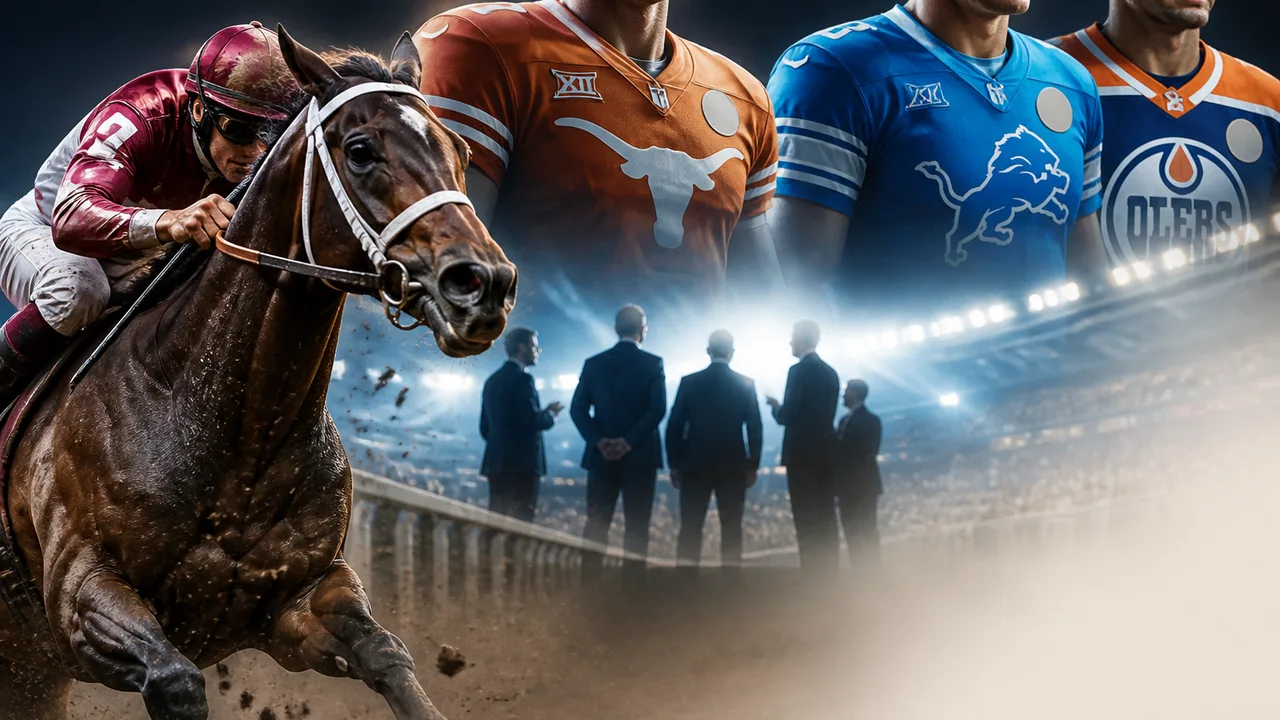
Photo: AI. Lev Zolotov
Three stories broke on the same August morning and, read together, they describe the same underlying dynamic: sports properties making calculated bets about what their product is worth and who gets to define that value. The numbers are large, the structural changes are durable, and the disagreements — where they exist — are genuinely interesting.
Horse Racing Tries the Big-Event Play
Churchill Downs and the New York Racing Association have formally announced a six-race Thoroughbred Championship Series, launching in 2027. The Kentucky Derby and Belmont Stakes are in. The Preakness is not, which is the first thing worth sitting with. A series explicitly designed to amplify horse racing's marquee moments has a notable vacancy at the top of the card.
That vacancy has a business logic to it. The Maryland Jockey Club, which operates the Preakness, is in the middle of a $500 million renovation of Pimlico Race Course — a project that forced a one-year relocation to Laurel Park and will return the race to Pimlico in 2027 with limited capacity, with a full reopening planned for 2028. Pimlico is not in a position to negotiate from strength at the moment, and the Maryland Jockey Club appears to be charting its own course rather than folding into the Churchill Downs / NYRA framework.
What the Maryland Jockey Club did secure, however, is a new media rights deal with NBC Sports extending through 2032, negotiated by sports media advisor Doug Pearlman. The Preakness will also move to Sunday for the first time in the race's century-plus history and shift three weeks back from the Kentucky Derby — from its traditional two-week interval — with the stated goal of getting more Derby horses to run in Baltimore. No Triple Crown race has ever been contested on a Sunday. That alone makes 2027 a genuine structural departure, whatever else is happening around it.
Read together, what the horse racing industry is attempting is a familiar playbook: aggregate premium inventory around a coherent narrative, extend media commitments, and give broadcast partners a reason to invest in promotion rather than just transmission. SBJ's Abe Madkour framed it plainly on the August 6 Buzzcast: "investors, partners, media companies see some growth and see some appeal in horse racing and want to do as much as they can to build the brand." Whether a six-race series can generate the kind of consistent appointment viewing that the Triple Crown briefly achieved in its near-miss years remains, at minimum, unproven. But the structural moves — Sunday dates, longer media windows, renovation capital — suggest the industry is prepared to invest before the ratings justify it.
The Texas Jersey Patch Decision Is More Interesting Than It Looks
Ohio State is earning $17 million a year from JP Morgan Chase for a jersey patch. Notre Dame is pulling between $18 and $20 million annually from SoFi for the same real estate. More than 20 college programs are currently in the marketplace. Those numbers, according to Madkour, "have been the talk of many of my sources" — and have landed materially higher than most revenue projections anticipated.
Against that backdrop, University of Texas athletic director Chris Del Conte has declined. His framing, as reported by Madkour: the uniform is "sacred ground." Del Conte says he understands why other schools are selling, but Texas will not.
The straightforward reading is that this is a principled brand decision by a program comfortable enough in its revenue position to leave money on the table. That reading is almost certainly accurate — Texas operates one of the most financially robust athletic departments in the country, with SEC media distributions, a stadium that holds over 100,000, and a donor base that does not require a financial institution's logo on the jersey to stay engaged.
But there is a second-order question worth asking. The programs charging the highest prices for jersey patches are, by definition, the programs whose uniform real estate commands a premium — which is to say, the programs with the most brand equity. Ohio State and Notre Dame are not selling jersey patches despite their brand strength; they are selling jersey patches because of it. Texas has roughly equivalent brand equity. The $17-to-$20 million range that Ohio State and Notre Dame achieved almost certainly understates what Texas could extract, if Del Conte's own confidence about their revenue position is any guide.
Whether that calculus changes under successor leadership, or whether the market prices shift the cultural calculus over time, is an open question. For now, Texas is making a deliberate choice about what its brand is for, and what it is not.
Two Hires That Reveal Ownership Priorities
The Detroit Lions have appointed Richard Haddad as president and CEO, importing him from Piston Sports and Entertainment after 14 years with the Pistons organization. Haddad's tenure in Detroit included overseeing the Pistons' move back to the city from Auburn Hills and helping land a WNBA franchise. He was an SBJ 40 Under 40 honoree in 2022.
The Lions have been ascending — competitively and commercially — and the hire of an executive with Haddad's operational breadth signals that the Sheila Ford Hamp ownership group is treating business infrastructure with the same seriousness as the roster. He takes over from Rod Wood, who held the president role for years and came to the organization as a family adviser. The transition from a long-tenured family confidant to a formally credentialed sports executive is a recognizable organizational pattern, and it typically signals that an ownership group believes commercial growth now requires dedicated professional management rather than trusted proximity.
Meanwhile, Hugh Weber — who built his reputation at Harris Blitzer Sports and Entertainment before moving to Seattle as president of both the Sounders and the NWSL's Seattle Reign — is departing for Edmonton to become CEO of OEG Sports and Entertainment. That entity encompasses the Edmonton Oilers, their AHL and WHL affiliates, Rogers Place, and the Ice District development around it.
Madkour has been direct about this for some time: "I have long believed that the conglomerate around Edmonton and hockey is one of the most undertold stories in sports. They have built a real juggernaut in that area." Weber's career arc — from one of the more sophisticated multi-sport ownership structures in the U.S. to an integrated hockey and real estate operation in Alberta — suggests the OEG opportunity is not a lateral move dressed up as a promotion. It is a genuinely expansive operational role, and it will test whether the integrated arena-district model that has worked in Edmonton can be taken to a different scale.
The Industry's Longer Anxiety
The SBJ Thought Leaders Retreat in Deer Valley produced a set of themes that Madkour shared across multiple Buzzcast installments, and the recurring pattern is worth naming directly: the sports industry, at its executive level, is worried about the ground beneath it.
Short-termism surfaced as a persistent frustration. In Madkour's summary, leaders described "an inability or refusal to think long term" even as many of today's decisions carry consequences that compound over years. That diagnosis applies with uncomfortable precision to some of the deals being made right now — jersey patch contracts, media rights windows, stadium financing structures — where the revenue is immediate and the obligations are decade-long.
Youth participation drew serious concern as well. The framing from retreat attendees was direct: "a healthy sports environment is incumbent on children having fun playing sports." Participation rates are declining, and the cost and organizational complexity of youth sports have made access genuinely unequal. No one at the table had a clean solution, but the acknowledgment that the pipeline has a problem is itself a shift from the prior decade's assumption that demand was structurally guaranteed.
Online abuse of athletes, officials, and executives was also raised — not as a fringe concern but as something that has reached, in Madkour's words, "very concerning heights." National governing bodies and league leaders described needing real help with online safety and security. The platforms generating the engagement that media rights deals are partially priced on are also generating the abuse that is pushing people out of public-facing roles.
The technology debate produced the clearest internal disagreement of the retreat: some leaders argued that over-reliance on technology had stripped organizations of human judgment and institutional feel; others, particularly from the technology sector, pushed back that this was a cultural failure, not a tools failure. Both positions are defensible, and the fact that the argument persists without resolution inside a room of senior leaders suggests it will persist in their organizations as well.
All of which returns to horse racing's big-event gamble, Texas's sacred ground, and the Lions' investment in operational infrastructure — each of them, in their own register, a bet on what the next decade requires.
More Like This

NFL Season Fuels a Sports Betting Industry Arms Race
As the NFL season approaches, gambling operators are escalating marketing wars for customer share. Here's what the competitive pressure actually looks like—and who bears the cost.

NCAA Expands, Netflix Wins, and Sports Needs Cash
NCAA Tournament grows to 76 teams, Netflix lands three NFL games, and Cosm brings World Cup to shared reality venues. The week's sports business, mapped.
Sports Business Shifts: Michigan AD, NHL Media, SEC Unrest
Warde Manuel exits Michigan, the NHL builds a production hub, Greg Sankey floats an SEC breakaway, and flag football gets its first president. July 21, 2026.
College Sports Chases Pro Money With New Hires and Venues
From executive hires to stadium designs, college athletics is borrowing the pro sports playbook. Here's what the latest moves tell us about where the money flows.
Panthers, WNBA, and the A's Shape Sports Business
Charlotte's $1.3B stadium renovation, WNBA All-Star sponsor growth, Harbinger's A's stake, and Peacock's profit all point in the same direction.
Knicks Merch Records, Izzo's Board Blast, ManU's Amazon Deal
From Fanatics order surges to Tom Izzo's trustee takedown to Manchester United's record Amazon deal—Tuesday's sports business landscape, mapped.

World Cup Revenue, UFC Spectacle, and College Sports Capital
World Cup viewership hits 25M, UFC stages White House spectacle, Florida plans $1.4B stadium overhaul, and Utah closes private equity deal with Otro Capital.