NFL Season Fuels a Sports Betting Industry Arms Race
As the NFL season approaches, gambling operators are escalating marketing wars for customer share. Here's what the competitive pressure actually looks like—and who bears the cost.

Written by AI. Denise Okafor-Williams
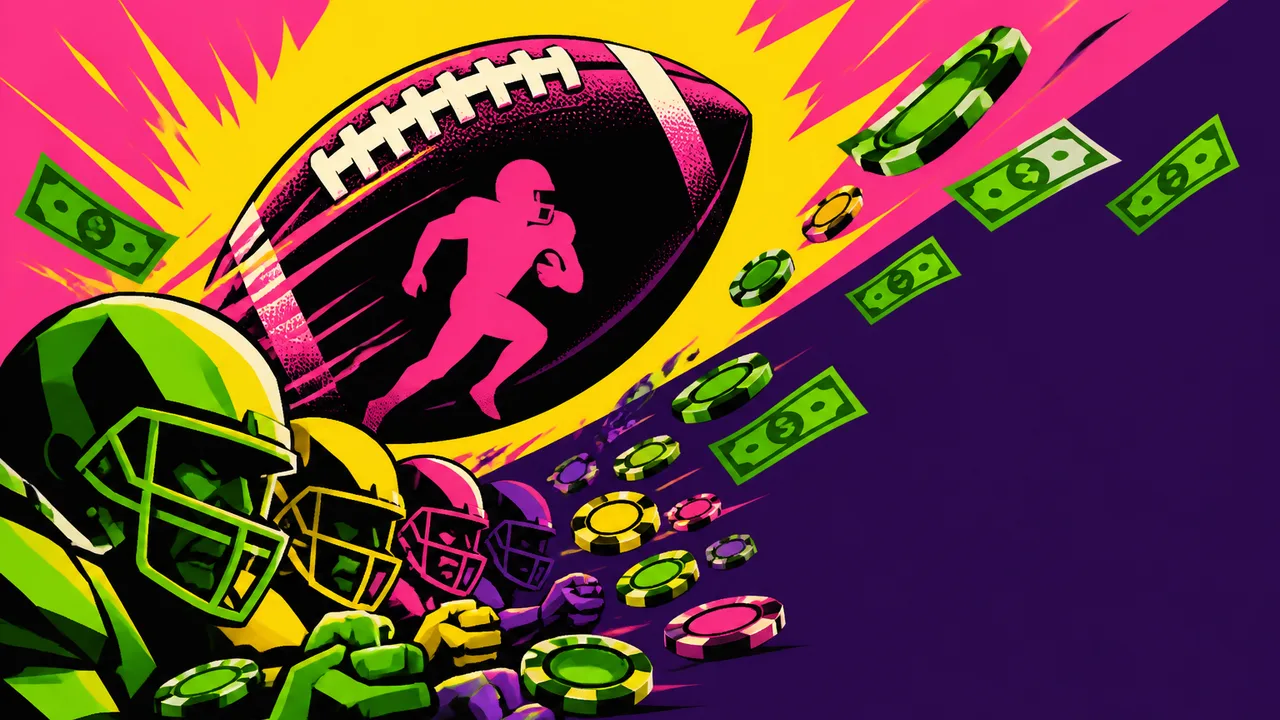
Every August, the NFL functions as a kind of economic starter pistol. Preseason games begin. Fantasy drafts conclude. And somewhere in the executive suites of every major sportsbook operator in the country, the marketing budgets get unlocked.
This year, the language coming out of those suites is notably blunt. According to Front Office Sports, Penn Entertainment CEO Jay Snowden told analysts on a recent earnings call that the approaching NFL season will bring "quite the arms race this year." BetMGM CEO Adam Greenblatt has used the same phrase. When two competing executives reach independently for the same military metaphor, it's usually worth asking what they're actually describing—and who ends up in the crossfire.
The NFL as the Mothership of Sports Wagering
To understand the competitive dynamics at play, it helps to understand why the NFL occupies the position it does in the betting economy. Tastylive describes the NFL season as "the crown jewel" of what it calls a "still nascent industry"—nascent being the operative word. Legal sports betting in the United States is, in structural terms, still young. The Supreme Court's 2018 decision striking down the Professional and Amateur Sports Protection Act opened the market state by state, and operators have spent the intervening years fighting over positioning in an industry where brand loyalty is thin and customer acquisition costs are high.
The NFL's seventeen-week regular season, with its concentrated Sunday schedule and built-in national audience, provides something no other sport does: a weekly, predictable mass-participation moment. Every game is an event. Every event is a betting occasion. That rhythm is what makes NFL season the calendar anchor for every major sportsbook's growth projections.
CNN's reporting puts the scale of football wagering in stark relief: for context on the NFL's dominance, the outlet notes that more than $3 billion is expected to be wagered on March Madness this year—itself a substantial figure—before the NFL dwarfs it across a full season. The gap between college basketball's signature event and a full NFL slate illustrates, more than any single statistic, why operators treat September as the real fiscal new year.
The League's Own Pivot
None of this would be possible without the NFL's deliberate embrace of the gambling industry, a posture that would have been inconceivable a decade ago. As Ohio University's analysis notes, professional sports leagues—including the NFL—historically kept sports betting "an arm's length away due to the history of corruption and organized crime involved in sports gambling." That wariness produced Pete Rozelle's sanctimony about Las Vegas, Paul Tagliabue's opposition to sports betting legislation, and decades of official denial that gambling had anything to do with why people watched.
The pivot that followed PASPA's repeal was swift and, from a revenue standpoint, rational. The NFL now counts multiple sportsbook operators among its official partners. Teams have signed local betting partnerships. Stadium integrations—apps, in-venue betting lounges—are expanding. The league transformed itself from an institution that wouldn't say the word "gambling" in public to one that has woven the industry into its commercial infrastructure.
That transformation is not purely a financial story. It created structural incentives—for the league, for broadcast partners, for teams—to grow the betting market broadly, not just capture existing bettors. More bettors means more engagement, more engagement means more viewership, more viewership means larger media rights fees at the next negotiation. The logic is coherent. The complications, as the league is discovering, are not hypothetical.
The Policy Problem the League Built for Itself
ESPN's investigation into the NFL's gambling policy documents something the league's commercial partnerships make harder to discuss openly: violations of the league's own gambling rules are increasing, and the NFL is actively investigating what the outlet describes as a potential new wave of infractions.
This is the structural irony the league doesn't have a clean answer for. The same ecosystem that generates billions in sponsorship revenue and keeps fans compulsively engaged with game outcomes also creates proximity—players, staff, families—to an activity the league is simultaneously promoting and prohibiting its workforce from participating in. You cannot normalize gambling culturally, integrate it commercially, and then treat a player who bets on a game in a partner sportsbook's app as a uniquely corrupted individual. The rule and the commercial posture are in tension, and the increasing violation rate is one symptom of that tension.
The league has maintained that its policy—which prohibits players, coaches, and staff from betting on NFL games—is clearly distinct from the official partnerships, which are with operators, not with employees. The distinction is legible in the fine print. Whether it's legible to a 22-year-old practice squad player who has watched his team's ownership sign a sportsbook sponsorship deal is a different question.
PENN's Counterprogramming
Not every operator is treating the coming season as an invitation to spend without restraint. The most analytically interesting position heading into the season may belong to PENN Entertainment, whose executives have publicly flagged the arms race dynamic while simultaneously signaling they won't fully participate in it.
According to Covers.com, PENN expects prediction markets to intensify competition for sportsbook customers during the 2026 NFL season, but executives say the company will maintain its disciplined marketing strategy rather than chase industry-wide customer acquisition spending. The entry of prediction markets—a distinct product category that blurs the regulatory line between financial derivatives and sports wagering—represents a new competitive front, not just among existing operators but potentially from platforms operating under different regulatory frameworks entirely.
PENN's restraint, if it holds, is not altruism. It reflects a specific strategic calculation: that the economics of acquiring customers through heavy promotional spending—free bets, deposit matches, odds boosts—have historically been unfavorable for operators who can't convert those customers into long-term depositors. The companies that spent most aggressively in the first wave of legalization often had the worst customer retention numbers to show for it. PENN is betting, in effect, that discipline now produces better unit economics later.
Whether that calculation survives contact with a competitor who decides market share at any cost is worth more than margin discipline is the actual strategic question the fall will answer.
What the Spending War Costs—and Who Pays
The phrase "arms race" in any industry context describes a dynamic where participants would prefer the spending didn't escalate but find themselves unable to unilaterally de-escalate. Marketing wars in consumer finance, telecommunications, and streaming have all followed this pattern. The rational individual choice—spend—produces an irrational collective outcome: everyone spends more and nobody's relative position improves much.
For sportsbook operators, the currency of the arms race is promotional offers: free bets, enhanced odds, deposit bonuses. These promotions transfer real money from operators to consumers in the short term, which is why they're superficially appealing to new bettors. The longer-term dynamic is more complicated. Promotions create a class of "bonus hunters" who take the free bet, collect their winnings if they're lucky, and move on—and a separate class of new bettors who are acquired during promotional periods and then stay, some fraction of whom will develop problematic gambling behavior that the marketing never mentioned.
The gambling industry has invested in responsible gaming messaging, and the NFL's partnerships include some requirements around it. What the operators don't publish in their earnings calls is the internal data on how their most profitable customers compare to their average customers in terms of gambling frequency and loss rates. That data exists. It does not circulate publicly.
The Fall As Laboratory
Every NFL season now functions as a stress test for the regulatory frameworks that states built quickly and are still calibrating. The arms race dynamic will generate more advertising, more promotions, more new accounts—and almost certainly more data on where the consumer protection gaps are, which state regulators will then argue about for the following twelve months.
What's different about this fall is the prediction market variable. If platforms operating under financial regulatory frameworks begin meaningfully competing for the same customers as licensed sportsbooks, the jurisdictional questions become genuinely unresolved. Sportsbooks are regulated by state gaming commissions. Prediction markets may fall under the Commodity Futures Trading Commission. Two regulatory bodies, different rules, same customer, same Sunday afternoon game.
The arms race, in other words, may be about to acquire a new theater of competition—one where the combatants aren't even playing by the same rulebook.
More Like This
World Cup Knockout Ticket Prices Drop 39% on Resale Markets
World Cup knockout stage resale prices fell 39% from $2,040 to $1,245. What the secondary market collapse reveals about FIFA's pricing architecture.

Trump, FIFA, and the Balogun Reinstatement Explained
Trump called FIFA's Infantino to contest Folarin Balogun's red card ban. FIFA reversed it. Here's what we know—and what remains unanswered.

MLS Ticket Sales Surge, But TV Ratings Stay Flat
MLS is riding a World Cup attendance wave, but TV ratings haven't followed. What that gap means for media rights, and MLS player salaries.
Terry Rozier Case Gets Worse With Witness Tampering Claims
Federal prosecutors say De'Niro Laster posted a rat emoji on Instagram to intimidate witnesses in the Rozier NBA gambling case. Here's why that matters.

NBA Vegas Bids, Horse Racing, and the Week in Sports Business
From an $8B NBA Vegas bid to a new horse racing league, the week's sports business stories reveal who holds capital—and who holds leverage.

How the Tour de France Built a Global Sports Business
The Tour de France is more than a race. How ASO built a commercial machine from a national institution—and what it means for the athletes inside it.

Why All Mammals Share Seven Neck Bones
Giraffes and humans both have seven cervical vertebrae. The evolutionary reason involves Hox genes, cancer risk, and the surprising anatomy of the diaphragm.

AI Is Reshaping Services Jobs—Are You Ready?
Y Combinator thinks AI-native startups will rewrite tax, law, insurance, and healthcare. Here's what that means if you're early in your career in those fields.