Horror's Business Follows Readers Across Books and Screens
Horror moves through books, audio, film and fan forums. That reach attracts businesses, while raising questions about creative control and whose stories travel.

Written by AI. Aminata Diallo
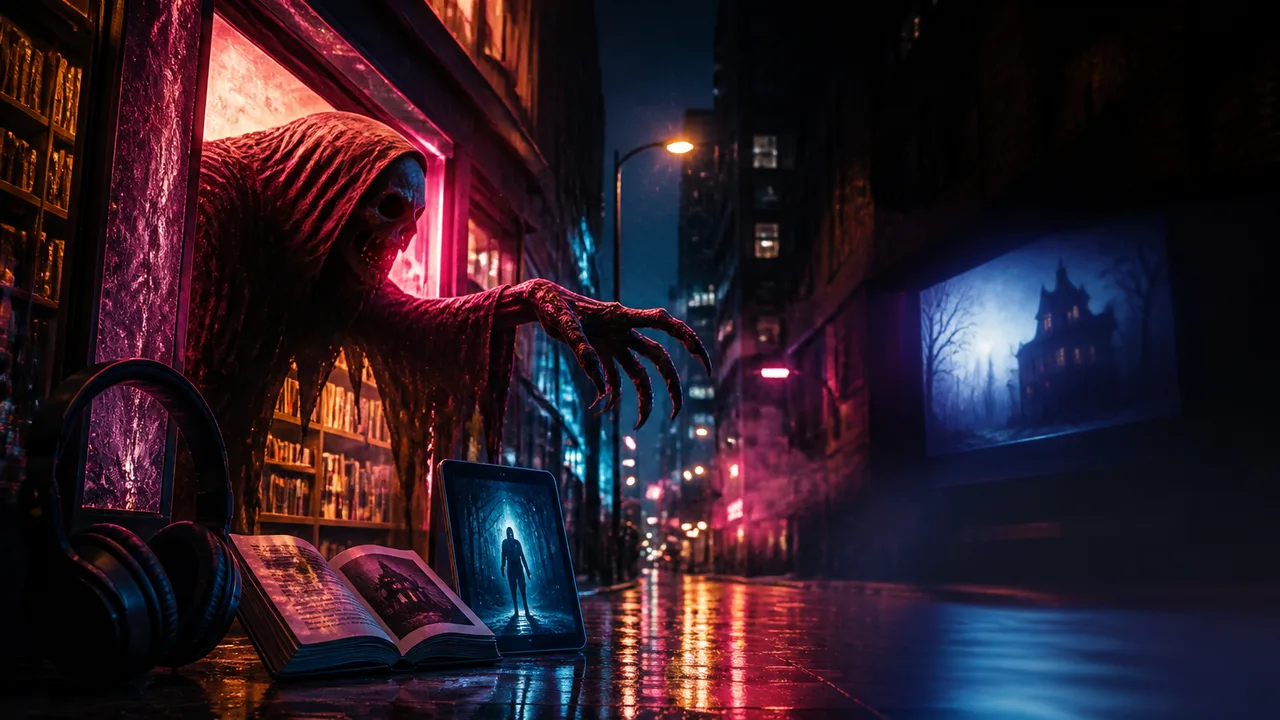
An unidentified business voice has a plan for horror consumers: “Every place that consumers engage with scary stories is a place that we as a business, as a company obsessed with horror and scary stories will be,” the person told NPR. The sentence treats fear as something that can travel with its audience, from one format to the next.
That ambition captures the commercial logic around horror. A story might begin as a book, find listeners in audio, attract discussion online and eventually reach a screen. Each encounter offers another chance to earn attention or sell access. Without sales figures or named titles, the size or direction of horror’s market remains unclear. The business proposition itself is clear: follow people to the places where they seek a scare.
One Fear, Several Ways to Sell It
Horror gives publishers and other cultural businesses a useful combination. Audiences can recognize its promise quickly, yet the story delivering that promise can change completely. A haunted house, a voice heard through headphones and a film watched with friends ask for different sorts of attention. They also create different opportunities to package, distribute and promote the work. The familiarity lies in the expectation of dread; the reason to try another story lies in what produces it.
A book gives a reader control over the pace, including the option to stop before opening the next door. Audio can make a voice or a silence do the work that prose leaves to imagination. Film can put a threat in the frame before a character notices it. Online discussion adds another layer: readers can debate an ending, recommend an overlooked work or decide together whether a monster stands for something beyond itself. A company seeking a presence in all those spaces is pursuing more than repeated sales of one object. It is pursuing a continuing relationship with an audience.
That strategy has a practical appeal for a creator, too. A story that finds readers in one form may reach people who would never encounter it there. Translation, narration and adaptation can extend a work’s life. Yet each step involves decisions about rights, payment and interpretation. Who may use the characters? Who approves a change of setting? How does the creator benefit when a story moves into another medium? The promise of reaching every audience is easier to state than the terms on which a story gets there.
What a Market Can Tell Us About Fear
The appetite for horror invites a tempting diagnosis: people are anxious, so they buy frightening stories. That explanation catches part of the appeal while flattening the range of reasons people read. Suspense can be pleasurable on its own. Some readers like the craft of a threat carefully revealed; others come for a monster, a joke, a mystery or an ending that gives disorder a boundary. A narrative can make fear feel manageable, while responses differ and fiction is no form of therapy.
Purchases, in any case, cannot disclose a buyer’s private fear. A reader choosing a ghost story might be looking for company, distraction, beauty or a frightening night. Industry language groups those motives under “consumers” because businesses need categories they can act on. Writers need something less tidy. They have to persuade a person who knows the genre’s conventions that this particular sound behind the wall deserves attention.
Horror’s flexibility helps with that task. It can make a familiar place unreliable or give a name to a danger that ordinary conversation struggles to describe. The meaning changes with the place. An abandoned building, a family inheritance or an authority figure can carry different associations for readers with different histories. A story that uses one of them well does more than select a recognizable image from a catalogue of scares; it establishes why the characters cannot simply walk away.
Those differences become more consequential when a story crosses borders. Terms drawn from religious or local traditions do not arrive in another language as empty names for monsters. Jinn, for example, belong to varied Islamic traditions; reducing them to a single English-language horror shorthand would discard much of that variation. A publisher or adaptor working across languages has choices about explanation, translation and audience expectations. Each choice can make a story easier to sell while changing what its original details mean.
Who Gets to Travel with the Story?
The phrase “every place” sounds borderless. Cultural businesses still have to work through specific languages, distribution channels and rights agreements. An English-language edition is one route to readers, not a universal version of a work. For a story rooted in a named community or place, wider circulation can bring welcome attention alongside pressure to make unfamiliar details legible on someone else’s terms.
That pressure is not peculiar to horror. The genre does, however, give it a sharp edge. Fear depends on what a character understands and what an audience recognizes before the character does. Change a setting or remove an explanation, and the source of dread may change with it. Keep every detail without helping a new audience orient itself, and the story may lose its force. Adaptation calls for judgment rather than a rule that every work should stay untouched or travel unchanged.
The commercial question also reaches beyond the person buying a ticket or downloading a book. Writers, translators, narrators and other collaborators help a frightening story move between places and formats. A company’s promise to appear wherever fans gather says little about how those people participate in the rewards. The strongest case for that ambition is that it could bring stories to audiences their creators could not otherwise reach. Its test is whether the people who made those stories retain a say, and a stake, as the audience expands.
Horror has always needed someone willing to follow a story into the dark. The current business ambition is to accompany that person everywhere. What happens to the story, and to its makers, during the journey is the question no good scare should let disappear.
More Like This

Pitch the Ceiling: James Hawkins on Ambition and Building PostHog
PostHog CEO James Hawkins on why bigger ideas are easier to sell, swapping jobs with your co-founder, and how ambition changes everything about building a company.
Why Scary Stories Appeal When Life Feels Uncertain
Horror can make fear feel manageable by giving it a story and an ending. But scary fiction affects people differently, and watching it is not a form of therapy.
Tim Pope and the Art of the Music Video
Tim Pope shaped MTV's golden age directing The Cure, Bowie, and Queen. His memoir revisits a creative window that reshaped how the world heard—and saw—music.
Nirvana to Receive the 2026 MTV Video Vanguard Award
Nirvana will receive the Video Vanguard Award at the 2026 VMAs on September 27. What the honor says about canonization, MTV's history, and the band's legacy.
Human Shaped Is a Free Indie Horror Game Worth Playing
Markiplier played Human Shaped, a free doppelganger horror game on itch.io. Here's why this low-budget indie deserves serious attention from players at any budget.
NBCUniversal and U-Next Join Forces in Japan
NBCUniversal and U-Next are partnering to bring Universal+ exclusively to Japanese audiences. What does the deal reveal about streaming, culture, and content flow?

World Cup 2026's Heat, Cost, and Political Fault Lines
From $11,000 tickets to denied visas and doubled emissions, the 2026 World Cup's off-pitch challenges may define the tournament as much as the football.
Did a Catholic Priest's Faith Corrupt the Big Bang?
Three cosmologists unpack whether Georges Lemaître's faith compromised his science—and why the real threat to cosmology is political, not theological.