Heather O'Reilly on Life After Soccer and Women's Football Growth
O'Reilly opens up on athlete identity loss after retirement, her Home 4T mentorship program, and building women's football at Como 1907 in Italy.

Written by AI. Marcus Tate
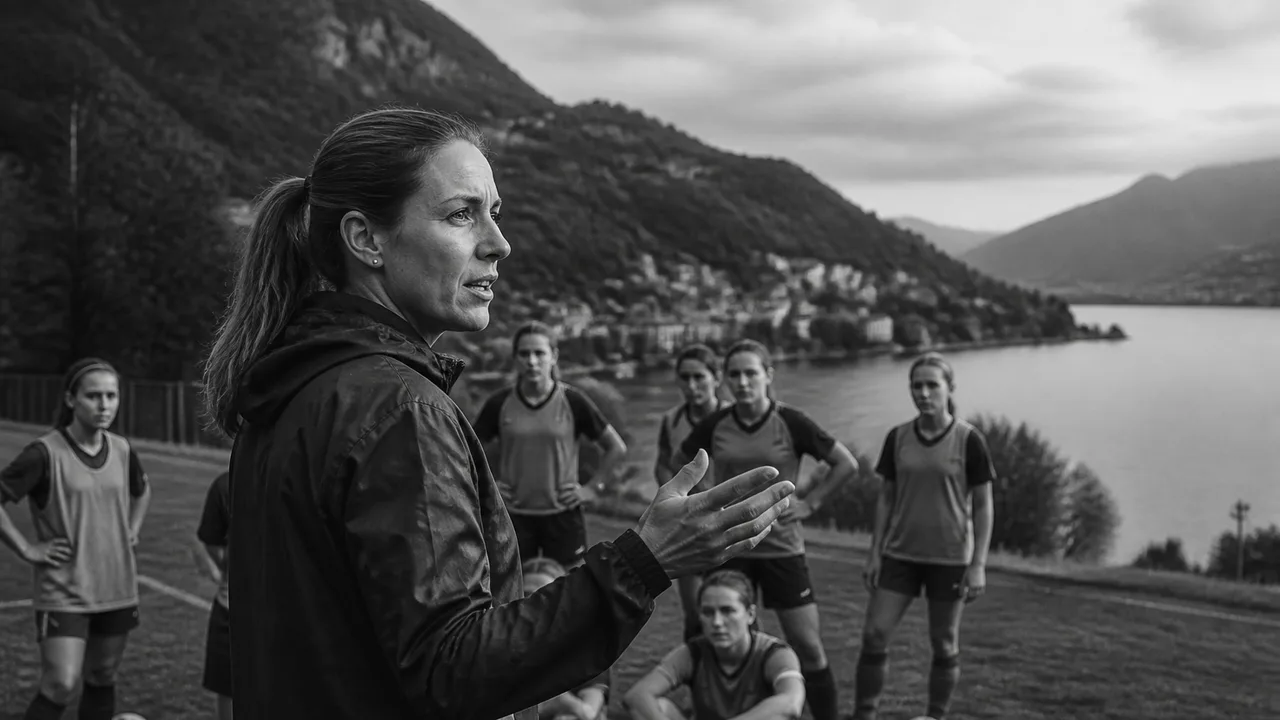
Photo: AI. Atticus Ferenczi
Three Olympic gold medals and a World Cup title are, by any reasonable accounting, a career. When Heather O'Reilly retired from professional soccer, she had won nearly everything the sport offers. None of it made the exit easier.
"I did, without knowing it, tie a lot of my identity and sort of self-esteem to being an athlete and to being a soccer player," she told Front Office Sports in a conversation produced in partnership with RBC Wealth Management. "I lacked a little bit of self-confidence that I could do that at first. It took a few years, really, to gain my footing again after retirement."
That admission is worth sitting with. O'Reilly is not describing a failure of preparation — she had the education, the financial foundation, the professional network. What she lacked was something no investment account addresses: a clear sense of what the athlete identity was actually made of, and which parts of it were transferable. The credentials transferred. The self-understanding had to be rebuilt from scratch.
This is not a novel problem. The sports industry has spent considerable energy in recent years acknowledging that the machinery built around professional athletes — the agents, the contracts, the media obligations — is almost entirely oriented toward the playing career, with retirement treated as a footnote. Player associations in the major leagues have expanded mental health resources and transition programs, some more substantively than others. The NFLPA, NBPA, and USWNT's own collective bargaining history each reflect different levels of institutionalized attention to what happens after the final whistle. But the structural incentive for most parties in the athlete-support ecosystem is to maximize playing-career value. The post-career chapter is, largely, someone else's problem.
O'Reilly's prescription is less structural and more diagnostic. Her advice to players contemplating retirement centers on a question she wishes she had asked herself sooner: what, specifically, do you love about the sport? The camera, the crowd, the teammates, the competition itself? "You really need to be true to yourself," she said. "That will lead you into your next chapter in a more successful way if you can figure out what it is about this great sport that you love so much."
The self-audit framing is useful precisely because it resists the generic. It does not tell every retiring athlete to become a coach, or a broadcaster, or an entrepreneur. It asks them to reverse-engineer their own motivation before they find themselves two years post-retirement, accomplished and disoriented.
There is a particular piece of O'Reilly's career narrative that tends to get lost in the medal count: she occupied the generation between American soccer's two most celebrated cohorts. The 1999 World Cup team — Mia Hamm, Brandi Chastain, the group that mainstreamed women's soccer in the United States — cast a long shadow forward. The 2019 World Cup team, with Alex Morgan and Megan Rapinoe at the center, cast a long shadow backward. O'Reilly played in the space between them.
"I used to be sort of a little insecure because I had this group of legends before me and this group of superstars after me," she said. "I took so much confidence and pride in being a culture carrier, but maybe never gave myself enough credit of how hard that truly is and how important that really truly is."
The culture carrier role is genuinely undervalued in how sports teams and leagues are analyzed. The athletes who define eras attract the capital and the retrospectives. The athletes who maintain institutional standards, professionalism, and team culture across the transitional years between peaks are harder to quantify and easier to overlook. O'Reilly's observation is honest rather than self-aggrandizing — she is naming a structural gap in how athletic contribution gets credited, not lobbying for a recount.
Her current work runs along two tracks that are structurally related even if they operate in different geographies.
The first is Home 4T, a year-long mentorship program aimed at girls in the early high school years — the period O'Reilly describes as among the hardest of her own life. The program's premise is not complicated: young women navigating the transition from middle school to high school, with all the social and identity pressures that entails, benefit from structured community and explicit permission to pursue ambitious goals. "I dreamt it, and then I planned for it, and then I executed it," O'Reilly said of her own path to the national team at age 14. Home 4T is, in part, an attempt to make that process legible to the next generation.
The mentorship economy in women's sports has expanded meaningfully as the league infrastructure has grown, but it remains fragmented. Most of it happens informally, through relationships between veterans and younger players within club environments. Structured programs like Home 4T attempt to systematize what has historically been a function of luck — whether a young athlete happened to know the right older player at the right moment. Whether that model scales, and how it sustains itself financially over time, are questions the women's sports industry is still working through.
The second track is O'Reilly's role as Head of Women's Football at Como 1907, the Italian club now competing in Serie A with Cesc Fàbregas as manager of the men's side. Her involvement grew from a networking conversation — she made her interest clear early, kept the relationship warm, and eventually took on the role of building the women's program from its early stages. "If the athletes are taken care of, then they're going to put together good product, then they're going to win, then people are interested," she said, laying out the flywheel logic of club-building as clearly as any executive presentation.
The Italian market presents a distinctive set of variables. The Azzurre currently rank approximately 13th in the FIFA world rankings — competitive, but well behind the top tier dominated by the United States, England, Germany, and Spain. Domestic fan engagement with women's club football in Italy has historically lagged behind the men's game more sharply than in some other European markets. O'Reilly is candid about both the opportunity and the friction, describing her mandate partly as cultural: persuading Italian audiences to invest attention in a product they have not historically prioritized.
The NIL and social media conversation O'Reilly raises is, from a business perspective, the most structurally interesting thread in the interview. The young women's soccer player of 2024 operates in a monetization environment that did not exist a decade ago — name, image, and likeness deals, European club contracts with professional salaries, brand partnerships accessible to players still in college. O'Reilly is careful not to frame this as purely problematic. "It's not all a bad thing for these young athletes," she said. The concern is more specific: the opportunity cost of attention. Time spent managing a social media presence or navigating brand relationships is time not spent on technical development, recovery, or the kind of focused training that produces the 10-to-15-year professional career O'Reilly describes as the real prize.
"Your focus needs to be on being the best athlete you can be, and you will reap the rewards for that," she said. "If you stretch yourself too thin, then you're probably not training as much as you should have that day."
This is, on its face, the conventional wisdom of every veteran athlete to every younger one. But the structural backdrop has shifted enough that it deserves fresh examination. The player coming up in 2024 has genuine revenue decisions to make at seventeen in ways that O'Reilly's generation simply did not. The advice to prioritize the pitch is sound; the question of how young players and their families navigate those decisions without sophisticated guidance — the kind that Home 4T and programs like it are trying to provide — is still being answered.
How that balance gets struck, across a generation of athletes with more choices and more noise than any before them, may determine the competitive ceiling of the next wave of American women's soccer.
More Like This

Kenny Beecham's Bold Bet on Media Ownership
Kenny Beecham turned down $1M to build his own sports media empire. Here's how ownership transformed his journey.

Gen Z's Dating Retreat Is Also an Economy Story
Gen Z isn't just retreating from dating—they're optimizing themselves for a labor market logic that's colonized their bodies. Christine Emba unpacks what's actually happening.

Como 1907: Building Football's Most Ambitious Brand
The Hartono brothers didn't just buy a football club—they bought a canvas. How Como 1907's tourism-meets-football model could rewrite sports business.

Who Actually Breaks Into AI/ML—And Why It's Not Who You Think
Marina Wyss says credentials don't determine who breaks into AI/ML—mindset does. Here's what her argument gets right, and what it leaves out.

Marina Wyss Went From $60K to $600K in 8 Years
Marina Wyss details the pay cuts, pivots, and 100+ job rejections that took her from $60K to $600K in AI—and what her creator business actually reveals.

Mark Cuban on Why NBA Ownership Isn't Fun Anymore
Mark Cuban explains how private equity reshaped NBA ownership, why he sold the Mavericks, and what NIL, Vegas expansion, and prop bets mean for pro sports.
Knicks Merch Records, Izzo's Board Blast, ManU's Amazon Deal
From Fanatics order surges to Tom Izzo's trustee takedown to Manchester United's record Amazon deal—Tuesday's sports business landscape, mapped.

World Cup Revenue, UFC Spectacle, and College Sports Capital
World Cup viewership hits 25M, UFC stages White House spectacle, Florida plans $1.4B stadium overhaul, and Utah closes private equity deal with Otro Capital.