Hand Tension Relief Techniques That Actually Work
Tight, aching hands from typing, parenting, and just surviving? Here are the hand tension techniques worth trying — and the honest case for why they matter.

Written by AI. Marcus Obi
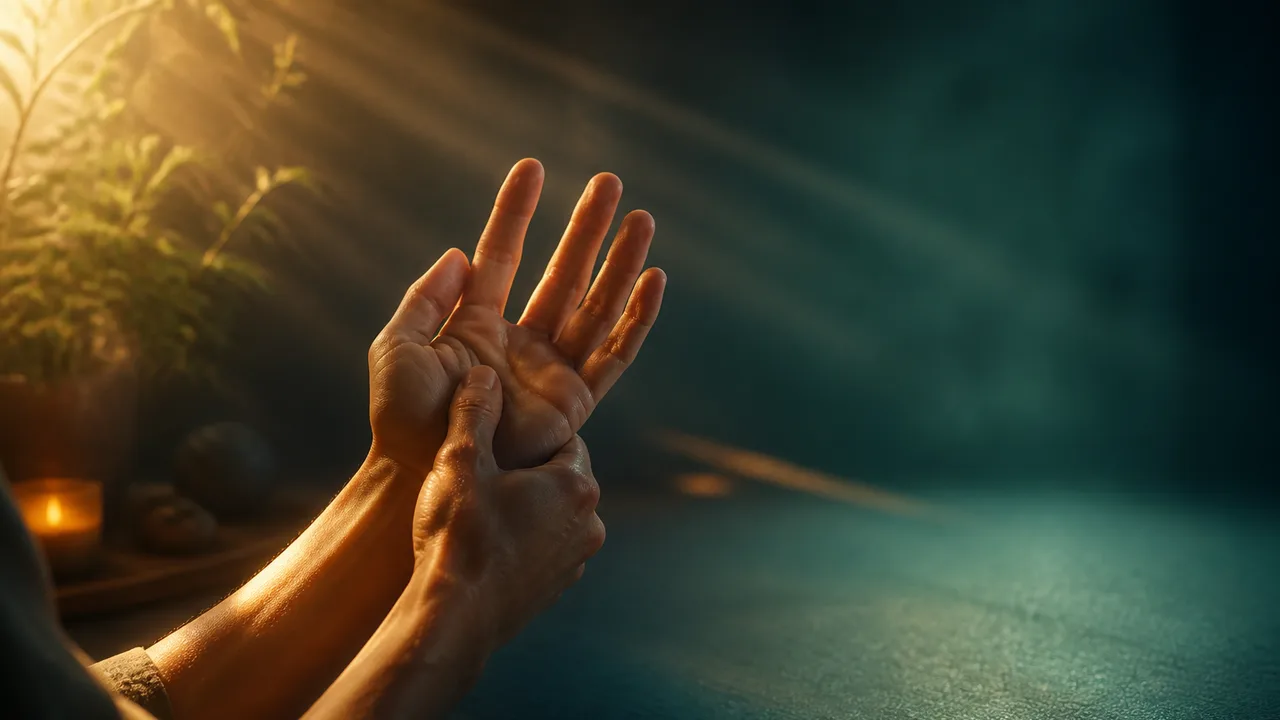
My hands look like they belong to someone who owes you an apology.
Not injured, not dramatic — just permanently mid-clench. The knuckles a little stiff, the palms carrying the phantom grip of a coffee mug held during a Zoom call while one twin tried to eat a crayon and the other one screamed about the wrong kind of cheese. You know the grip. You're probably doing it right now.
I've been reading about hand tension because a friend mentioned her hands hurt and I, a person who writes about parenting and therefore owns a slightly irresponsible interest in any self-care technique that costs nothing and takes under a minute, went down a rabbit hole. What I found was a cluster of sources making a pretty consistent case — and also, lurking underneath the wellness language, something more honest about what's happening to our bodies when we operate under constant low-grade load.
Let me tell you what's actually there, and what I think is worth your 30 seconds.
The most immediate thing I noticed reading across Mindful, True Relaxations, and Duke Health's Wellness Programs is that these techniques are genuinely simple — like, embarrassingly simple. Not "simple" in the wellness-content way where simple means you still need a foam roller and thirty uninterrupted minutes. Actually simple.
True Relaxations describes a finger-tapping sequence where you turn your palm toward you and touch your thumb to each finger starting with your index finger, tap your way to your pinkie, then back again. That's it. You can do it during a work call. You can do it while watching a kid eat something questionable. I did it twice writing this paragraph.
Duke Health recommends self-massage movements for the hands, arms, shoulders, and neck, and emphasizes breathing deeply on the exhale to release tightness — which sounds obvious until you notice you've been half-breathing for the last three hours because you've been slightly tense since approximately 7am.
Ahead App describes pressing your thumb firmly into the center of your opposite palm and making small circular motions for 30 seconds, then switching hands. The app describes this as helping relax the mind by releasing physical tension. I can't verify the precise mechanism from here, but the basic claim — that addressing physical tension has mental effects — is consistent across all of these sources, and also just... matches my experience of loosening a clenched hand and exhaling at 3pm.
Carrington College's guide walks through wrist stretches, including extending one arm straight out, bending the hand down with fingers toward the floor, and using the other hand to gently press on the back of the bent hand. If you've sat at a keyboard for any significant portion of the last five years, this stretch is going to feel like finding a twenty in a coat pocket.
Greatist covers techniques that pair breathing with physical movement — specifically a sequence where you breathe in, sigh deeply, and let your upper body flop forward before pulling back up. This one's slightly more involved, but the "sigh out" instruction alone is doing something. There is real, underappreciated value in being given permission to exhale dramatically in the middle of a workday.
HeadStart.gov offers five finger and hand stretches described as appropriate for desk use or classroom settings — a quiet acknowledgment that the people who might most need a 45-second hand stretch are the people least likely to have 45 uninterrupted seconds. That tension (pun, sorry) between needing the intervention and not having space for it is the most interesting thing in the whole set of sources.
Here's what I keep turning over: the reason these techniques are presented as mindfulness practices isn't just branding. There's something real in the framing.
When I'm at peak parenting-chaos — which for me is roughly the 90-minute stretch between school pickup and bedtime, when I'm also apparently supposed to make dinner and answer email and remember that I'm a person — my hands are doing a lot of invisible work. Gripping the steering wheel. Typing one-handed while cutting grapes with the other. Opening snack packaging under genuine time pressure. By 8pm my hands feel like they've lived a full separate life that day.
The thing about any of these exercises — the palm pressure, the wrist stretches, the thumb-to-finger tapping — is that doing them requires you to briefly not be doing seventeen other things. That's the intervention. Not just the stretch. The stretch is a Trojan horse for 30 seconds of singular attention, which most of us are running about 14 hours behind on.
I don't mean that in a precious way. I mean it literally: the muscle release and the mental pause are probably landing together because our bodies don't cleanly separate them. That's less mystical than it sounds, and more structural than the wellness content usually admits.
And here's where I get slightly less zen about it: the fact that we need a formal technique to take 30 seconds for our hands — that we need it explained to us in seven steps with breathing cues — is a little bleak. Not because the techniques aren't useful. They are. It's that the load producing the tension doesn't come with a break built in. The seven techniques are good. The conditions requiring them are not.
Last Tuesday I did the palm pressure thing from Ahead App at my desk during a work call, one camera off, slightly hoping nobody would ask me to talk for 30 seconds. It helped. My hands loosened. I exhaled. I went back to the call. The conditions that had clenched my hands in the first place were still exactly there.
I'm not saying don't do the stretch. I'm saying the stretch works — and also notice that you needed it, because you're carrying a lot, and that fact deserves more than a 30-second massage, even though the 30-second massage is genuinely not nothing.
Do the thumb-to-palm circles. Do the wrist extension. Let yourself exhale dramatically at 3pm. These are small things that actually help, and in a moment when free and fast are the only requirements most of us can meet, that's a meaningful bar to clear.
Just maybe also notice that your hands shouldn't feel this tired.
More Like This
Eckhart Tolle Says You're Not Who You Think You Are
Eckhart Tolle's 'historical self' vs 'deep eye' framework is either profound or a very elegant dodge. A parenting writer tries to figure out which.
Handwriting Beats Typing for Learning, Studies Find
New research shows handwritten notes improve memory and recall more than typing. Here's what the science says — and what it actually means for kids and parents.
Dr. K Walked Into Chaos and Won the Room
Dr. K's Tiger Belly appearance is a masterclass in social dynamics. Here's what the Charisma on Command breakdown gets right—and what it glosses over.
How to Start Journaling: A Practical Beginner's Guide
Journaling can sharpen mental clarity and ease stress—but only if you actually start. Here's what the research and real journalers say works for beginners.
Five Patterns That Keep People Stuck, Examined
A recent video maps five behavioral patterns behind feeling stuck. Ellis Redmond examines the framework—what holds up, what it leaves out, and what's worth your attention.
AI Therapists Are Rising. The Questions Are Hard.
AI therapists are moving from novelty to norm, especially for younger users. Here's what's driving that shift—and what remains genuinely unresolved.
Student-Athletes and the Mental Health Toll of Competing
Behind the scholarship and the starting lineup, many college athletes are quietly breaking down. Here's what the data — and the silence — actually tells us.

Alex Hormozi on Hard Work, Courage, and Wasted Potential
Alex Hormozi tells Chris Williamson why doing hard things physically doesn't build emotional resilience—and what kind of hard actually changes your life.