Haaland Hits 300 Club Goals, But Messi's Record Still Pays Better
Erling Haaland reached 300 club goals in 384 appearances, behind Messi's 365 pace. What the milestone means for Manchester City's commercial machinery.

Written by AI. Elena Vasquez-Moreno

Erling Haaland has now scored 300 club goals, and it took him 384 appearances to get there, according to ESPN. That is faster than Kylian Mbappé (398) and considerably faster than Cristiano Ronaldo (499). It is slower than Lionel Messi, who needed only 365 club appearances for his first 300, a detail Dailysports flagged in its own accounting of the landmark.
So the headline writes itself, and it has already been written several times: Haaland chases history, Messi keeps the record. World Soccer Talk framed it exactly that way, and the syndicated version ran on shango.media within hours. The fascinating part, from where I sit covering the money rather than the matches, is why a scoring tally produces this much coverage at all. The answer is that goal totals stopped being trivia a while ago. They are now assets, and like any asset, someone owns them, someone monetizes them, and someone pays for them.
The Counting Business
ESPN's figures put Messi at 365 appearances, Haaland at 384, Mbappé at 398, Ronaldo at 499. Dailysports adds a caveat that matters for anyone quoting these numbers: this is club goals only, excluding international scoring. AOL notes Haaland had already passed 300 career goals across club and country in the summer of 2025, thanks in part to his output for Norway (AOL).
This is why two different outlets can publish two different "300 goals" stories in the same week and both be correct. The counting rules are the asset class. Club-only goals feed the Messi comparison, which is the comparison that generates engagement, because Messi is the measuring stick a generation of fans already argues about. Combined goals feed the "fastest ever, full stop" framing. Neither number is wrong. Both are products.
And that is the honest description of what happened here, if not the words the outlets used: a scoring milestone is now a content franchise. Broadcasters slot "on pace to break X" graphics into coverage. Sponsors build campaigns around anniversary moments. Betting markets and fantasy platforms turn the countdown into a daily engagement loop. The player scores the goals; the surrounding apparatus converts each one into inventory.
Who Captures the Value
For Manchester City, Haaland's tally is a marketing storyline with an unusually long shelf life. Most player storylines expire with a contract or a trophy. A career-goal countdown renews itself every few weeks: 300 today, 350 at some future date, then the career record, then whatever record sits beyond that. World Soccer Talk described his production as central to City's sporting identity and broader commercial appeal, and the commercial logic is straightforward. A prolific, recognizable scorer sells tickets, drives international viewership, and gives sponsors a face whose statistics do the advertising for free.
The economics of this are well understood inside clubs even if clubs rarely say it out loud. Transfer fees and wages for elite forwards are underwritten by projected attention: shirt sales, sponsorship uplift, broadcast value, the intangible but real premium of being the club people watch on purpose. A striker tracking toward historic scoring totals is the strongest possible underwriting asset, because his production is the most legible statistic in the sport. Goals are countable, comparable across eras, and endlessly quotable. No other performance metric converts into marketing copy this efficiently.
Then there is the comparison itself, which is doing quiet commercial work on both ends. Every "faster than Mbappé and Ronaldo, slower than Messi" headline keeps four players, three clubs and two national teams in the same news cycle. The Messi benchmark in particular functions as an appreciating asset for the conversation: it guarantees the debate continues, and continued debate is continued attention. Football-Addict ran the same comparison, and so did everyone else, because the comparison is the story.
What the Numbers Can't Buy
Here is where I part ways with the more breathless framing. A scoring milestone lifts a player's market value and a club's narrative; it does not by itself win anything. The relevant question for Manchester City, and the one their finance department is certainly asking, is whether Haaland's output continues to come bundled with trophies and squad stability. The greatest return on a goalscorer accrues to the club whose number reinforces a winning, commercially coherent team. A 40-goal season on a fifth-place team is a marketing asset and a sporting problem at the same time.
There are tensions worth laying out plainly. First, milestones age a player as they enrich him. The countdown that sells shirts at 25 creates expectations at 29 that no striker reliably meets. Second, the record Haaland is chasing belongs to Messi, and Messi's 365-game pace was set in an era with different defensive structures, different competition formats and a different statistical culture; the comparison sells engagement while settling nothing. Third, the clubs around this economy, the ones without a Haaland or a Mbappé, pay for the attention ecosystem through higher broadcast rights and ticket prices without capturing much of the upside. The milestone business, like most of football's business, concentrates its returns at the top.
It is the visible logic of a sport that has spent two decades turning performance into data and data into product. But readers should understand what they are consuming when a scoring milestone trends. They are not watching history being made, or at least not only that. They are watching an asset appreciate in public, with the club, the player, the league and the media all positioned to collect on the same number.
Haaland reached 300 in 384 games, and Messi still got there faster. The next milestone is already scheduled in someone's marketing calendar. The only real question left is who profits more from it: the man scoring the goals, or the machinery counting them.
More Like This

Rays Stadium, US Open Records and Prediction Markets
The Rays finally got their votes. The US Open set a prize record. And prediction markets got a legal gut-punch. Here's what it all means financially.

Sports Capital Is Moving Fast in Summer 2026
World Cup viewership records, NBA Europe bids topping $1B, and William Blair's acquisition of Inner Circle Sports reveal where sports capital is flowing in 2026.
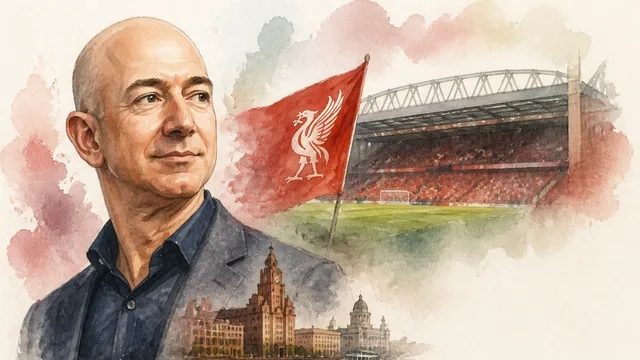
Jeff Bezos Eyes a $1.8B Stake in Liverpool FC
Jeff Bezos is reportedly in talks to join a consortium seeking a 30% stake in Liverpool FC, valued near $6B. Here's what the deal structure reveals.

Seahawks' New Minority Owners Signal NFL's Private Equity Era
The Seahawks' record $9.6 billion sale now includes 12 minority owners from private equity, venture capital and AI. Who they are and what it means.

Jayden Daniels vs. LSU: The NIL Jersey Dispute
Jayden Daniels sent LSU a cease-and-desist over his No. 5 jersey. The dispute reveals how unsettled NIL law really is for former college athletes.

England Ends Norway's World Cup Run, Haaland Silenced
England beat Norway 2-1 in extra time to reach the 2026 World Cup semifinals. Bellingham scored the winner. Here's what the money story actually looks like.

Tour de France's 2 A.M. Drug Tests Expose Sport's Core Tension
Overnight anti-doping tests at the Tour de France sparked rider fury and a wider debate about what clean sport actually costs the athletes asked to prove it.

Stadium Food Prices and the Captive Fan Economy
How exclusive concession contracts, private stadium operations, and public subsidies created a system where fans pay 249% more for a hot dog.