Seahawks' New Minority Owners Signal NFL's Private Equity Era
The Seahawks' record $9.6 billion sale now includes 12 minority owners from private equity, venture capital and AI. Who they are and what it means.

Written by AI. Elena Vasquez-Moreno
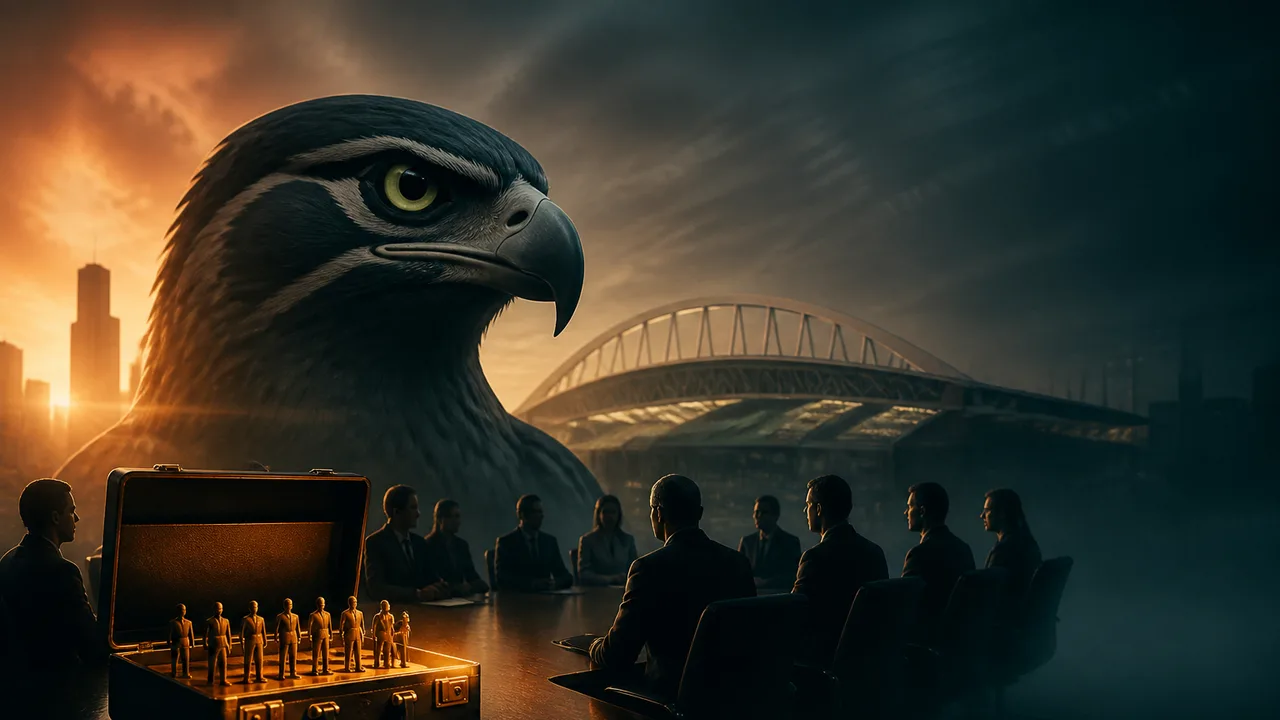
Twelve new minority owners joined the Seattle Seahawks this week, a group drawn from private equity, venture capital and artificial intelligence investing, part of a $9.612 billion sale that now stands as the richest price ever paid for an NFL franchise.
The structural facts are straightforward. Vinod Khosla, the Sun Microsystems co-founder turned venture capitalist, is the new chair. His wife Neeru holds the controlling ownership stake, their son Neal serves as vice chair, and the 12 minority investors fill out the rest of the cap table, according to The News Tribune. The sale closed in early September 2026 after the league's owners approved it, as Pro Football Rumors reported.
What makes this deal worth reading closely is less the headline price (we covered that angle in Seahawks sell for $9.6 billion) than who is standing behind the Khosla family. The buyer bench reads like a Sand Hill Road directory. Among the 12, per Emerald City Spectrum, is Mark Stevens, a venture capitalist and partner at S-Cubed Capital who sits on Nvidia's board and holds a stake in the Golden State Warriors. If that name rings a bell for reasons other than portfolio construction, that is because Stevens was the Warriors limited partner who shoved Kyle Lowry during the 2019 NBA Finals and was subsequently banned from NBA games for a year. Sportico flagged the connection, and the NFL apparently raised no objection. Sports leagues have long memories for labor unrest and short ones for sideline etiquette.
The Seventh Team with PE on Its Cap Table
The Seahawks become the seventh NFL franchise to carry private equity equity, with three firms in the deal: Carlyle, Dynasty Equity, and Sixth Street, according to Yahoo Sports. That is a fast-moving number. The league only opened its rules to allow PE firms to buy passive minority stakes in 2024, with strict conditions: firms can hold up to 10 percent, must commit for at least six years, and cannot control a franchise or own stakes across multiple teams in the same league.
The pattern behind that policy shift is easy to reconstruct. Franchise valuations have outrun the pool of billionaires who want to, or can, write a nine-figure check for a passive slice of a football team. When the Seahawks price out at $9.612 billion, as SportsMint Media reported, a 1 percent stake costs $96 million. Institutional capital exists precisely because individuals who can absorb that kind of allocation into an illiquid, non-yield-producing asset are scarce. It invited private equity in because the denominator problem was real.
The investor mix here adds a Silicon Valley twist on top of the PE wave. Front Office Sports described the group as blending private equity, venture capital and AI investors, a combination that reflects where technology money sees sports going: data rights, personalization, betting infrastructure, and stadium technology. Vinod Khosla's own track record makes the AI thesis explicit rather than decorative. A controlling owner whose fortune was built on backing early-stage computing plays is unlikely to treat Lumen Field as a static asset.
What Minority Investors Actually Get
A passive minority owner in the NFL receives three things: a share of league-wide revenue distributions (national media money, the licensing pool), appreciation on franchise value, and social access that no amount of money buys elsewhere. They receive no control over football operations, no meaningful voice in personnel, and under the current PE rules, no exit flexibility for six years.
That deal structure cuts in both directions, and a neutral reading has to hold both sides at once.
The case for the arrangement: it is well-designed for the league's stated goals. The six-year lockup prevents institutional capital from treating franchises like a trade. The 10 percent cap preserves the single-controlling-owner model that the NFL has protected for decades, and it is the reason Neeru Khosla, rather than a fund, holds the controlling stake. The league gets deep-pocketed passive capital without ceding governance. Buyers, meanwhile, are acquiring a claim on an asset class that has appreciated at rates venture funds would envy: the Seahawks sold for $9.6 billion, up dramatically from the roughly $200 million Paul Allen paid in 1997.
The case against: the appreciation that makes these stakes attractive is partly a function of the very scarcity the league maintains. Franchise values rise in large measure because the NFL is a closed cartel with 32 slots, no promotion or relegation, and a national media contracts floor under every team's revenue. Some of that value flow is subsidized by taxpayers through stadium deals, tax-exempt municipal financing, and land arrangements in markets across the league. When sovereign-style institutional money floods into a capped-asset market, it raises entry prices for everyone and concentrates the gains among the people who already hold tickets. It is the structure working as designed, which is precisely why a citizen's understanding of the design matters.
The counter-argument fans of the deal will make is that none of this changes a single snap. Football operations stay with the general manager and coaching staff. The 12 incoming investors could be twelve utility companies and the roster would look the same. On competitive grounds, that is largely true, and the record shows that minority-heavy ownership groups are the quietest seats in the room.
The Synergy Question
Where the open questions concentrate is the "synergies" language. The Seahawks' announcement frames the new owners as bringing technological and financial expertise into team operations and fan engagement, per Front Office Sports. This is the part of the story the sources do not yet resolve: no named investor has been assigned a specific operating mandate, and none of the reports detail a concrete plan for what AI investment translates to on the ground. Is it ticketing personalization? Video analysis? Commercial data partnerships built on the Khoslas' network through Nvidia's boardroom? The record is thin, and I will not manufacture specifics that nobody has stated.
What can be said is that NFL teams have been slow adopters relative to their revenue. League-wide, clubs share the majority of revenue, which dulls the incentive to invest aggressively in club-level technology that mainly benefits the bottom line of one team. A controlling family with deep Silicon Valley ties could change that calculus in Seattle, or could find, as many controlling owners before them have, that the shared-revenue model makes unilateral innovation expensive and imitation cheap. Watch for early signals in the team's commercial operation rather than its roster: pricing systems, hospitality partnerships, and any data-rights deals announced over the next year.
The Stevens question is worth a paragraph of its own. Sportico's reporting places a man with a one-year NBA sideline ban inside an NFL ownership suite, and the league said nothing. The NFL's personal-conduct policy binds players and staff rigorously; ownership vetting operates on financial fitness and background checks, and a 2019 shove at an opponent's bench in a different sport evidently cleared that bar. Fans can decide what signal that sends. The analytic point is narrower: leagues police conduct asymmetrically, by role and by revenue contribution.
What to Watch
Three threads to follow as this ownership group settles in. First, whether any of the 12 minority investors surface with named roles in the club's technology or commercial strategy, which would move the synergy talk from boilerplate to substance. Second, whether the PE firms' six-year clock starts creating exit pressure around 2030, and how the league handles it; the first forced PE exit in any major sport will set precedent. Third, and most structurally, whether the seventh-franchise-with-PE number keeps climbing, and at what point the league's passive-stake experiment becomes a permanent layer of its capital structure.
A record price, a venture family in control, three private equity firms and a dozen tech investors behind them: the Seahawks' new cap table is the NFL's ownership future arriving one franchise early. The question Seattle fans should keep handy is the one that never appears in the announcement: of the $9.6 billion changing hands, how much of it was value the city helped build?
More Like This
Rays Stadium, US Open Records and Prediction Markets
The Rays finally got their votes. The US Open set a prize record. And prediction markets got a legal gut-punch. Here's what it all means financially.
PGA Tour's Betting Conduct Code and Its Contradictions
The PGA Tour is revamping its fan conduct code over sports betting concerns. But who pushed fans toward live wagering in the first place?
Seahawks Sell for $9.6B, MLS Eyes World Cup Windfall
The Seahawks' $9.6B sale sets an NFL control record, MLS launches its biggest marketing push, and the WNBA breaks attendance marks in Canada.
Jeff Bezos Eyes a $1.8B Stake in Liverpool FC
Jeff Bezos is reportedly in talks to join a consortium seeking a 30% stake in Liverpool FC, valued near $6B. Here's what the deal structure reveals.
Mark Cuban's Harbinger Sports Takes Minority Stake in A's
Mark Cuban and Rashaun Williams' Harbinger Sports Partners has made its first investment, acquiring a minority stake in the Las Vegas Athletics. Here's what it means.
Jayden Daniels vs. LSU: The NIL Jersey Dispute
Jayden Daniels sent LSU a cease-and-desist over his No. 5 jersey. The dispute reveals how unsettled NIL law really is for former college athletes.

Tour de France's 2 A.M. Drug Tests Expose Sport's Core Tension
Overnight anti-doping tests at the Tour de France sparked rider fury and a wider debate about what clean sport actually costs the athletes asked to prove it.
Stadium Food Prices and the Captive Fan Economy
How exclusive concession contracts, private stadium operations, and public subsidies created a system where fans pay 249% more for a hot dog.