Google's Chrome AI Update and the Zero-Click Future
Google's new Chrome AI mode lets users search across open tabs, screenshots, and PDFs at once. Here's what that means for websites and web traffic.

Written by AI. Samira Barnes
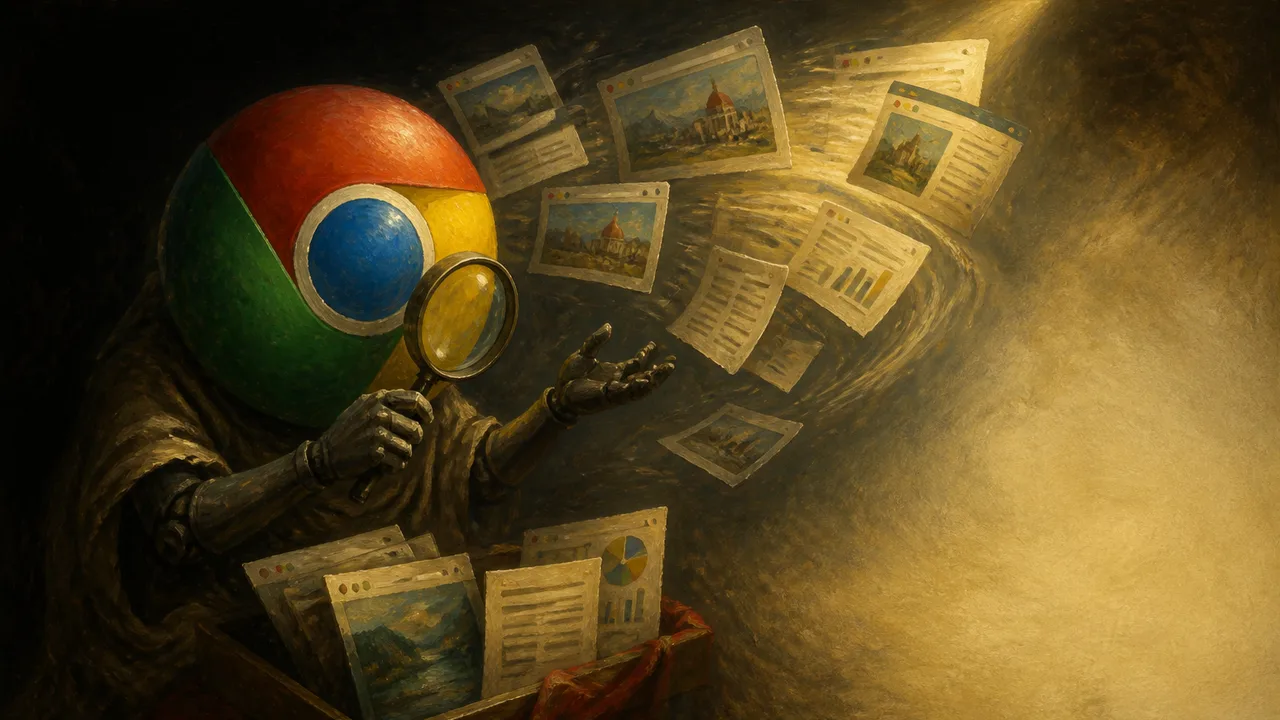
Photo: AI. Henrik Solberg
Google called it the biggest change to their search box since the company was founded. That is either the most significant product announcement in the company's 25-year history, or the kind of hyperbole that has become standard operating procedure in Silicon Valley's AI sprint. Probably some of both. Either way, the update is real, it is live in the US, and it is worth understanding on its own terms before deciding what to make of it.
The new features, confirmed by Robby Stein, VP of product at Google Search, and Mike Torres, VP of product at Chrome, center on three capabilities. First: multi-tab search. A user with multiple tabs open—research articles, competitor pages, forum threads—can now add all of them into a single Chrome AI query via a plus icon in the search bar. Google reads every tab simultaneously and synthesizes a single answer. Second: image and document analysis, meaning screenshots and PDFs can be loaded into the same query and interrogated conversationally. Third: side-by-side browsing, where clicking a link from within AI mode opens the page alongside the search panel rather than navigating away from it, so the research thread stays intact.
Julian Goldie, an SEO agency CEO who covers AI search developments on his YouTube channel, walked through practical applications of these features in a recent video. The use cases he demonstrated—feeding Reddit threads, YouTube comment sections, and competitor sales pages into a single query to extract audience objections; loading trending LinkedIn and Reddit posts to auto-generate a content calendar—illustrate the genuine utility here. Tasks that previously required an hour of tab management and manual synthesis can, in principle, collapse into a single prompt. That part is not hype. That is just what these features do.
The more interesting question is what they do to everyone else.
The numbers behind the feature
Goldie cites Ahrefs research from February 2026 showing that AI Overviews—the AI-generated answer boxes Google already surfaces at the top of standard search results—now cause a 58% drop in click-through rates for pages that rank in the top positions. Twelve months prior, that number was 34.5%. The trajectory is not subtle. He also cites data showing that zero-click searches—queries that end with the user reading the AI answer and leaving without clicking any link—now account for over 58% of all Google searches in the US. More than half of all searches currently result in no website visit at all.
The individual cases are starker. HubSpot, one of the largest content publishers on the internet, reported losing between 70 and 80 percent of its organic search traffic. Chegg, the education platform, reported a 49 percent decline. Some publishers documented drops approaching 89 percent on specific search categories. NPR described the situation as an "extinction-level event for online publishers."
Lily Ray, VP of SEO strategy at the digital marketing agency Amisive, framed the concern in structural rather than statistical terms: "This is going to have a devastating impact on the internet as a whole. Her concern isn't just traffic numbers—it's that the entire economic model websites have been built on for 20 years is changing underneath everyone's feet."
That framing matters. Traffic numbers can be reframed as an adaptation problem—pivot your strategy, optimize for AI citations, adjust your content mix. But economic model disruption is a different category of problem. The ad-supported, SEO-dependent web was built on the assumption that Google's job was to send people somewhere. If Google's job is now to be the destination, the underlying architecture of how publishers, small businesses, and informational websites sustain themselves requires rethinking, not just adjusting.
What the Chrome update adds to that picture
The existing AI Overviews already intercept a query before it reaches the open web. The new Chrome features go a step further: they work on content the user has already retrieved. A person who clicked through to five websites and opened them as tabs can now get those five websites synthesized for them without engaging with any of them meaningfully—no scrolling through the full article, no exposure to surrounding content, no path to conversion for the publisher. The visit happened, technically. The traffic was counted. But the engagement the publisher built their model around did not.
Goldie puts this plainly: "The reason to click through to any website just got smaller again."
He is not wrong, and the observation doesn't require buying into his particular framework for responding to it. Google has built a feature that makes the web more useful to users while simultaneously making users less necessary to the web's economic engine. This is not a bug in the design. It is the design. Google's users are its product; publishers have always been, in a meaningful sense, its inputs. The current update makes that relationship more explicit.
Where the analysis gets complicated
There are at least two places where the straightforward "everything is collapsing" narrative deserves some friction.
First, the data on traffic declines is real, but it is not evenly distributed. The categories most affected—informational queries, how-to content, definitional searches—were always the category most susceptible to a smarter answer box. Long-form investigative journalism, proprietary data, primary-source reporting, and genuinely original analysis occupy a different position. AI systems can summarize; they cannot originate. Publishers who built on informational commodity content are in a different situation than those producing work that cannot be synthesized because it did not exist before someone reported it.
Second, the AI citation economy is emerging as a partial countervailing force. When AI Overviews and AI mode synthesize answers, they frequently cite and link to sources. Whether those citations generate meaningful traffic is an open empirical question—one that the SEO industry is actively trying to measure and that Google has not been fully transparent about. Goldie's framing of content publishing as "training the agent's understanding of you" is a real strategic consideration, not just marketing copy, even if the payoff timelines and mechanisms remain uncertain.
Neither of these observations negates the underlying structural shift. They complicate the all-or-nothing version of the story, which is where the truth usually lives anyway.
The policy vacuum in the room
What is largely absent from the SEO community's discussion of these changes—understandably, since their focus is tactical—is the regulatory dimension. The EU's Digital Markets Act designated Google as a gatekeeper, with obligations around fair access to search results. How AI-generated answer boxes and synthesized tab searches interact with those obligations is not yet settled. The US has no comparable framework. Congressional interest in AI and search is real but unfocused; the legislative calendar is crowded and tech-specific regulation moves slowly when industry lobbying is well-funded and the technical details are genuinely complex.
What we do know is that the web's publisher community is watching their traffic data change in real time, and the regulatory mechanisms that might address the structural question—whether a dominant search engine can appropriate the informational labor of the web it indexes—are not keeping pace with the product changes. That gap is worth noting, even when the immediate conversation is about content calendars and landing page audits.
Google built something that works better for users who search. The question of what that costs, and who pays it, is being answered by market forces faster than by any other institution positioned to weigh in.
More Like This

SEO Has Changed: Here's What Actually Works in 2026
The traditional SEO playbook is dead. A Semrush video outlines how search behavior has evolved and what strategies actually drive conversions in 2026.
The Prove-It Economy Cuts Both Ways
AI agents are reshaping how brands get found — but the prove-it economy has a privacy shadow most marketers haven't noticed yet.

RuFlow 3.6.12: Claude Agent Swarms Explained
RuFlow 3.6.12 lets 100+ Claude AI agents share memory and collaborate across machines. Here's what the new federation feature actually does—and what it doesn't.
Claude's AI Video Stack and the Disclosure Gap
Claude can now orchestrate entire AI video workflows in minutes. The tech works. The legal framework governing disclosure doesn't exist yet—and that gap has real consequences.

Higgsfield CLI Brings AI Studio Into Claude
Higgsfield's new CLI embeds generative AI directly into Claude and Cursor. Here's what it does, what the law says about face-cloning, and what regulators should be watching.
Answer Engine Optimization: Is AEO the New SEO?
AI is changing how people find businesses. Here's what Answer Engine Optimization actually is, what it can and can't do, and whether the hype holds up.

AI Chip Smuggling and the US-China Tech Divide
FT's Eleanor Olcott investigates the black market for Nvidia AI chips reaching China despite US export controls — and what it reveals about the tech race.

Promptware: When AI Agents Become Attack Vectors
Prompt injection attacks on AI agents follow a structured kill chain — and existing legal frameworks have almost nothing to say about who's liable when it works.