Higgsfield CLI Brings AI Studio Into Claude
Higgsfield's new CLI embeds generative AI directly into Claude and Cursor. Here's what it does, what the law says about face-cloning, and what regulators should be watching.

Written by AI. Samira Barnes
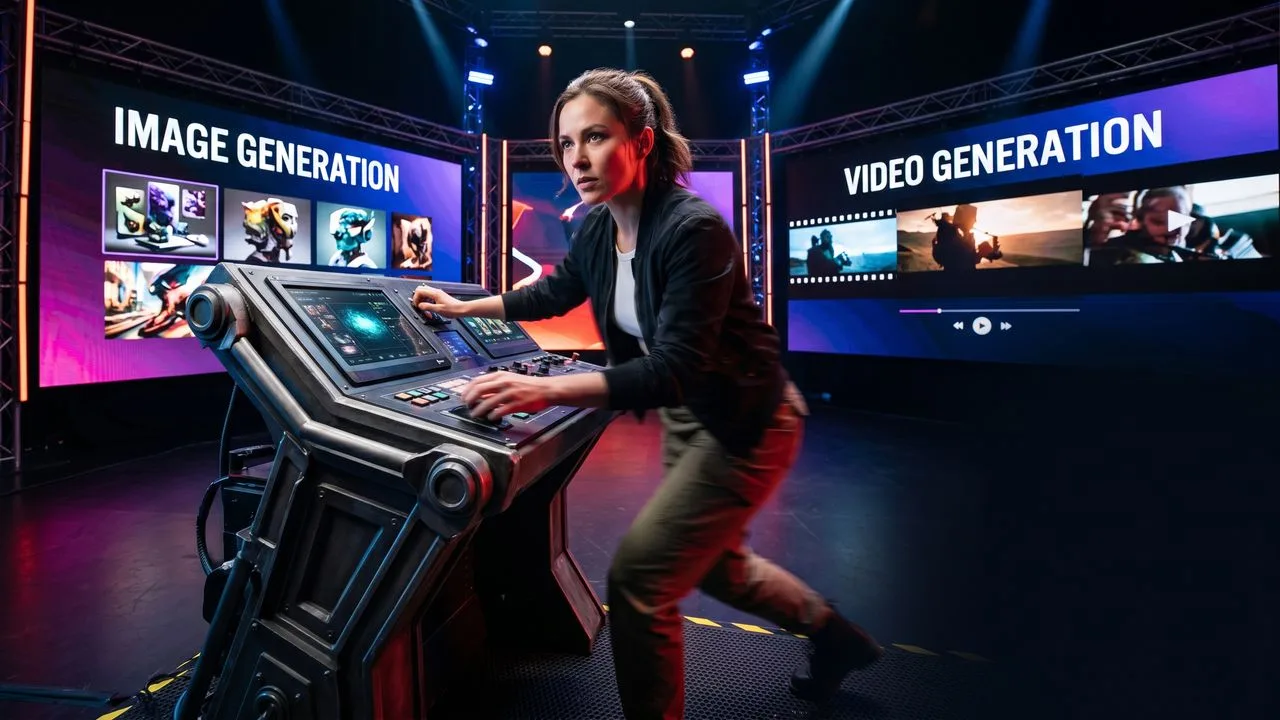
Photo: AI. Lev Zolotov
The standard critique of generative AI creative tools is that there are too many of them and they all want to be your primary workspace. Higgsfield AI has arrived at a different answer: stop asking users to come to the tool, and embed the tool where the users already are.
That's the core proposition of the Higgsfield CLI, released this week — a command-line interface that wires Higgsfield's image and video generation directly into AI coding environments like Claude Code, Cursor, and Codex. SEO consultant Julian Goldie walked through the release in a recent YouTube video, and the workflow he describes is worth taking seriously — as is what the release quietly raises about consent, platform concentration, and the legal frameworks that haven't caught up yet.
What the CLI Actually Does
The setup, per Goldie's walkthrough, is genuinely minimal: one npm install command, an auth handshake, and you're done. No separate API key management, no new billing account — if you already have Higgsfield credits, they carry over. The agent integration handles authentication and result-polling automatically, which eliminates the scaffolding that normally makes this kind of pipeline a half-day project.
The skills package — Higgsfield's term for pre-built agentic workflows — ships with three core capabilities: Generate (image and video up to 4K, up to 15-second clips), Soul (character training from reference photos, enabling consistent face and figure across scenes), and Product Photoshoot (e-commerce lifestyle shots and ad creatives from a single product upload). The marketing tier adds an Ad Engine that takes a brand brief and produces creative variants across formats, a Brand Builder that can scaffold a D2C product concept from scratch, and a Content at Scale tool for batch video generation.
Goldie's technical read on why the skills architecture matters: "When AI agents handle creative jobs the old way, they burn through a lot of tokens on bloated instructions. With these new skills, the instructions are tight and clean. So your agent works faster, costs less to run, and gives better results." That's a genuine efficiency argument, not just marketing copy — token overhead is a real operational cost at volume.
One factual note before going further: Goldie's walkthrough lists the platform's model roster as including Soul, Flux, Seedance, Kling, Veo, and Nano Banana, and describes this as "over 30 different models." Buzzrag was unable to independently verify the full model count or complete list against Higgsfield's official documentation ahead of publication, and has reached out to Higgsfield for confirmation. The Veo attribution deserves specific attention: Veo is Google DeepMind's video generation model, and it's not clear from the video whether Higgsfield is licensing it, accessing it through an API arrangement, or whether Goldie was using an informal name that refers to something else entirely. That distinction matters for understanding what's actually running under the hood. Similarly, the claim that the CLI supports twelve AI agents is sourced only to Goldie's walkthrough and has not been confirmed against Higgsfield's release documentation.
The Soul Feature Is Where the Law Enters the Room
Goldie describes the Soul skill in practical terms — brand mascots, recurring storytelling characters, personal branding shots. "Train a soul character. Then generate a full scene by scene visual storyboard with that same character showing up consistently. That's something that used to need a real cast and a real shoot."
That framing is accurate as far as it goes. What it doesn't address is the consent question that makes this feature the most legally exposed part of the platform.
Higgsfield's terms of service require users to confirm they have rights to any likeness they upload. The platform's acceptable use policy prohibits generating content that depicts real individuals without consent, and it explicitly bans the creation of non-consensual intimate imagery. That's the contractual baseline. The regulatory picture is considerably more unsettled.
At the federal level in the U.S., the NO FAKES Act — formally the Nurture Originals, Foster Art, and Keep Entertainment Safe Act — was reintroduced in the Senate in 2024 and would establish a federal right of publicity for digital replicas, making it illegal to produce an AI-generated likeness of a real person without their consent. The bill has not yet passed, which means the legal framework for Soul-style character training currently varies by state. California's AB 2602, signed into law in 2024, requires explicit consent before a performer's likeness can be replicated by AI for work they haven't actually performed. Illinois's Biometric Information Privacy Act creates separate liability exposure for companies that collect or process biometric identifiers — which a face-trained AI model arguably does — without a written release.
The EU AI Act, which entered into force in August 2024 with obligations phasing in through 2026, classifies deepfakes and AI-generated synthetic media as subject to mandatory transparency requirements: systems that generate synthetic images, audio, or video of real people must label that content as AI-generated. That applies to outputs, not just training, which creates compliance questions for any marketing agency using Soul to produce client-facing content at scale.
None of this makes Soul an illegal product. It does mean that the distance between Higgsfield's ToS and a user's actual legal exposure is not zero, and anyone using the character-training feature for commercial work involving real people's likenesses should be thinking about more than just prompt quality.
Integration as Market Strategy — and as Regulatory Surface
The strategic logic of the CLI is legible and smart: Higgsfield isn't trying to win on interface. It's trying to become infrastructure. Goldie frames this as a convenience story — "they're meeting you inside the tools you already use" — but the competitive architecture deserves a harder look.
The CLI integrates with AI coding environments through what Higgsfield describes as an agent integration model, analogous to the Model Context Protocol (MCP) pattern that Anthropic and others have been developing as a standard for connecting AI agents to external tools. If that pattern becomes the dominant distribution channel for generative AI capabilities — and the velocity of MCP adoption in the developer ecosystem suggests it might — then whoever controls the preferred integration layer for a given environment controls a significant share of how users access competing tools.
That's not a hypothetical antitrust concern; it's the kind of distribution bottleneck that agencies like the FTC and the DOJ's Antitrust Division have been scrutinizing in adjacent markets. The question of whether AI agent ecosystems create platform dependency risks — where switching costs accumulate not through user preference but through toolchain lock-in — is one that regulators should be watching now, before the market structure calcifies. The EU's Digital Markets Act, which applies to designated "gatekeepers" in digital markets, is already being tested against AI-adjacent platform behaviors. Whether agent integration frameworks fall within its scope is an active question in Brussels.
The integration model also raises a subtler issue: when a generative AI tool embeds itself into a developer's primary coding environment and handles authentication, billing, and result-processing invisibly, the user's ability to audit what data is being transmitted — and where — diminishes. That's not unique to Higgsfield, but it's worth naming as a pattern.
The Product Assessment
Setting aside the policy dimensions, the release is technically coherent. The skills architecture solves a real problem — agentic creative workflows have been cumbersome to set up and expensive to run at volume — and the marketing skill tier addresses a genuine market gap for small teams that can't sustain a creative production stack. "The tool gets out of the way," Goldie says in his final assessment. "Taste is the rest." That's an honest characterization of where the value actually sits.
What the demo doesn't settle is production reliability at scale — consistency across hundreds of generations, model behavior under edge-case prompts, latency under load. Those aren't criticisms of this release specifically; they're the questions that separate a capable demo from a dependable workflow tool, and they take time and volume to answer.
The legal frameworks governing what you can generate with Soul are incomplete at the federal level and inconsistent across state lines. The model attribution questions — particularly around Veo — are unresolved. The platform dependency dynamics of agent-layer integration are real and deserve regulatory attention before the pattern becomes the default.
The CLI is a clean piece of engineering in service of a clear market strategy. Whether the regulatory environment matures fast enough to keep pace with what it enables is a different question, and one with a less tidy answer.
Higgsfield did not respond to a request for comment by publication deadline.
More Like This
Ideogram AI's New Updates Fix the Two Biggest Problems in AI Design
Ideogram AI just launched three features that solve AI design's most annoying issues: broken text and inconsistent characters. Here's what actually changed.

RuFlow 3.6.12: Claude Agent Swarms Explained
RuFlow 3.6.12 lets 100+ Claude AI agents share memory and collaborate across machines. Here's what the new federation feature actually does—and what it doesn't.
X's Grok Imagine 1.0 Raises Questions About AI Video
X's new Grok Imagine 1.0 creates 10-second AI videos. What does this mean for content creation, platform lock-in, and the synthetic media landscape?
AI Agents Are Now Hiring Humans for Real-World Tasks
New platforms let AI agents post jobs and hire humans, creating an inverted gig economy. What happens when automation needs manual labor?
When AI Benchmarks Meet Reality: Testing Two New Models
OpenAI and Anthropic released competing models simultaneously. Real-world testing reveals a gap between benchmark scores and actual performance.
Kling 3.0 AI Video Generator: Testing the Hype
CyberJungle stress-tests Kling 3.0's AI video generation: multi-shot scenes, native audio in 5+ languages, and character consistency. The results reveal both promise and problems.

Promptware: When AI Agents Become Attack Vectors
Prompt injection attacks on AI agents follow a structured kill chain — and existing legal frameworks have almost nothing to say about who's liable when it works.

Planet Labs, Orbital AI Compute, and the Chip Tax
Planet Labs CEO Will Marshall argues chip efficiency—not launch cost—will determine who wins the race to put AI compute in orbit.