Claude's AI Video Stack and the Disclosure Gap
Claude can now orchestrate entire AI video workflows in minutes. The tech works. The legal framework governing disclosure doesn't exist yet—and that gap has real consequences.

Written by AI. Samira Barnes
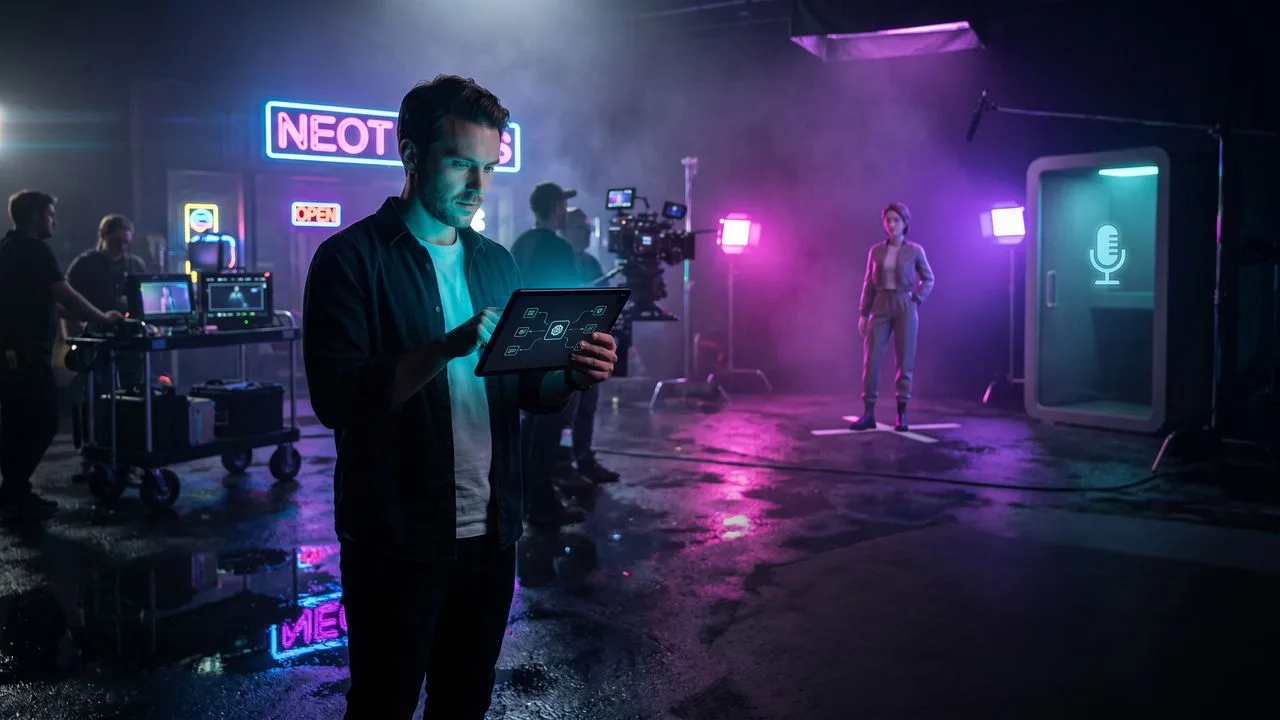
Photo: AI. Quinn Adler
Here is the situation no one in these tutorials pauses to address: a small business owner in Austin can now instruct Claude to write five scripts, generate five videos featuring their synthetic voice and digital likeness, and post all of them to social media—in approximately ten minutes, with no disclosure to viewers that a human neither wrote, recorded, nor appeared in any of it. The workflow is real. The legal framework governing it is not.
That's the actual story here. The productivity gain is the headline. The regulatory vacuum is the news.
What the Stack Actually Does
Julian Goldie's recent walkthrough of Claude's emerging video automation capabilities is worth taking seriously as a technical document, even if it's framed primarily as a sales pitch for his AI Profit Boardroom community. Strip away the coaching upsell and what remains is a coherent explanation of something genuinely new in how AI tools are being assembled.
Claude, as Goldie correctly explains, is not a video generation model in the way Sora or Veo are. It doesn't synthesize footage from scratch. What it does is more architecturally interesting: it acts as an orchestration layer, calling specialized tools in sequence and stitching their outputs together. In Goldie's framing: "Claude is the brain. Claude is the director."
The practical workflow he describes runs roughly as follows. A user installs the open-source Claude Code Video Toolkit from GitHub. They run a /video command. Claude prompts them for brand parameters, then generates a structured JSON file mapping the video into discrete "beats"—hook, problem, insight, call to action—and passes that structure to Remotion, a code-based video rendering tool. For voiceover, Claude calls ElevenLabs, which can deliver a cloned voice trained on a few minutes of the user's own speech. For visual assets, the workflow can route through Higgsfield, described in the video as an API gateway to a large number of image and video generation models (Goldie cites "over 50," though Higgsfield's own documentation should be consulted to confirm current model availability). For avatar video—a digital twin that lip-syncs to any script—Claude integrates with HeyGen via a Model Context Protocol connector that HeyGen released earlier this year.
The result Goldie describes: "You write one prompt. Claude code goes and finds current AI news, drafts five scripts from what it finds, and passes each one to HeyGen to produce a finished video. About 10 minutes later you have five videos and a log file. You didn't open an editor once."
That pipeline works. The setup friction is real—GitHub cloning, API keys, voice training—and the "no coding required" framing sells the simplicity somewhat short. But for technically comfortable users, this is not aspirational. It is operational.
The Disclosure Problem, Right Now
Which brings me to the part of this story that the tutorial genre structurally cannot accommodate: what happens when someone actually runs this workflow and publishes the output without telling anyone.
The EU AI Act's Article 50 is not forthcoming legislation. It is in force. Under its transparency obligations, providers of AI systems that generate synthetic audio or video of real persons—including voice clones and digital avatars—are required to label that content as artificially generated in a machine-readable format, and deployers are required to ensure that labeling reaches end users. A creator using the HeyGen-Claude stack to produce avatar videos of themselves and posting them to European audiences without that disclosure is not in a regulatory gray zone. They are in violation of an enacted law, with enforcement timelines now running.
In the United States, the picture is more fragmented but not toothless. The FTC's revised Endorsement Guides, updated in 2023, make clear that material connections between endorsers and advertisers must be disclosed—and the Commission has extended that reasoning explicitly to AI-generated testimonials and endorsements. If a business uses a synthetic voice clone to narrate a promotional video recommending a product or service, and that video doesn't disclose the voice as AI-generated, the FTC's guidance treats that as potentially deceptive under Section 5 of the FTC Act. The agency has already brought enforcement actions involving undisclosed AI content in commercial contexts, and its 2024 guidance on AI and dark patterns named synthetic media as a priority concern. "Watching closely" is not where the FTC is. Acting is.
Several U.S. states have moved independently. California's AB 2655 and related legislation require disclosure of AI-generated political content. Texas and Georgia have enacted statutes targeting synthetic media of real persons without consent. None of these frameworks were designed with the Claude-HeyGen-ElevenLabs workflow in mind, because they predate it. That mismatch—laws written for a capability that has since been dramatically expanded—is precisely where exposure accumulates.
The Architecture of Trust
The piece of Goldie's presentation that I find most worth interrogating is the voice cloning proposition. His framing is pure convenience: "Imagine you record one weekend. After that, every promo video, every explainer, every social clip sounds like you. You go on holiday. The videos keep coming out with your voice saying what you want them to say."
What he's describing is a system where a cloned voice can be instructed to say anything the workflow's owner chooses, indefinitely, without the original speaker needing to approve each instance. Within a single operator's workflow, that's a productivity tool. Extend the scenario slightly—a disgruntled employee with access to the API keys, a platform breach, a misconfigured automation—and the same architecture becomes an instrument for generating audio content that sounds exactly like a real person saying things they never said.
ElevenLabs has consent and verification requirements for voice cloning, and those guardrails matter. The question is what happens when the orchestration layer between the user and ElevenLabs—in this case, Claude—becomes complex enough that the consent layer is three API calls upstream from where the content actually lands. Regulatory frameworks are not yet equipped to assign liability across that chain. When a cloned-voice video causes harm, who answers for it: the model that cloned the voice, the orchestrator that directed it, the platform that hosted the output, or the user who typed the original prompt? Current law offers no settled answer.
The Platform Enforcement Gap
There is a related problem that sits below the regulatory level but above individual liability: platform content policies are being outpaced by orchestration-based workflows.
YouTube, TikTok, and Meta all have disclosure requirements for AI-generated content. YouTube requires creators to label realistic AI-generated content in specific contexts. TikTok's policies require disclosure when AI tools are used to generate lifelike video. Meta has similar requirements for political and social-issue content. These policies exist. Their enforcement depends almost entirely on creator self-reporting.
A workflow that produces five avatar videos from one prompt in ten minutes and exports them as finished MP4 files does not embed disclosure labels. The creator has to add them manually at upload, and there is currently no technical mechanism that compels them to. If the workflow becomes as accessible as Goldie describes—and there's no particular reason to doubt that trajectory—platform self-reporting as the primary enforcement mechanism will be insufficient before the end of this year.
What Comes Next
The most likely near-term consequence isn't a dramatic enforcement action against a small business owner running a Claude video workflow. Regulatory attention at this scale is slow, and small operators rarely attract it first. What comes next, more probably, is a cascade of quieter harms: audiences who trusted a voice they recognized and didn't know it had been automated; employees at small companies whose likenesses are used in marketing materials they didn't consent to; competitors who can't tell whether a testimonial is from a real customer or a synthetic one.
The second-order effect is trust erosion in video as a medium. Once audiences broadly understand that any video featuring a familiar voice or face may be entirely synthetic and algorithmically directed, the verification cost of every piece of video content goes up. That cost gets distributed across the entire information ecosystem—not just the businesses that ran the workflow.
Goldie's pitch positions early adopters as gaining "a year-long head start." On the productivity dimension, he may be right. On the regulatory dimension, early adoption without disclosure architecture isn't a head start. It's first-mover exposure in a space where enforcement catches up eventually, and catches up hard.
The technology is not waiting for the law. It never does. But the gap between them is now wide enough that business owners treating this as purely a productivity decision are making a legal judgment without knowing it.
More Like This
Claude Can Now Edit Your Videos. Here's What That Means.
AI automation creator Nate Herk demonstrates Claude's new video editing pipeline—trimming filler words, adding motion graphics, all through natural language.

Higgsfield CLI Brings AI Studio Into Claude
Higgsfield's new CLI embeds generative AI directly into Claude and Cursor. Here's what it does, what the law says about face-cloning, and what regulators should be watching.
X's Grok Imagine 1.0 Raises Questions About AI Video
X's new Grok Imagine 1.0 creates 10-second AI videos. What does this mean for content creation, platform lock-in, and the synthetic media landscape?
When AI Benchmarks Meet Reality: Testing Two New Models
OpenAI and Anthropic released competing models simultaneously. Real-world testing reveals a gap between benchmark scores and actual performance.
Kling 3.0 AI Video Generator: Testing the Hype
CyberJungle stress-tests Kling 3.0's AI video generation: multi-shot scenes, native audio in 5+ languages, and character consistency. The results reveal both promise and problems.
New AI Agent Nanobot Challenges Industry With 99% Less Code
Nanobot's 4,000-line codebase versus OpenClaw's 430,000 raises questions about whether AI complexity serves users or just creates technical debt.

AI Chip Smuggling and the US-China Tech Divide
FT's Eleanor Olcott investigates the black market for Nvidia AI chips reaching China despite US export controls — and what it reveals about the tech race.

Promptware: When AI Agents Become Attack Vectors
Prompt injection attacks on AI agents follow a structured kill chain — and existing legal frameworks have almost nothing to say about who's liable when it works.